violetFluor™ 450 Anti-Human CD3 (UCHT1)
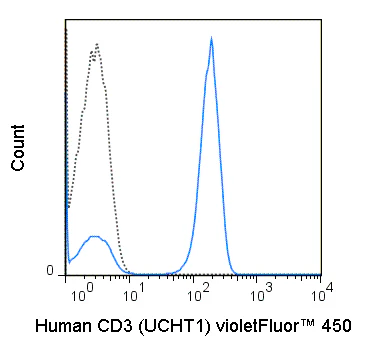
The UCHT1 antibody is specific for human CD3e, also known as CD3 epsilon, a 20 kDa subunit of the T cell receptor complex, along with CD3 gamma and CD3 delta. These integral membrane protein chains assemble with additional chains of the T cell receptor (TCR), as well as CD3 zeta chain, to form the T cell receptor – CD3 complex. Together with co-receptors CD4 or CD8, the complex serves to recognize antigens bound to MHC molecules on antigen-presenting cells. These interactions promote T cell receptor signaling (T cell activation), inducing cell proliferation, differentiation, production of cytokines or activation-induced cell death. CD3 is differentially expressed during thymocyte-to-T cell development and on all mature T cells.
The UCHT1 antibody is a widely used phenotypic marker for human T cells. In addition, binding/cross-linking of UCHT1 antibody to CD3e can induce cell activation (use format suitable for functional assays). A recent publication of the crystal structure of a CD3e- antibody complex provides insight as to the action of commonly used agonist antibodies, as well as specific epitope-binding data for the human CD3 antibodies UCHT1 and OKT3 (Fernandes, R.A. et al. 2012. J. Biol. Chem. 287: 13324-13335).
UCHT1 antibody reacts with both surface-expressed and intracellular CD3e protein, in contrast to an alternative human CD3 clone, HIT3a, which will stain only the extracellular (membrane-expressed) CD3e protein. Also, the UCHT1 antibody is reported to be cross-reactive with chimpanzee and has been used for phenotypic analysis of expression by flow cytometry; however the antibody is reported to be unsuitable for induction of T cell activation in this species (Bibollet-Ruche et al. 2009. J. Virol. 82: 10271-10278).
| Name | violetFluor™ 450 Anti-Human CD3 (UCHT1) |
|---|---|
| Cat. No. | 75-0038 |
| Alternative Names | Leu-4, T3 |
| Gene ID | 915 |
| Clone | UCHT1 |
| Isotype | Mouse IgG1, kappa |
| Reactivity | Human |
| Cross Reactivity | Chimpanzee |
| Format | violetFluor™ 450 |
| Application | Flow Cytometry |
Original: $71.00
-70%$71.00
$21.30violetFluor™ 450 Anti-Human CD3 (UCHT1)
The UCHT1 antibody is specific for human CD3e, also known as CD3 epsilon, a 20 kDa subunit of the T cell receptor complex, along with CD3 gamma and CD3 delta. These integral membrane protein chains assemble with additional chains of the T cell receptor (TCR), as well as CD3 zeta chain, to form the T cell receptor – CD3 complex. Together with co-receptors CD4 or CD8, the complex serves to recognize antigens bound to MHC molecules on antigen-presenting cells. These interactions promote T cell receptor signaling (T cell activation), inducing cell proliferation, differentiation, production of cytokines or activation-induced cell death. CD3 is differentially expressed during thymocyte-to-T cell development and on all mature T cells.
The UCHT1 antibody is a widely used phenotypic marker for human T cells. In addition, binding/cross-linking of UCHT1 antibody to CD3e can induce cell activation (use format suitable for functional assays). A recent publication of the crystal structure of a CD3e- antibody complex provides insight as to the action of commonly used agonist antibodies, as well as specific epitope-binding data for the human CD3 antibodies UCHT1 and OKT3 (Fernandes, R.A. et al. 2012. J. Biol. Chem. 287: 13324-13335).
UCHT1 antibody reacts with both surface-expressed and intracellular CD3e protein, in contrast to an alternative human CD3 clone, HIT3a, which will stain only the extracellular (membrane-expressed) CD3e protein. Also, the UCHT1 antibody is reported to be cross-reactive with chimpanzee and has been used for phenotypic analysis of expression by flow cytometry; however the antibody is reported to be unsuitable for induction of T cell activation in this species (Bibollet-Ruche et al. 2009. J. Virol. 82: 10271-10278).
| Name | violetFluor™ 450 Anti-Human CD3 (UCHT1) |
|---|---|
| Cat. No. | 75-0038 |
| Alternative Names | Leu-4, T3 |
| Gene ID | 915 |
| Clone | UCHT1 |
| Isotype | Mouse IgG1, kappa |
| Reactivity | Human |
| Cross Reactivity | Chimpanzee |
| Format | violetFluor™ 450 |
| Application | Flow Cytometry |
Product Information
Product Information
Shipping & Returns
Shipping & Returns
Description
The UCHT1 antibody is specific for human CD3e, also known as CD3 epsilon, a 20 kDa subunit of the T cell receptor complex, along with CD3 gamma and CD3 delta. These integral membrane protein chains assemble with additional chains of the T cell receptor (TCR), as well as CD3 zeta chain, to form the T cell receptor – CD3 complex. Together with co-receptors CD4 or CD8, the complex serves to recognize antigens bound to MHC molecules on antigen-presenting cells. These interactions promote T cell receptor signaling (T cell activation), inducing cell proliferation, differentiation, production of cytokines or activation-induced cell death. CD3 is differentially expressed during thymocyte-to-T cell development and on all mature T cells.
The UCHT1 antibody is a widely used phenotypic marker for human T cells. In addition, binding/cross-linking of UCHT1 antibody to CD3e can induce cell activation (use format suitable for functional assays). A recent publication of the crystal structure of a CD3e- antibody complex provides insight as to the action of commonly used agonist antibodies, as well as specific epitope-binding data for the human CD3 antibodies UCHT1 and OKT3 (Fernandes, R.A. et al. 2012. J. Biol. Chem. 287: 13324-13335).
UCHT1 antibody reacts with both surface-expressed and intracellular CD3e protein, in contrast to an alternative human CD3 clone, HIT3a, which will stain only the extracellular (membrane-expressed) CD3e protein. Also, the UCHT1 antibody is reported to be cross-reactive with chimpanzee and has been used for phenotypic analysis of expression by flow cytometry; however the antibody is reported to be unsuitable for induction of T cell activation in this species (Bibollet-Ruche et al. 2009. J. Virol. 82: 10271-10278).
| Name | violetFluor™ 450 Anti-Human CD3 (UCHT1) |
|---|---|
| Cat. No. | 75-0038 |
| Alternative Names | Leu-4, T3 |
| Gene ID | 915 |
| Clone | UCHT1 |
| Isotype | Mouse IgG1, kappa |
| Reactivity | Human |
| Cross Reactivity | Chimpanzee |
| Format | violetFluor™ 450 |
| Application | Flow Cytometry |