redFluor™ 710 Anti-Mouse CD4 (RM4-5)
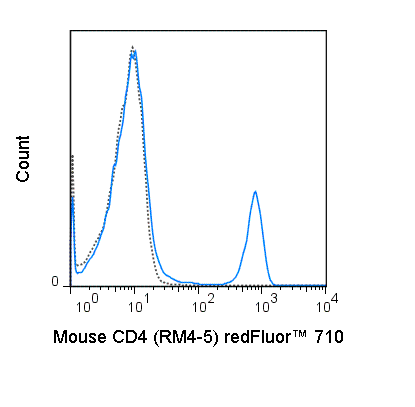
The RM4-5 antibody reacts with mouse CD4, a 55 kDa protein which acts as a co-receptor for the T cell receptor (TCR) in its interaction with MHC Class II molecules on antigen-presenting cells. The extracellular domain of CD4 binds to the beta2-domain of MHC Class II, while its cytoplasmic tail provides a binding site for the tyrosine kinase lck, facilitating the signaling cascade that initiates T cell activation. CD4 is typically expressed on thymocytes, certain mature T cell populations such as Th17 and T regulatory (Treg) cells, as well as on dendritic cells.
The RM4-5 antibody is widely used as a phenotypic marker for CD4 expression. If used together, the RM4-5 antibody and an alternative antibody, Anti-Mouse CD4 clone GK1.5, will “compete” for binding, i.e. RM4-5 antibody is able to block GK1.5 antibody binding to cells. In contrast, RM4-5 antibody does not block the binding of Anti-Mouse CD4 clone RM4-4 to cells.
Recent Publications:
Takahashi D, Hoshina N, Kabumoto Y, et al. Microbiota-derived butyrate limits the autoimmune response by promoting the differentiation of follicular regulatory T cells. EBioMedicine. 2020;58:102913. doi:10.1016/j.ebiom.2020.102913.
Weist BM, Kurd N, Boussier J, Chan SW and Robey EA. 2015. Nat Immunol. 16(6): 635-641. (Flow Cytometry)
| Name | redFluor™ 710 Anti-Mouse CD4 (RM4-5) |
|---|---|
| Cat. No. | 80-0042 |
| Alternative Names | L3T4, T4 |
| Gene ID | 12504 |
| Clone | RM4-5 |
| Isotype | Rat IgG2a, κ |
| Reactivity | Mouse |
| Format | redFluor™ 710 |
| Application | Flow Cytometry |
Original: $91.00
-70%$91.00
$27.30redFluor™ 710 Anti-Mouse CD4 (RM4-5)
The RM4-5 antibody reacts with mouse CD4, a 55 kDa protein which acts as a co-receptor for the T cell receptor (TCR) in its interaction with MHC Class II molecules on antigen-presenting cells. The extracellular domain of CD4 binds to the beta2-domain of MHC Class II, while its cytoplasmic tail provides a binding site for the tyrosine kinase lck, facilitating the signaling cascade that initiates T cell activation. CD4 is typically expressed on thymocytes, certain mature T cell populations such as Th17 and T regulatory (Treg) cells, as well as on dendritic cells.
The RM4-5 antibody is widely used as a phenotypic marker for CD4 expression. If used together, the RM4-5 antibody and an alternative antibody, Anti-Mouse CD4 clone GK1.5, will “compete” for binding, i.e. RM4-5 antibody is able to block GK1.5 antibody binding to cells. In contrast, RM4-5 antibody does not block the binding of Anti-Mouse CD4 clone RM4-4 to cells.
Recent Publications:
Takahashi D, Hoshina N, Kabumoto Y, et al. Microbiota-derived butyrate limits the autoimmune response by promoting the differentiation of follicular regulatory T cells. EBioMedicine. 2020;58:102913. doi:10.1016/j.ebiom.2020.102913.
Weist BM, Kurd N, Boussier J, Chan SW and Robey EA. 2015. Nat Immunol. 16(6): 635-641. (Flow Cytometry)
| Name | redFluor™ 710 Anti-Mouse CD4 (RM4-5) |
|---|---|
| Cat. No. | 80-0042 |
| Alternative Names | L3T4, T4 |
| Gene ID | 12504 |
| Clone | RM4-5 |
| Isotype | Rat IgG2a, κ |
| Reactivity | Mouse |
| Format | redFluor™ 710 |
| Application | Flow Cytometry |
Product Information
Product Information
Shipping & Returns
Shipping & Returns
Description
The RM4-5 antibody reacts with mouse CD4, a 55 kDa protein which acts as a co-receptor for the T cell receptor (TCR) in its interaction with MHC Class II molecules on antigen-presenting cells. The extracellular domain of CD4 binds to the beta2-domain of MHC Class II, while its cytoplasmic tail provides a binding site for the tyrosine kinase lck, facilitating the signaling cascade that initiates T cell activation. CD4 is typically expressed on thymocytes, certain mature T cell populations such as Th17 and T regulatory (Treg) cells, as well as on dendritic cells.
The RM4-5 antibody is widely used as a phenotypic marker for CD4 expression. If used together, the RM4-5 antibody and an alternative antibody, Anti-Mouse CD4 clone GK1.5, will “compete” for binding, i.e. RM4-5 antibody is able to block GK1.5 antibody binding to cells. In contrast, RM4-5 antibody does not block the binding of Anti-Mouse CD4 clone RM4-4 to cells.
Recent Publications:
Takahashi D, Hoshina N, Kabumoto Y, et al. Microbiota-derived butyrate limits the autoimmune response by promoting the differentiation of follicular regulatory T cells. EBioMedicine. 2020;58:102913. doi:10.1016/j.ebiom.2020.102913.
Weist BM, Kurd N, Boussier J, Chan SW and Robey EA. 2015. Nat Immunol. 16(6): 635-641. (Flow Cytometry)
| Name | redFluor™ 710 Anti-Mouse CD4 (RM4-5) |
|---|---|
| Cat. No. | 80-0042 |
| Alternative Names | L3T4, T4 |
| Gene ID | 12504 |
| Clone | RM4-5 |
| Isotype | Rat IgG2a, κ |
| Reactivity | Mouse |
| Format | redFluor™ 710 |
| Application | Flow Cytometry |