PerCP-Cyanine5.5 Anti-Mouse CD4 (RM4-5)
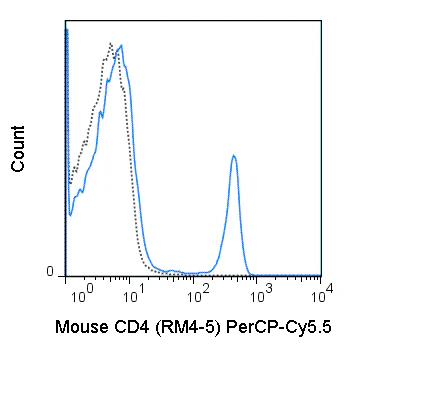
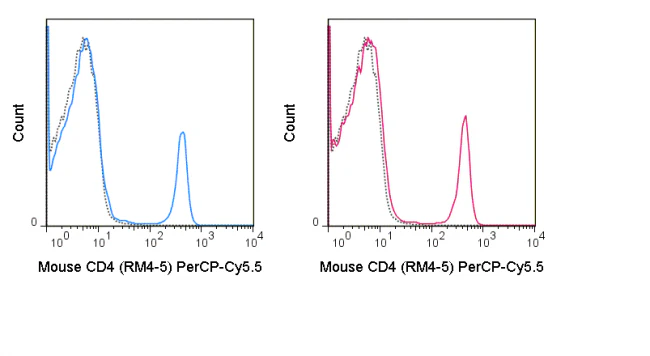
The RM4-5 antibody reacts with mouse CD4, a 55 kDa protein which acts as a co-receptor for the T cell receptor (TCR) in its interaction with MHC Class II molecules on antigen-presenting cells. The extracellular domain of CD4 binds to the beta2-domain of MHC Class II, while its cytoplasmic tail provides a binding site for the tyrosine kinase lck, facilitating the signaling cascade that initiates T cell activation. CD4 is typically expressed on thymocytes, certain mature T cell populations such as Th17 and T regulatory (Treg) cells, as well as on dendritic cells.
The RM4-5 antibody is widely used as a phenotypic marker for CD4 expression. If used together, the RM4-5 antibody and an alternative antibody, Anti-Mouse CD4 clone GK1.5, will “compete” for binding, i.e. RM4-5 antibody is able to block GK1.5 antibody binding to cells. In contrast, RM4-5 antibody does not block the binding of Anti-Mouse CD4 clone RM4-4 to cells.
Recent Publications:
Whittington KB, Prislovsky A, Beaty J, Albritton L, Radic M, Rosloniec EF. CD8+ T Cells Expressing an HLA-DR1 Chimeric Antigen Receptor Target Autoimmune CD4+ T Cells in an Antigen-Specific Manner and Inhibit the Development of Autoimmune Arthritis. J Immunol. 2021 Nov 24:ji2100643. doi: 10.4049/jimmunol.2100643. Epub ahead of print. PMID: 34819392.
» View on The Journal of Immunology
Hiroshi Kobayashi and Keiyo Takubo. Protocol for the Maintenance of Quiescent Murine Hematopoietic Stem Cells. STAR Protocols. Published 2 August 2020. https://doi.org/10.1016/j.xpro.2020.100078.
Dolina JS, Lee J, Griswold RQ, Labarta-Bajo L, Kannan S, Greenbaum JA, Bahia El Idrissi N, Pont MJ, Croft M, Schoenberger SP. TLR9 Sensing of Self-DNA Controls Cell-Mediated Immunity to Listeria Infection via Rapid Conversion of Conventional CD4+ T Cells to Treg. Cell Rep. 2020 Apr 7;31(1):107249. doi: 10.1016/j.celrep.2020.01.040.
Kobayashi H, Morikawa T, Okinaga A, et al. Environmental Optimization Enables Maintenance of Quiescent Hematopoietic Stem Cells Ex Vivo. Cell Rep. 2019;28(1):145-158.e9. doi:10.1016/j.celrep.2019.06.008.
Bally APR, Lu P, Tang Y, Austin JW, Scharer CD, Ahmed R and Boss JM. 2015. J Immunol. doi: 10.4049/jimmunol.1402550. (Flow Cytometry)
Sekiya T, Kondo T, Shichita T, Morita R, Ichinose H and Yoshimura A. 2015. J Exp Med. 212(10): 1623-1640. (Flow Cytometry)
| Name | PerCP-Cyanine5.5 Anti-Mouse CD4 (RM4-5) |
|---|---|
| Cat. No. | 65-0042 |
| Alternative Names | L3T4, T4 |
| Gene ID | 12504 |
| Clone | RM4-5 |
| Isotype | Rat IgG2a, κ |
| Reactivity | Mouse |
| Format | PerCP-Cyanine5.5 |
| Application | Flow Cytometry |
More Images
PerCP-Cyanine5.5 Anti-Mouse CD4 (RM4-5)
The RM4-5 antibody reacts with mouse CD4, a 55 kDa protein which acts as a co-receptor for the T cell receptor (TCR) in its interaction with MHC Class II molecules on antigen-presenting cells. The extracellular domain of CD4 binds to the beta2-domain of MHC Class II, while its cytoplasmic tail provides a binding site for the tyrosine kinase lck, facilitating the signaling cascade that initiates T cell activation. CD4 is typically expressed on thymocytes, certain mature T cell populations such as Th17 and T regulatory (Treg) cells, as well as on dendritic cells.
The RM4-5 antibody is widely used as a phenotypic marker for CD4 expression. If used together, the RM4-5 antibody and an alternative antibody, Anti-Mouse CD4 clone GK1.5, will “compete” for binding, i.e. RM4-5 antibody is able to block GK1.5 antibody binding to cells. In contrast, RM4-5 antibody does not block the binding of Anti-Mouse CD4 clone RM4-4 to cells.
Recent Publications:
Whittington KB, Prislovsky A, Beaty J, Albritton L, Radic M, Rosloniec EF. CD8+ T Cells Expressing an HLA-DR1 Chimeric Antigen Receptor Target Autoimmune CD4+ T Cells in an Antigen-Specific Manner and Inhibit the Development of Autoimmune Arthritis. J Immunol. 2021 Nov 24:ji2100643. doi: 10.4049/jimmunol.2100643. Epub ahead of print. PMID: 34819392.
» View on The Journal of Immunology
Hiroshi Kobayashi and Keiyo Takubo. Protocol for the Maintenance of Quiescent Murine Hematopoietic Stem Cells. STAR Protocols. Published 2 August 2020. https://doi.org/10.1016/j.xpro.2020.100078.
Dolina JS, Lee J, Griswold RQ, Labarta-Bajo L, Kannan S, Greenbaum JA, Bahia El Idrissi N, Pont MJ, Croft M, Schoenberger SP. TLR9 Sensing of Self-DNA Controls Cell-Mediated Immunity to Listeria Infection via Rapid Conversion of Conventional CD4+ T Cells to Treg. Cell Rep. 2020 Apr 7;31(1):107249. doi: 10.1016/j.celrep.2020.01.040.
Kobayashi H, Morikawa T, Okinaga A, et al. Environmental Optimization Enables Maintenance of Quiescent Hematopoietic Stem Cells Ex Vivo. Cell Rep. 2019;28(1):145-158.e9. doi:10.1016/j.celrep.2019.06.008.
Bally APR, Lu P, Tang Y, Austin JW, Scharer CD, Ahmed R and Boss JM. 2015. J Immunol. doi: 10.4049/jimmunol.1402550. (Flow Cytometry)
Sekiya T, Kondo T, Shichita T, Morita R, Ichinose H and Yoshimura A. 2015. J Exp Med. 212(10): 1623-1640. (Flow Cytometry)
| Name | PerCP-Cyanine5.5 Anti-Mouse CD4 (RM4-5) |
|---|---|
| Cat. No. | 65-0042 |
| Alternative Names | L3T4, T4 |
| Gene ID | 12504 |
| Clone | RM4-5 |
| Isotype | Rat IgG2a, κ |
| Reactivity | Mouse |
| Format | PerCP-Cyanine5.5 |
| Application | Flow Cytometry |
Product Information
Product Information
Shipping & Returns
Shipping & Returns
Description
The RM4-5 antibody reacts with mouse CD4, a 55 kDa protein which acts as a co-receptor for the T cell receptor (TCR) in its interaction with MHC Class II molecules on antigen-presenting cells. The extracellular domain of CD4 binds to the beta2-domain of MHC Class II, while its cytoplasmic tail provides a binding site for the tyrosine kinase lck, facilitating the signaling cascade that initiates T cell activation. CD4 is typically expressed on thymocytes, certain mature T cell populations such as Th17 and T regulatory (Treg) cells, as well as on dendritic cells.
The RM4-5 antibody is widely used as a phenotypic marker for CD4 expression. If used together, the RM4-5 antibody and an alternative antibody, Anti-Mouse CD4 clone GK1.5, will “compete” for binding, i.e. RM4-5 antibody is able to block GK1.5 antibody binding to cells. In contrast, RM4-5 antibody does not block the binding of Anti-Mouse CD4 clone RM4-4 to cells.
Recent Publications:
Whittington KB, Prislovsky A, Beaty J, Albritton L, Radic M, Rosloniec EF. CD8+ T Cells Expressing an HLA-DR1 Chimeric Antigen Receptor Target Autoimmune CD4+ T Cells in an Antigen-Specific Manner and Inhibit the Development of Autoimmune Arthritis. J Immunol. 2021 Nov 24:ji2100643. doi: 10.4049/jimmunol.2100643. Epub ahead of print. PMID: 34819392.
» View on The Journal of Immunology
Hiroshi Kobayashi and Keiyo Takubo. Protocol for the Maintenance of Quiescent Murine Hematopoietic Stem Cells. STAR Protocols. Published 2 August 2020. https://doi.org/10.1016/j.xpro.2020.100078.
Dolina JS, Lee J, Griswold RQ, Labarta-Bajo L, Kannan S, Greenbaum JA, Bahia El Idrissi N, Pont MJ, Croft M, Schoenberger SP. TLR9 Sensing of Self-DNA Controls Cell-Mediated Immunity to Listeria Infection via Rapid Conversion of Conventional CD4+ T Cells to Treg. Cell Rep. 2020 Apr 7;31(1):107249. doi: 10.1016/j.celrep.2020.01.040.
Kobayashi H, Morikawa T, Okinaga A, et al. Environmental Optimization Enables Maintenance of Quiescent Hematopoietic Stem Cells Ex Vivo. Cell Rep. 2019;28(1):145-158.e9. doi:10.1016/j.celrep.2019.06.008.
Bally APR, Lu P, Tang Y, Austin JW, Scharer CD, Ahmed R and Boss JM. 2015. J Immunol. doi: 10.4049/jimmunol.1402550. (Flow Cytometry)
Sekiya T, Kondo T, Shichita T, Morita R, Ichinose H and Yoshimura A. 2015. J Exp Med. 212(10): 1623-1640. (Flow Cytometry)
| Name | PerCP-Cyanine5.5 Anti-Mouse CD4 (RM4-5) |
|---|---|
| Cat. No. | 65-0042 |
| Alternative Names | L3T4, T4 |
| Gene ID | 12504 |
| Clone | RM4-5 |
| Isotype | Rat IgG2a, κ |
| Reactivity | Mouse |
| Format | PerCP-Cyanine5.5 |
| Application | Flow Cytometry |