PerCP-Cyanine5.5 Anti-Human CD4 (OKT4)
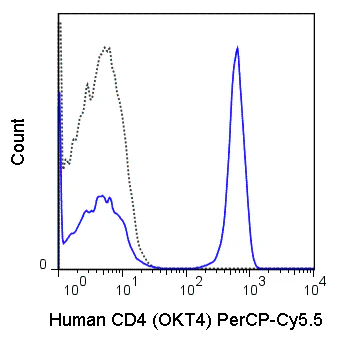
The OKT4 antibody reacts with human CD4, a 59 kDa protein which acts as a co-receptor for the T cell receptor (TCR) in its interaction with MHC Class II molecules on antigen-presenting cells. The extracellular domain of CD4 binds to the beta-2 domain of MHC Class II, while its cytoplasmic tail provides a binding site for the tyrosine kinase lck, facilitating the signaling cascade that initiates T cell activation. CD4, and co-receptors CCR5 and CXCR4, may also be utilized by HIV-1 to enter T cells. Human CD4 is typically expressed on thymocytes, some mature T cell populations such as Th17 and T regulatory (Treg) cells, as well as on dendritic cells.
The OKT4 antibody is widely used as a phenotypic marker for CD4 expression. It is cross-reactive with CD4 in several non-human species, including Chimpanzee, Cynomolgus and Rhesus. This antibody recognizes a different epitope, and thus does not block binding of, the alternative Anti-Human CD4 antibody clone RPA-T4 (Reinherz EL, et al. 1979. Proc. Natl. Acad. Sci. 76:4061-4065)
Recent Citations:
Grotle AK, Darling AM, Saunders EFH, Fadel PJ, Trott DW, Greaney JL. Augmented T cell mitochondrial reactive oxygen species in adults with major depressive disorder. Am J Physiol Heart Circ Physiol. 2022 Feb 18. doi: 10.1152/ajpheart.00019.2022. Epub ahead of print. PMID: 35179977.
| Name | PerCP-Cyanine5.5 Anti-Human CD4 (OKT4) |
|---|---|
| Cat. No. | 65-0048 |
| Alternative Names | Leu-3, T4 |
| Gene ID | 920 |
| Clone | OKT4 |
| Isotype | Mouse IgG2b, kappa |
| Reactivity | Human |
| Cross Reactivity | Chimpanzee, Cynomolgus, Rhesus |
| Format | PerCP-Cyanine5.5 |
| Application | Flow Cytometry |
Original: $63.00
-70%$63.00
$18.90PerCP-Cyanine5.5 Anti-Human CD4 (OKT4)
The OKT4 antibody reacts with human CD4, a 59 kDa protein which acts as a co-receptor for the T cell receptor (TCR) in its interaction with MHC Class II molecules on antigen-presenting cells. The extracellular domain of CD4 binds to the beta-2 domain of MHC Class II, while its cytoplasmic tail provides a binding site for the tyrosine kinase lck, facilitating the signaling cascade that initiates T cell activation. CD4, and co-receptors CCR5 and CXCR4, may also be utilized by HIV-1 to enter T cells. Human CD4 is typically expressed on thymocytes, some mature T cell populations such as Th17 and T regulatory (Treg) cells, as well as on dendritic cells.
The OKT4 antibody is widely used as a phenotypic marker for CD4 expression. It is cross-reactive with CD4 in several non-human species, including Chimpanzee, Cynomolgus and Rhesus. This antibody recognizes a different epitope, and thus does not block binding of, the alternative Anti-Human CD4 antibody clone RPA-T4 (Reinherz EL, et al. 1979. Proc. Natl. Acad. Sci. 76:4061-4065)
Recent Citations:
Grotle AK, Darling AM, Saunders EFH, Fadel PJ, Trott DW, Greaney JL. Augmented T cell mitochondrial reactive oxygen species in adults with major depressive disorder. Am J Physiol Heart Circ Physiol. 2022 Feb 18. doi: 10.1152/ajpheart.00019.2022. Epub ahead of print. PMID: 35179977.
| Name | PerCP-Cyanine5.5 Anti-Human CD4 (OKT4) |
|---|---|
| Cat. No. | 65-0048 |
| Alternative Names | Leu-3, T4 |
| Gene ID | 920 |
| Clone | OKT4 |
| Isotype | Mouse IgG2b, kappa |
| Reactivity | Human |
| Cross Reactivity | Chimpanzee, Cynomolgus, Rhesus |
| Format | PerCP-Cyanine5.5 |
| Application | Flow Cytometry |
Product Information
Product Information
Shipping & Returns
Shipping & Returns
Description
The OKT4 antibody reacts with human CD4, a 59 kDa protein which acts as a co-receptor for the T cell receptor (TCR) in its interaction with MHC Class II molecules on antigen-presenting cells. The extracellular domain of CD4 binds to the beta-2 domain of MHC Class II, while its cytoplasmic tail provides a binding site for the tyrosine kinase lck, facilitating the signaling cascade that initiates T cell activation. CD4, and co-receptors CCR5 and CXCR4, may also be utilized by HIV-1 to enter T cells. Human CD4 is typically expressed on thymocytes, some mature T cell populations such as Th17 and T regulatory (Treg) cells, as well as on dendritic cells.
The OKT4 antibody is widely used as a phenotypic marker for CD4 expression. It is cross-reactive with CD4 in several non-human species, including Chimpanzee, Cynomolgus and Rhesus. This antibody recognizes a different epitope, and thus does not block binding of, the alternative Anti-Human CD4 antibody clone RPA-T4 (Reinherz EL, et al. 1979. Proc. Natl. Acad. Sci. 76:4061-4065)
Recent Citations:
Grotle AK, Darling AM, Saunders EFH, Fadel PJ, Trott DW, Greaney JL. Augmented T cell mitochondrial reactive oxygen species in adults with major depressive disorder. Am J Physiol Heart Circ Physiol. 2022 Feb 18. doi: 10.1152/ajpheart.00019.2022. Epub ahead of print. PMID: 35179977.
| Name | PerCP-Cyanine5.5 Anti-Human CD4 (OKT4) |
|---|---|
| Cat. No. | 65-0048 |
| Alternative Names | Leu-3, T4 |
| Gene ID | 920 |
| Clone | OKT4 |
| Isotype | Mouse IgG2b, kappa |
| Reactivity | Human |
| Cross Reactivity | Chimpanzee, Cynomolgus, Rhesus |
| Format | PerCP-Cyanine5.5 |
| Application | Flow Cytometry |