PE-Cyanine7 Anti-Mouse CD86 (B7-2) (GL-1)
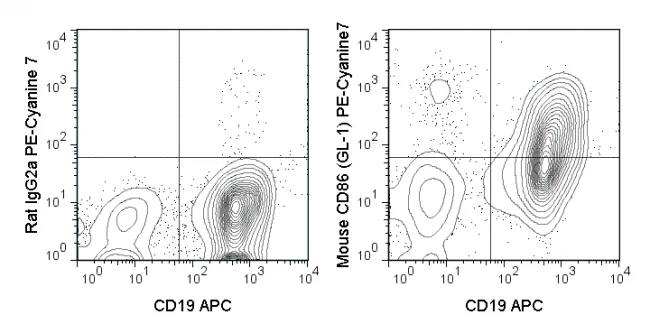
The GL-1 antibody reacts with mouse CD86, also known as B7-2, an 80 kDa cell surface protein which is a ligand for CD28, a co-stimulatory receptor for the T cell receptor (TCR). CD28 can also bind a second B7 ligand known as CD80 (B7-1). Both CD80 and CD86 are expressed on activated B cells and antigen-presenting cells. These ligands trigger CD28 signaling in concert with TCR activation to drive T cell proliferation, induce high-level expression of IL-2, impart resistance to apoptosis, and enhance T cell cytotoxicity. The interaction / co-stimulatory signaling between ≥ ≥ ≥ the B7 ligands and CD28 provides crucial communication between ≥ ≥ ≥ T cells and B cells or APCs to coordinate the adaptive immune response. The GL-1 antibody may be used as a marker for CD86 expression on B cells, macrophages, and dendritic cells.
| Name | PE-Cyanine7 Anti-Mouse CD86 (B7-2) (GL-1) |
|---|---|
| Cat. No. | 60-0862 |
| Alternative Names | B7.2, B70, Ly-58 |
| Gene ID | 12524 |
| Clone | GL-1 (GL1) |
| Isotype | Rat IgG2a, κ |
| Reactivity | Mouse |
| Format | PE-Cyanine7 |
| Application | Flow Cytometry |
PE-Cyanine7 Anti-Mouse CD86 (B7-2) (GL-1)
The GL-1 antibody reacts with mouse CD86, also known as B7-2, an 80 kDa cell surface protein which is a ligand for CD28, a co-stimulatory receptor for the T cell receptor (TCR). CD28 can also bind a second B7 ligand known as CD80 (B7-1). Both CD80 and CD86 are expressed on activated B cells and antigen-presenting cells. These ligands trigger CD28 signaling in concert with TCR activation to drive T cell proliferation, induce high-level expression of IL-2, impart resistance to apoptosis, and enhance T cell cytotoxicity. The interaction / co-stimulatory signaling between ≥ ≥ ≥ the B7 ligands and CD28 provides crucial communication between ≥ ≥ ≥ T cells and B cells or APCs to coordinate the adaptive immune response. The GL-1 antibody may be used as a marker for CD86 expression on B cells, macrophages, and dendritic cells.
| Name | PE-Cyanine7 Anti-Mouse CD86 (B7-2) (GL-1) |
|---|---|
| Cat. No. | 60-0862 |
| Alternative Names | B7.2, B70, Ly-58 |
| Gene ID | 12524 |
| Clone | GL-1 (GL1) |
| Isotype | Rat IgG2a, κ |
| Reactivity | Mouse |
| Format | PE-Cyanine7 |
| Application | Flow Cytometry |
Product Information
Product Information
Shipping & Returns
Shipping & Returns
Description
The GL-1 antibody reacts with mouse CD86, also known as B7-2, an 80 kDa cell surface protein which is a ligand for CD28, a co-stimulatory receptor for the T cell receptor (TCR). CD28 can also bind a second B7 ligand known as CD80 (B7-1). Both CD80 and CD86 are expressed on activated B cells and antigen-presenting cells. These ligands trigger CD28 signaling in concert with TCR activation to drive T cell proliferation, induce high-level expression of IL-2, impart resistance to apoptosis, and enhance T cell cytotoxicity. The interaction / co-stimulatory signaling between ≥ ≥ ≥ the B7 ligands and CD28 provides crucial communication between ≥ ≥ ≥ T cells and B cells or APCs to coordinate the adaptive immune response. The GL-1 antibody may be used as a marker for CD86 expression on B cells, macrophages, and dendritic cells.
| Name | PE-Cyanine7 Anti-Mouse CD86 (B7-2) (GL-1) |
|---|---|
| Cat. No. | 60-0862 |
| Alternative Names | B7.2, B70, Ly-58 |
| Gene ID | 12524 |
| Clone | GL-1 (GL1) |
| Isotype | Rat IgG2a, κ |
| Reactivity | Mouse |
| Format | PE-Cyanine7 |
| Application | Flow Cytometry |