PE-Cyanine5 Anti-Mouse CD4 (GK1.5)
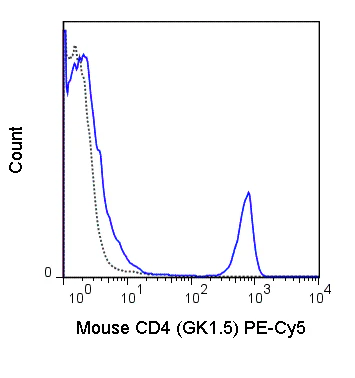
The GK1.5 antibody reacts with mouse CD4, a 55 kDa protein which acts as a co-receptor for the T cell receptor (TCR) in its interaction with MHC Class II molecules on antigen-presenting cells. The extracellular domain of CD4 binds to the beta-2 domain of MHC Class II, while its cytoplasmic tail provides a binding site for the tyrosine kinase lck, facilitating the signaling cascade that initiates T cell activation. CD4 is typically expressed on thymocytes, certain mature T cell populations such as Th17 and T regulatory (Treg) cells, as well as on dendritic cells.
The GK1.5 antibody is widely used as a phenotypic marker for CD4 expression. If used together, the GK1.5 antibody and an alternative antibody, Anti-Mouse CD4 clone RM4-5, will “compete” for binding, i.e. RM4-5 is able to block GK1.5 binding to cells. In contrast, the Anti-Mouse CD4 clone RM4-4 does not block binding of the GK1.5 antibody to cells (Arora S et al. 2006. Infect. Immun. 74: 4339-4348). The GK1.5 antibody is also reported to be cross-reactive with Syrian hamster CD4.
| Name | PE-Cyanine5 Anti-Mouse CD4 (GK1.5) |
|---|---|
| Cat. No. | 55-0041 |
| Alternative Names | L3T4, T4 |
| Gene ID | 12504 |
| Clone | GK1.5 |
| Isotype | Rat IgG2b, κ |
| Reactivity | Mouse |
| Cross Reactivity | Syrian Hamster |
| Format | PE-Cyanine5 |
| Application | Flow Cytometry |
PE-Cyanine5 Anti-Mouse CD4 (GK1.5)
The GK1.5 antibody reacts with mouse CD4, a 55 kDa protein which acts as a co-receptor for the T cell receptor (TCR) in its interaction with MHC Class II molecules on antigen-presenting cells. The extracellular domain of CD4 binds to the beta-2 domain of MHC Class II, while its cytoplasmic tail provides a binding site for the tyrosine kinase lck, facilitating the signaling cascade that initiates T cell activation. CD4 is typically expressed on thymocytes, certain mature T cell populations such as Th17 and T regulatory (Treg) cells, as well as on dendritic cells.
The GK1.5 antibody is widely used as a phenotypic marker for CD4 expression. If used together, the GK1.5 antibody and an alternative antibody, Anti-Mouse CD4 clone RM4-5, will “compete” for binding, i.e. RM4-5 is able to block GK1.5 binding to cells. In contrast, the Anti-Mouse CD4 clone RM4-4 does not block binding of the GK1.5 antibody to cells (Arora S et al. 2006. Infect. Immun. 74: 4339-4348). The GK1.5 antibody is also reported to be cross-reactive with Syrian hamster CD4.
| Name | PE-Cyanine5 Anti-Mouse CD4 (GK1.5) |
|---|---|
| Cat. No. | 55-0041 |
| Alternative Names | L3T4, T4 |
| Gene ID | 12504 |
| Clone | GK1.5 |
| Isotype | Rat IgG2b, κ |
| Reactivity | Mouse |
| Cross Reactivity | Syrian Hamster |
| Format | PE-Cyanine5 |
| Application | Flow Cytometry |
Product Information
Product Information
Shipping & Returns
Shipping & Returns
Description
The GK1.5 antibody reacts with mouse CD4, a 55 kDa protein which acts as a co-receptor for the T cell receptor (TCR) in its interaction with MHC Class II molecules on antigen-presenting cells. The extracellular domain of CD4 binds to the beta-2 domain of MHC Class II, while its cytoplasmic tail provides a binding site for the tyrosine kinase lck, facilitating the signaling cascade that initiates T cell activation. CD4 is typically expressed on thymocytes, certain mature T cell populations such as Th17 and T regulatory (Treg) cells, as well as on dendritic cells.
The GK1.5 antibody is widely used as a phenotypic marker for CD4 expression. If used together, the GK1.5 antibody and an alternative antibody, Anti-Mouse CD4 clone RM4-5, will “compete” for binding, i.e. RM4-5 is able to block GK1.5 binding to cells. In contrast, the Anti-Mouse CD4 clone RM4-4 does not block binding of the GK1.5 antibody to cells (Arora S et al. 2006. Infect. Immun. 74: 4339-4348). The GK1.5 antibody is also reported to be cross-reactive with Syrian hamster CD4.
| Name | PE-Cyanine5 Anti-Mouse CD4 (GK1.5) |
|---|---|
| Cat. No. | 55-0041 |
| Alternative Names | L3T4, T4 |
| Gene ID | 12504 |
| Clone | GK1.5 |
| Isotype | Rat IgG2b, κ |
| Reactivity | Mouse |
| Cross Reactivity | Syrian Hamster |
| Format | PE-Cyanine5 |
| Application | Flow Cytometry |