PE-Cyanine5 Anti-Mouse CD3e (145-2C11)
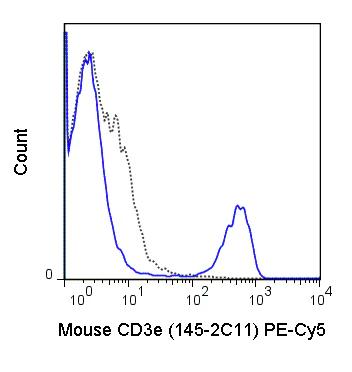
The 145-2C11 antibody is specific for mouse CD3e, also known as CD3 epsilon, a 20 kDa subunit of the T cell receptor complex, along with CD3 gamma and CD3 delta. These integral membrane protein chains assemble with additional chains of the T cell receptor (TCR), as well as CD3 zeta chain, to form the T cell receptor – CD3 complex. Together with co-receptors CD4 or CD8, the complex serves to recognize antigens bound to MHC molecules on antigen-presenting cells. Such interactions promote T cell receptor signaling (T cell activation) and can result in a number of cellular responses including proliferation, differentiation, production of cytokines or activation-induced cell death. CD3 is differentially expressed during thymocyte-to-T cell development and on all mature T cells.
The 145-2C11 antibody is a widely used phenotypic marker for mouse T cells. In addition, binding of 145-2C11 antibody to CD3e can induce cell activation. A recent publication of the crystal structure of a murine CD3e-mitogenic antibody complex provides further insight into the action of commonly used agonist antibodies (Fernandes, R.A. et al. 2012. J. Biol. Chem. 287: 13324-13335).
Recent Publications:
Neyt K, GeurtsvanKessel CH and Lambrecht BN. 2015. Mucosal Immunol. DOI 10.1038/mi2015.91. (Flow Cytometry)
| Name | PE-Cyanine5 Anti-Mouse CD3e (145-2C11) |
|---|---|
| Cat. No. | 55-0031 |
| Alternative Names | CD3 epsilon |
| Gene ID | 12501 |
| Clone | 145-2C11 |
| Isotype | Armenian Hamster IgG |
| Reactivity | Mouse |
| Format | PE-Cyanine5 |
| Application | Flow Cytometry |
More Images
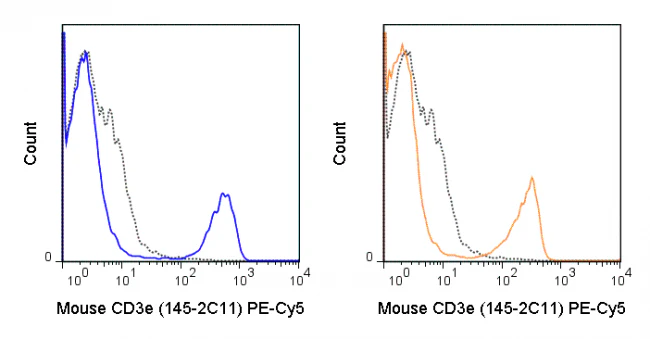
PE-Cyanine5 Anti-Mouse CD3e (145-2C11)
The 145-2C11 antibody is specific for mouse CD3e, also known as CD3 epsilon, a 20 kDa subunit of the T cell receptor complex, along with CD3 gamma and CD3 delta. These integral membrane protein chains assemble with additional chains of the T cell receptor (TCR), as well as CD3 zeta chain, to form the T cell receptor – CD3 complex. Together with co-receptors CD4 or CD8, the complex serves to recognize antigens bound to MHC molecules on antigen-presenting cells. Such interactions promote T cell receptor signaling (T cell activation) and can result in a number of cellular responses including proliferation, differentiation, production of cytokines or activation-induced cell death. CD3 is differentially expressed during thymocyte-to-T cell development and on all mature T cells.
The 145-2C11 antibody is a widely used phenotypic marker for mouse T cells. In addition, binding of 145-2C11 antibody to CD3e can induce cell activation. A recent publication of the crystal structure of a murine CD3e-mitogenic antibody complex provides further insight into the action of commonly used agonist antibodies (Fernandes, R.A. et al. 2012. J. Biol. Chem. 287: 13324-13335).
Recent Publications:
Neyt K, GeurtsvanKessel CH and Lambrecht BN. 2015. Mucosal Immunol. DOI 10.1038/mi2015.91. (Flow Cytometry)
| Name | PE-Cyanine5 Anti-Mouse CD3e (145-2C11) |
|---|---|
| Cat. No. | 55-0031 |
| Alternative Names | CD3 epsilon |
| Gene ID | 12501 |
| Clone | 145-2C11 |
| Isotype | Armenian Hamster IgG |
| Reactivity | Mouse |
| Format | PE-Cyanine5 |
| Application | Flow Cytometry |
Product Information
Product Information
Shipping & Returns
Shipping & Returns
Description
The 145-2C11 antibody is specific for mouse CD3e, also known as CD3 epsilon, a 20 kDa subunit of the T cell receptor complex, along with CD3 gamma and CD3 delta. These integral membrane protein chains assemble with additional chains of the T cell receptor (TCR), as well as CD3 zeta chain, to form the T cell receptor – CD3 complex. Together with co-receptors CD4 or CD8, the complex serves to recognize antigens bound to MHC molecules on antigen-presenting cells. Such interactions promote T cell receptor signaling (T cell activation) and can result in a number of cellular responses including proliferation, differentiation, production of cytokines or activation-induced cell death. CD3 is differentially expressed during thymocyte-to-T cell development and on all mature T cells.
The 145-2C11 antibody is a widely used phenotypic marker for mouse T cells. In addition, binding of 145-2C11 antibody to CD3e can induce cell activation. A recent publication of the crystal structure of a murine CD3e-mitogenic antibody complex provides further insight into the action of commonly used agonist antibodies (Fernandes, R.A. et al. 2012. J. Biol. Chem. 287: 13324-13335).
Recent Publications:
Neyt K, GeurtsvanKessel CH and Lambrecht BN. 2015. Mucosal Immunol. DOI 10.1038/mi2015.91. (Flow Cytometry)
| Name | PE-Cyanine5 Anti-Mouse CD3e (145-2C11) |
|---|---|
| Cat. No. | 55-0031 |
| Alternative Names | CD3 epsilon |
| Gene ID | 12501 |
| Clone | 145-2C11 |
| Isotype | Armenian Hamster IgG |
| Reactivity | Mouse |
| Format | PE-Cyanine5 |
| Application | Flow Cytometry |