FITC Anti-Mouse Ly-6G/Ly-6C (Gr-1) (RB6-8C5)
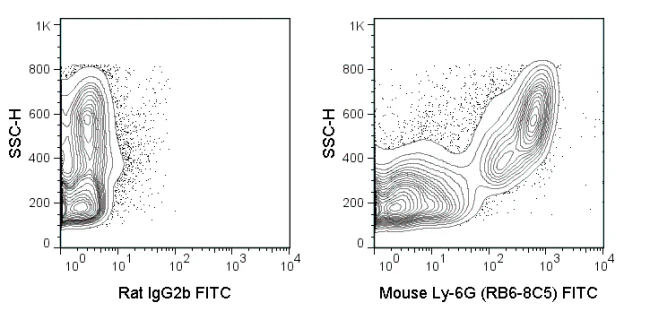
The RB6-8C5 antibody binds to mouse Ly-6G/Ly-6C, commonly known as Gr-1, a member of the Ly-6 superfamily of GPI-anchored cell surface proteins with roles in cell signaling and cell adhesion. Gr-1 is differentially expressed during development and maturation of cells in the myeloid lineage and is expressed at varying stages and levels on monocytes, macrophages, granulocytes, and peripheral neutrophils.
Recent Publications:
Baba T, Yoshida T, Tanabe Y, et al. Cytoplasmic DNA accumulation preferentially triggers cell death of myeloid leukemia cells by interacting with intracellular DNA sensing pathway. Cell Death Dis. 2021 Mar 26;12(4):322. doi: 10.1038/s41419-021-03587-x. PMID: 33771977.
Ishida Y, Kuninaka Y, Nosaka M, et al. Prevention of CaCl2-induced aortic inflammation and subsequent aneurysm formation by the CCL3-CCR5 axis. Nat Commun. 2020 Nov 25;11(1):5994. doi: 10.1038/s41467-020-19763-0. PMID: 33239616.
» View on Nature Communications
Wu J and Waxman DJ. 2015. OncoImmunol. DOI:10.1080/2162402X.2015.1005521. (Flow Cytometry)
| Name | FITC Anti-Mouse Ly-6G (Gr-1) (RB6-8C5) |
|---|---|
| Cat. No. | 35-5931 |
| Alternative Names | Gr1, Ly6G |
| Gene ID | 17067 |
| Clone | RB6-8C5 |
| Isotype | Rat IgG2b, κ |
| Reactivity | Mouse |
| Format | FITC |
| Application | Flow Cytometry |
FITC Anti-Mouse Ly-6G/Ly-6C (Gr-1) (RB6-8C5)
The RB6-8C5 antibody binds to mouse Ly-6G/Ly-6C, commonly known as Gr-1, a member of the Ly-6 superfamily of GPI-anchored cell surface proteins with roles in cell signaling and cell adhesion. Gr-1 is differentially expressed during development and maturation of cells in the myeloid lineage and is expressed at varying stages and levels on monocytes, macrophages, granulocytes, and peripheral neutrophils.
Recent Publications:
Baba T, Yoshida T, Tanabe Y, et al. Cytoplasmic DNA accumulation preferentially triggers cell death of myeloid leukemia cells by interacting with intracellular DNA sensing pathway. Cell Death Dis. 2021 Mar 26;12(4):322. doi: 10.1038/s41419-021-03587-x. PMID: 33771977.
Ishida Y, Kuninaka Y, Nosaka M, et al. Prevention of CaCl2-induced aortic inflammation and subsequent aneurysm formation by the CCL3-CCR5 axis. Nat Commun. 2020 Nov 25;11(1):5994. doi: 10.1038/s41467-020-19763-0. PMID: 33239616.
» View on Nature Communications
Wu J and Waxman DJ. 2015. OncoImmunol. DOI:10.1080/2162402X.2015.1005521. (Flow Cytometry)
| Name | FITC Anti-Mouse Ly-6G (Gr-1) (RB6-8C5) |
|---|---|
| Cat. No. | 35-5931 |
| Alternative Names | Gr1, Ly6G |
| Gene ID | 17067 |
| Clone | RB6-8C5 |
| Isotype | Rat IgG2b, κ |
| Reactivity | Mouse |
| Format | FITC |
| Application | Flow Cytometry |
Product Information
Product Information
Shipping & Returns
Shipping & Returns
Description
The RB6-8C5 antibody binds to mouse Ly-6G/Ly-6C, commonly known as Gr-1, a member of the Ly-6 superfamily of GPI-anchored cell surface proteins with roles in cell signaling and cell adhesion. Gr-1 is differentially expressed during development and maturation of cells in the myeloid lineage and is expressed at varying stages and levels on monocytes, macrophages, granulocytes, and peripheral neutrophils.
Recent Publications:
Baba T, Yoshida T, Tanabe Y, et al. Cytoplasmic DNA accumulation preferentially triggers cell death of myeloid leukemia cells by interacting with intracellular DNA sensing pathway. Cell Death Dis. 2021 Mar 26;12(4):322. doi: 10.1038/s41419-021-03587-x. PMID: 33771977.
Ishida Y, Kuninaka Y, Nosaka M, et al. Prevention of CaCl2-induced aortic inflammation and subsequent aneurysm formation by the CCL3-CCR5 axis. Nat Commun. 2020 Nov 25;11(1):5994. doi: 10.1038/s41467-020-19763-0. PMID: 33239616.
» View on Nature Communications
Wu J and Waxman DJ. 2015. OncoImmunol. DOI:10.1080/2162402X.2015.1005521. (Flow Cytometry)
| Name | FITC Anti-Mouse Ly-6G (Gr-1) (RB6-8C5) |
|---|---|
| Cat. No. | 35-5931 |
| Alternative Names | Gr1, Ly6G |
| Gene ID | 17067 |
| Clone | RB6-8C5 |
| Isotype | Rat IgG2b, κ |
| Reactivity | Mouse |
| Format | FITC |
| Application | Flow Cytometry |