FITC Anti-Mouse KLRG1 (2F1)
The 2F1 antibody reacts with mouse KLRG1 (Killer cell Lectin-like Receptor G1). This 30-38 kDa homodimeric receptor may be expressed by activated, mature NK cells and by effector/memory T cells, with potentially different roles in each cell type. KLRG1 can regulate, in an inhibitory fashion, the development and effector functions of NK cells, and is often cited as a senescence or terminal differentiation marker for T cells. Ligands for KLRG1 include members of the cadherin family of adhesion molecules, specifically N-Cadherin, E-Cadherin, and R-Cadherin. These interactions may induce bidirectional, immunosuppressive signaling in both KLRG- and Cadherin-expressing cells. A more recently identified role for KLRG1-Cadherin signaling in tissue organization, e.g. in cardiac angiogenesis, expands the function of these interactions beyond immunosuppression of immune cells. (Bouchentouf et al. 2010. J. Immunol. 185: 7014-7025).
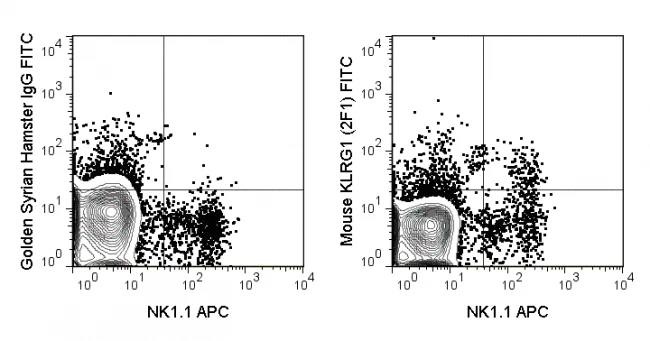
The 2F1 antibody may be used as a phenotypic marker for KLRG1 in mouse, frequently in combination with Anti-Mouse CD127 antibody (clone A7R34), for identification of effector T cell populations.
| Name | FITC Anti-Mouse KLRG1 (2F1) |
|---|---|
| Cat. No. | 35-5893 |
| Alternative Names | CLEC15A; MAFA; MAFA-2F1; MAFA-L; MAFA-LIKE |
| Gene ID | 50928 |
| Clone | 2F1 |
| Isotype | Golden Syrian Hamster IgG |
| Reactivity | Mouse |
| Format | FITC |
| Application | Flow Cytometry |
More Images
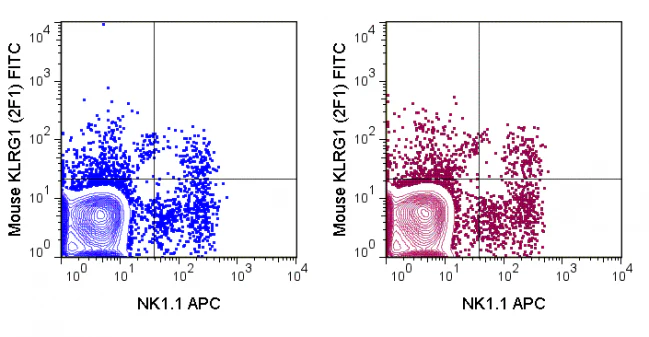
FITC Anti-Mouse KLRG1 (2F1)
The 2F1 antibody reacts with mouse KLRG1 (Killer cell Lectin-like Receptor G1). This 30-38 kDa homodimeric receptor may be expressed by activated, mature NK cells and by effector/memory T cells, with potentially different roles in each cell type. KLRG1 can regulate, in an inhibitory fashion, the development and effector functions of NK cells, and is often cited as a senescence or terminal differentiation marker for T cells. Ligands for KLRG1 include members of the cadherin family of adhesion molecules, specifically N-Cadherin, E-Cadherin, and R-Cadherin. These interactions may induce bidirectional, immunosuppressive signaling in both KLRG- and Cadherin-expressing cells. A more recently identified role for KLRG1-Cadherin signaling in tissue organization, e.g. in cardiac angiogenesis, expands the function of these interactions beyond immunosuppression of immune cells. (Bouchentouf et al. 2010. J. Immunol. 185: 7014-7025).
The 2F1 antibody may be used as a phenotypic marker for KLRG1 in mouse, frequently in combination with Anti-Mouse CD127 antibody (clone A7R34), for identification of effector T cell populations.
| Name | FITC Anti-Mouse KLRG1 (2F1) |
|---|---|
| Cat. No. | 35-5893 |
| Alternative Names | CLEC15A; MAFA; MAFA-2F1; MAFA-L; MAFA-LIKE |
| Gene ID | 50928 |
| Clone | 2F1 |
| Isotype | Golden Syrian Hamster IgG |
| Reactivity | Mouse |
| Format | FITC |
| Application | Flow Cytometry |
Product Information
Product Information
Shipping & Returns
Shipping & Returns
Description
The 2F1 antibody reacts with mouse KLRG1 (Killer cell Lectin-like Receptor G1). This 30-38 kDa homodimeric receptor may be expressed by activated, mature NK cells and by effector/memory T cells, with potentially different roles in each cell type. KLRG1 can regulate, in an inhibitory fashion, the development and effector functions of NK cells, and is often cited as a senescence or terminal differentiation marker for T cells. Ligands for KLRG1 include members of the cadherin family of adhesion molecules, specifically N-Cadherin, E-Cadherin, and R-Cadherin. These interactions may induce bidirectional, immunosuppressive signaling in both KLRG- and Cadherin-expressing cells. A more recently identified role for KLRG1-Cadherin signaling in tissue organization, e.g. in cardiac angiogenesis, expands the function of these interactions beyond immunosuppression of immune cells. (Bouchentouf et al. 2010. J. Immunol. 185: 7014-7025).
The 2F1 antibody may be used as a phenotypic marker for KLRG1 in mouse, frequently in combination with Anti-Mouse CD127 antibody (clone A7R34), for identification of effector T cell populations.
| Name | FITC Anti-Mouse KLRG1 (2F1) |
|---|---|
| Cat. No. | 35-5893 |
| Alternative Names | CLEC15A; MAFA; MAFA-2F1; MAFA-L; MAFA-LIKE |
| Gene ID | 50928 |
| Clone | 2F1 |
| Isotype | Golden Syrian Hamster IgG |
| Reactivity | Mouse |
| Format | FITC |
| Application | Flow Cytometry |