Biotin Anti-Mouse CD19 (1D3)
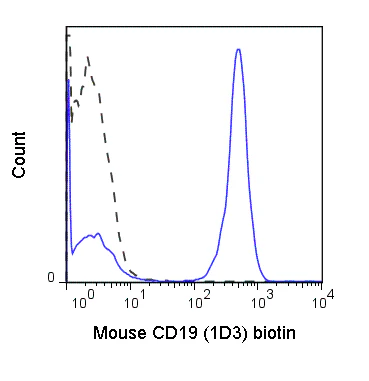
The 1D3 antibody reacts with mouse CD19, a 95 kDa glycoprotein which acts as a co-receptor, along with CD21 and CD81, in support of the functional B cell receptor (BCR). This complex provides antigen-specific recognition and subsequent activation of B cells to proliferate and differentiate into antibody-secreting cells (plasma cells) or memory B cells, which are crucial for secondary antigen encounter. CD19 is a lineage-differentiation marker, as its expression is detectable at the earliest B cell stages, through development, and is finally lost upon transition to mature plasma cells. The 1D3 antibody is widely used as a phenotypic marker for CD19 expression on B cells, as well as on dendritic cell subsets.
Recent Publications:
Daisuke Morichika, Akihiko Taniguchi, Naohiro Oda et al. Loss of IL-33 enhances elastase-induced and cigarette smoke extract-induced emphysema in mice. 04 August 2020. Research Square. https://doi.org/10.21203/rs.3.rs-52288/v1
Manz BN, Tan YX, Courtney A, Rutaganira F, Palmer E, Shokat KM and Weiss A. 2015. Elife. doi: 10.7554/eLife.08088. (Cell Separation)
Taniguchi A, Miyahara N, Waseda K, Kurimoto E, Fujii U, et al. 2015. Am J Physiol Lung Cell Mol Physiol. DOI: 10.1152/ajplung.00087.2015. (Flow Cytometry)
| Name | Biotin Anti-Mouse CD19 (1D3) |
|---|---|
| Cat. No. | 30-0193 |
| Alternative Names | Leu-12, B4 |
| Gene ID | 12478 |
| Clone | 1D3 |
| Isotype | Rat IgG2a, κ |
| Reactivity | Mouse |
| Format | Biotin |
| Application | Flow Cytometry |
Original: $38.00
-70%$38.00
$11.40Biotin Anti-Mouse CD19 (1D3)
The 1D3 antibody reacts with mouse CD19, a 95 kDa glycoprotein which acts as a co-receptor, along with CD21 and CD81, in support of the functional B cell receptor (BCR). This complex provides antigen-specific recognition and subsequent activation of B cells to proliferate and differentiate into antibody-secreting cells (plasma cells) or memory B cells, which are crucial for secondary antigen encounter. CD19 is a lineage-differentiation marker, as its expression is detectable at the earliest B cell stages, through development, and is finally lost upon transition to mature plasma cells. The 1D3 antibody is widely used as a phenotypic marker for CD19 expression on B cells, as well as on dendritic cell subsets.
Recent Publications:
Daisuke Morichika, Akihiko Taniguchi, Naohiro Oda et al. Loss of IL-33 enhances elastase-induced and cigarette smoke extract-induced emphysema in mice. 04 August 2020. Research Square. https://doi.org/10.21203/rs.3.rs-52288/v1
Manz BN, Tan YX, Courtney A, Rutaganira F, Palmer E, Shokat KM and Weiss A. 2015. Elife. doi: 10.7554/eLife.08088. (Cell Separation)
Taniguchi A, Miyahara N, Waseda K, Kurimoto E, Fujii U, et al. 2015. Am J Physiol Lung Cell Mol Physiol. DOI: 10.1152/ajplung.00087.2015. (Flow Cytometry)
| Name | Biotin Anti-Mouse CD19 (1D3) |
|---|---|
| Cat. No. | 30-0193 |
| Alternative Names | Leu-12, B4 |
| Gene ID | 12478 |
| Clone | 1D3 |
| Isotype | Rat IgG2a, κ |
| Reactivity | Mouse |
| Format | Biotin |
| Application | Flow Cytometry |
Product Information
Product Information
Shipping & Returns
Shipping & Returns
Description
The 1D3 antibody reacts with mouse CD19, a 95 kDa glycoprotein which acts as a co-receptor, along with CD21 and CD81, in support of the functional B cell receptor (BCR). This complex provides antigen-specific recognition and subsequent activation of B cells to proliferate and differentiate into antibody-secreting cells (plasma cells) or memory B cells, which are crucial for secondary antigen encounter. CD19 is a lineage-differentiation marker, as its expression is detectable at the earliest B cell stages, through development, and is finally lost upon transition to mature plasma cells. The 1D3 antibody is widely used as a phenotypic marker for CD19 expression on B cells, as well as on dendritic cell subsets.
Recent Publications:
Daisuke Morichika, Akihiko Taniguchi, Naohiro Oda et al. Loss of IL-33 enhances elastase-induced and cigarette smoke extract-induced emphysema in mice. 04 August 2020. Research Square. https://doi.org/10.21203/rs.3.rs-52288/v1
Manz BN, Tan YX, Courtney A, Rutaganira F, Palmer E, Shokat KM and Weiss A. 2015. Elife. doi: 10.7554/eLife.08088. (Cell Separation)
Taniguchi A, Miyahara N, Waseda K, Kurimoto E, Fujii U, et al. 2015. Am J Physiol Lung Cell Mol Physiol. DOI: 10.1152/ajplung.00087.2015. (Flow Cytometry)
| Name | Biotin Anti-Mouse CD19 (1D3) |
|---|---|
| Cat. No. | 30-0193 |
| Alternative Names | Leu-12, B4 |
| Gene ID | 12478 |
| Clone | 1D3 |
| Isotype | Rat IgG2a, κ |
| Reactivity | Mouse |
| Format | Biotin |
| Application | Flow Cytometry |