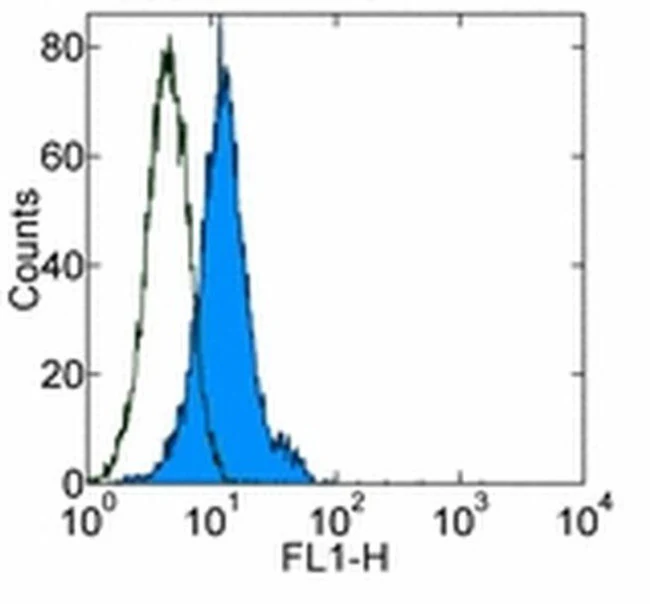
Zap-70 Monoclonal Antibody (1E7.2), eBioscience
PRODUCT DETAILS
Host: Mouse
Isotype: IgG1, kappa
Clonality: Monoclonal
Clone: 1E7.2
Reactivity: Hu, Ms
Application: Flow Cytometry
Tested Dilution: Assay-Dependent
Concentration: 0.5 mg/mL
Storage: 4°C
Formulation: PBS with 0.09% sodium azide; pH 7.2
Purification: Affinity chromatography
Data Sheet: TDS
Specific Information
Description: The 1E7.2 antibody reacts with human and mouse ZAP-70, the TCRζ-associated protein-70. ZAP-70 is a cytosolic protein tyrosine kinase (PTK) and a member of the Syk family of proteins. It is expressed in T and NK cells and is required for TCR signaling and development. ZAP-70 interacts with the TCR complex by binding to tyrosine-phosphorylated immunoreceptor tyrosine-based activation motifs (ITAMs) present in the invariant subunits of the TCR complex. Following activation, ZAP-70 is phosphorylated on several tyrosine residues by two mechanisms; an autophosphorylation and a transphosphorylation by the Src family tyrosine kinase Lck1-3. Tyrosine phosphorylation of ZAP-70 correlates to its increased kinase activity and triggers downstream signaling events. Mutations in ZAP-70 have been shown to result in a form of Severe Combined Immunodeficiency Syndrome (SCID) in humans. 1E7.2 was generated against a KLH-peptide sequence corresponding to the human ZAP-70 amino acid residues 282-307. While ZAP-70 is normally expressed in T and NK cells, several recent studies have also shown high correlation of ZAP-70 positive expression with mutated IgVH expression in B-chronic lymphocytic leukemia (CCL). In conclusion, the expression of ZAP-70, which can be measured by intracellular flow cytometry, may serve as a prognostic marker for B-CLL.
Applications Reported: The 1E7.2 antibody has been reported for use in intracellular staining followed by flow cytometric analysis, immunoprecipitation, and immunoblotting (WB). (Fluorochrome conjugated 1E7.2 is recommended for use in intracellular staining and flow cytometric analysis.).
Applications Tested: This 1E7.2 antibody has been tested by immunoblotting of mouse thymocyte and human Jurkat cell lysates. This can be used at less than or equal to 1 µg per test. A test is defined as the amount (µg) of antibody that will stain a cell sample in a final volume of 100 µL. Cell number should be determined empirically but can range from 10^5 to 10^8 cells/test. It is recommended that the antibody be carefully titrated for optimal performance in the assay of interest.
Purity: Greater than 90%, as determined by SDS-PAGE.
Aggregation: Less than 10%, as determined by HPLC.
Filtration: 0.2 µm post-manufacturing filtered.
For Research Use Only. Not for use in diagnostic procedures. Not for resale without express authorization.
Original: $253.00
-70%$253.00
$75.90Zap-70 Monoclonal Antibody (1E7.2), eBioscience
PRODUCT DETAILS
Host: Mouse
Isotype: IgG1, kappa
Clonality: Monoclonal
Clone: 1E7.2
Reactivity: Hu, Ms
Application: Flow Cytometry
Tested Dilution: Assay-Dependent
Concentration: 0.5 mg/mL
Storage: 4°C
Formulation: PBS with 0.09% sodium azide; pH 7.2
Purification: Affinity chromatography
Data Sheet: TDS
Specific Information
Description: The 1E7.2 antibody reacts with human and mouse ZAP-70, the TCRζ-associated protein-70. ZAP-70 is a cytosolic protein tyrosine kinase (PTK) and a member of the Syk family of proteins. It is expressed in T and NK cells and is required for TCR signaling and development. ZAP-70 interacts with the TCR complex by binding to tyrosine-phosphorylated immunoreceptor tyrosine-based activation motifs (ITAMs) present in the invariant subunits of the TCR complex. Following activation, ZAP-70 is phosphorylated on several tyrosine residues by two mechanisms; an autophosphorylation and a transphosphorylation by the Src family tyrosine kinase Lck1-3. Tyrosine phosphorylation of ZAP-70 correlates to its increased kinase activity and triggers downstream signaling events. Mutations in ZAP-70 have been shown to result in a form of Severe Combined Immunodeficiency Syndrome (SCID) in humans. 1E7.2 was generated against a KLH-peptide sequence corresponding to the human ZAP-70 amino acid residues 282-307. While ZAP-70 is normally expressed in T and NK cells, several recent studies have also shown high correlation of ZAP-70 positive expression with mutated IgVH expression in B-chronic lymphocytic leukemia (CCL). In conclusion, the expression of ZAP-70, which can be measured by intracellular flow cytometry, may serve as a prognostic marker for B-CLL.
Applications Reported: The 1E7.2 antibody has been reported for use in intracellular staining followed by flow cytometric analysis, immunoprecipitation, and immunoblotting (WB). (Fluorochrome conjugated 1E7.2 is recommended for use in intracellular staining and flow cytometric analysis.).
Applications Tested: This 1E7.2 antibody has been tested by immunoblotting of mouse thymocyte and human Jurkat cell lysates. This can be used at less than or equal to 1 µg per test. A test is defined as the amount (µg) of antibody that will stain a cell sample in a final volume of 100 µL. Cell number should be determined empirically but can range from 10^5 to 10^8 cells/test. It is recommended that the antibody be carefully titrated for optimal performance in the assay of interest.
Purity: Greater than 90%, as determined by SDS-PAGE.
Aggregation: Less than 10%, as determined by HPLC.
Filtration: 0.2 µm post-manufacturing filtered.
For Research Use Only. Not for use in diagnostic procedures. Not for resale without express authorization.
Product Information
Product Information
Shipping & Returns
Shipping & Returns
Description
PRODUCT DETAILS
Host: Mouse
Isotype: IgG1, kappa
Clonality: Monoclonal
Clone: 1E7.2
Reactivity: Hu, Ms
Application: Flow Cytometry
Tested Dilution: Assay-Dependent
Concentration: 0.5 mg/mL
Storage: 4°C
Formulation: PBS with 0.09% sodium azide; pH 7.2
Purification: Affinity chromatography
Data Sheet: TDS
Specific Information
Description: The 1E7.2 antibody reacts with human and mouse ZAP-70, the TCRζ-associated protein-70. ZAP-70 is a cytosolic protein tyrosine kinase (PTK) and a member of the Syk family of proteins. It is expressed in T and NK cells and is required for TCR signaling and development. ZAP-70 interacts with the TCR complex by binding to tyrosine-phosphorylated immunoreceptor tyrosine-based activation motifs (ITAMs) present in the invariant subunits of the TCR complex. Following activation, ZAP-70 is phosphorylated on several tyrosine residues by two mechanisms; an autophosphorylation and a transphosphorylation by the Src family tyrosine kinase Lck1-3. Tyrosine phosphorylation of ZAP-70 correlates to its increased kinase activity and triggers downstream signaling events. Mutations in ZAP-70 have been shown to result in a form of Severe Combined Immunodeficiency Syndrome (SCID) in humans. 1E7.2 was generated against a KLH-peptide sequence corresponding to the human ZAP-70 amino acid residues 282-307. While ZAP-70 is normally expressed in T and NK cells, several recent studies have also shown high correlation of ZAP-70 positive expression with mutated IgVH expression in B-chronic lymphocytic leukemia (CCL). In conclusion, the expression of ZAP-70, which can be measured by intracellular flow cytometry, may serve as a prognostic marker for B-CLL.
Applications Reported: The 1E7.2 antibody has been reported for use in intracellular staining followed by flow cytometric analysis, immunoprecipitation, and immunoblotting (WB). (Fluorochrome conjugated 1E7.2 is recommended for use in intracellular staining and flow cytometric analysis.).
Applications Tested: This 1E7.2 antibody has been tested by immunoblotting of mouse thymocyte and human Jurkat cell lysates. This can be used at less than or equal to 1 µg per test. A test is defined as the amount (µg) of antibody that will stain a cell sample in a final volume of 100 µL. Cell number should be determined empirically but can range from 10^5 to 10^8 cells/test. It is recommended that the antibody be carefully titrated for optimal performance in the assay of interest.
Purity: Greater than 90%, as determined by SDS-PAGE.
Aggregation: Less than 10%, as determined by HPLC.
Filtration: 0.2 µm post-manufacturing filtered.
For Research Use Only. Not for use in diagnostic procedures. Not for resale without express authorization.