ZAP-70 Monoclonal Antibody (1E7.2), Alexa Fluor 647, eBioscience
PRODUCT DETAILS
Host: Mouse
Isotype: IgG1, kappa
Clonality: Monoclonal
Clone: 1E7.2
Format: Alexa Fluor 647
Reactivity: Hu, Ms
Application: Flow Cytometry
Tested Dilution: 0.5 µg/test
Concentration: 0.2 mg/mL
Storage: 4°C, store in dark, DO NOT FREEZE!
Formulation: PBS with 0.09% sodium azide; pH 7.2
Purification: Affinity chromatography
Data Sheet: TDS
Specific Information
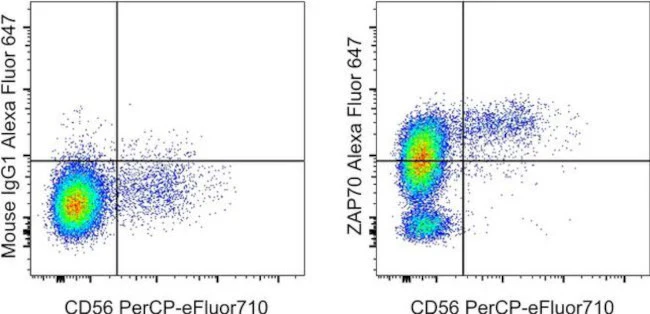
Description: The 1E7.2 antibody reacts with human and mouse ZAP-70, the TCR zeta-associated protein-70. ZAP-70 is a cytosolic protein tyrosine kinase (PTK) and a member of the Syk family of proteins. It is expressed in T and NK cells and is required for TCR signaling and development. ZAP-70 interacts with the TCR complex by binding to tyrosine-phosphorylated immunoreceptor tyrosine-based activation motifs (ITAMs) present in the invariant subunits of the TCR complex. Following activation, ZAP-70 is phosphorylated on several tyrosine residues by two mechanisms; an autophosphorylation and a transphosphorylation by the Src family tyrosine kinase Lck1-3. Tyrosine phosphorylation of ZAP-70 correlates to its increased kinase activity and triggers downstream signaling events. Mutations in ZAP-70 have been shown to result in a form of Severe Combined Immunodeficiency Syndrome (SCID) in humans. 1E7.2 was generated against a KLH-peptide sequence corresponding to the human ZAP-70 amino acid residues 282-307. While ZAP-70 is normally expressed in T and NK cells, several recent studies have also shown high correlation of ZAP-70 positive expression with mutated IgVH expression in B-chronic lymphocytic leukemia (CCL). In conclusion, the expression of ZAP-70, which can be measured by intracellular flow cytometry, may serve as a prognostic marker for B-CLL.
Applications Reported: The 1E7.2 antibody has been reported for use in intracellular flow cytometric analysis.
Applications Tested: This 1E7.2 antibody has been tested by intracellular flow cytometric analysis on normal human peripheral blood cells using the Foxp3/Transcription Factor Buffer Set (Product # 00-5523-00) and protocol. Please refer to BestProtocols®: Protocol B: One step protocol for (nuclear) intracellular proteins. This can be used at less than or equal to 0.5 µg per test. A test is defined as the amount (µg) of antibody that will stain a cell sample in a final volume of 100 µL. Cell number should be determined empirically but can range from 10^5 to 10^8 cells/test. It is recommended that the antibody be carefully titrated for optimal performance in the assay of interest.
Excitation: 633-647 nm; Emission: 668 nm; Laser: Red Laser.
For Research Use Only. Not for use in diagnostic procedures. Not for resale without express authorization.
Original: $400.00
-70%$400.00
$120.00ZAP-70 Monoclonal Antibody (1E7.2), Alexa Fluor 647, eBioscience
PRODUCT DETAILS
Host: Mouse
Isotype: IgG1, kappa
Clonality: Monoclonal
Clone: 1E7.2
Format: Alexa Fluor 647
Reactivity: Hu, Ms
Application: Flow Cytometry
Tested Dilution: 0.5 µg/test
Concentration: 0.2 mg/mL
Storage: 4°C, store in dark, DO NOT FREEZE!
Formulation: PBS with 0.09% sodium azide; pH 7.2
Purification: Affinity chromatography
Data Sheet: TDS
Specific Information
Description: The 1E7.2 antibody reacts with human and mouse ZAP-70, the TCR zeta-associated protein-70. ZAP-70 is a cytosolic protein tyrosine kinase (PTK) and a member of the Syk family of proteins. It is expressed in T and NK cells and is required for TCR signaling and development. ZAP-70 interacts with the TCR complex by binding to tyrosine-phosphorylated immunoreceptor tyrosine-based activation motifs (ITAMs) present in the invariant subunits of the TCR complex. Following activation, ZAP-70 is phosphorylated on several tyrosine residues by two mechanisms; an autophosphorylation and a transphosphorylation by the Src family tyrosine kinase Lck1-3. Tyrosine phosphorylation of ZAP-70 correlates to its increased kinase activity and triggers downstream signaling events. Mutations in ZAP-70 have been shown to result in a form of Severe Combined Immunodeficiency Syndrome (SCID) in humans. 1E7.2 was generated against a KLH-peptide sequence corresponding to the human ZAP-70 amino acid residues 282-307. While ZAP-70 is normally expressed in T and NK cells, several recent studies have also shown high correlation of ZAP-70 positive expression with mutated IgVH expression in B-chronic lymphocytic leukemia (CCL). In conclusion, the expression of ZAP-70, which can be measured by intracellular flow cytometry, may serve as a prognostic marker for B-CLL.
Applications Reported: The 1E7.2 antibody has been reported for use in intracellular flow cytometric analysis.
Applications Tested: This 1E7.2 antibody has been tested by intracellular flow cytometric analysis on normal human peripheral blood cells using the Foxp3/Transcription Factor Buffer Set (Product # 00-5523-00) and protocol. Please refer to BestProtocols®: Protocol B: One step protocol for (nuclear) intracellular proteins. This can be used at less than or equal to 0.5 µg per test. A test is defined as the amount (µg) of antibody that will stain a cell sample in a final volume of 100 µL. Cell number should be determined empirically but can range from 10^5 to 10^8 cells/test. It is recommended that the antibody be carefully titrated for optimal performance in the assay of interest.
Excitation: 633-647 nm; Emission: 668 nm; Laser: Red Laser.
For Research Use Only. Not for use in diagnostic procedures. Not for resale without express authorization.
Product Information
Product Information
Shipping & Returns
Shipping & Returns
Description
PRODUCT DETAILS
Host: Mouse
Isotype: IgG1, kappa
Clonality: Monoclonal
Clone: 1E7.2
Format: Alexa Fluor 647
Reactivity: Hu, Ms
Application: Flow Cytometry
Tested Dilution: 0.5 µg/test
Concentration: 0.2 mg/mL
Storage: 4°C, store in dark, DO NOT FREEZE!
Formulation: PBS with 0.09% sodium azide; pH 7.2
Purification: Affinity chromatography
Data Sheet: TDS
Specific Information
Description: The 1E7.2 antibody reacts with human and mouse ZAP-70, the TCR zeta-associated protein-70. ZAP-70 is a cytosolic protein tyrosine kinase (PTK) and a member of the Syk family of proteins. It is expressed in T and NK cells and is required for TCR signaling and development. ZAP-70 interacts with the TCR complex by binding to tyrosine-phosphorylated immunoreceptor tyrosine-based activation motifs (ITAMs) present in the invariant subunits of the TCR complex. Following activation, ZAP-70 is phosphorylated on several tyrosine residues by two mechanisms; an autophosphorylation and a transphosphorylation by the Src family tyrosine kinase Lck1-3. Tyrosine phosphorylation of ZAP-70 correlates to its increased kinase activity and triggers downstream signaling events. Mutations in ZAP-70 have been shown to result in a form of Severe Combined Immunodeficiency Syndrome (SCID) in humans. 1E7.2 was generated against a KLH-peptide sequence corresponding to the human ZAP-70 amino acid residues 282-307. While ZAP-70 is normally expressed in T and NK cells, several recent studies have also shown high correlation of ZAP-70 positive expression with mutated IgVH expression in B-chronic lymphocytic leukemia (CCL). In conclusion, the expression of ZAP-70, which can be measured by intracellular flow cytometry, may serve as a prognostic marker for B-CLL.
Applications Reported: The 1E7.2 antibody has been reported for use in intracellular flow cytometric analysis.
Applications Tested: This 1E7.2 antibody has been tested by intracellular flow cytometric analysis on normal human peripheral blood cells using the Foxp3/Transcription Factor Buffer Set (Product # 00-5523-00) and protocol. Please refer to BestProtocols®: Protocol B: One step protocol for (nuclear) intracellular proteins. This can be used at less than or equal to 0.5 µg per test. A test is defined as the amount (µg) of antibody that will stain a cell sample in a final volume of 100 µL. Cell number should be determined empirically but can range from 10^5 to 10^8 cells/test. It is recommended that the antibody be carefully titrated for optimal performance in the assay of interest.
Excitation: 633-647 nm; Emission: 668 nm; Laser: Red Laser.
For Research Use Only. Not for use in diagnostic procedures. Not for resale without express authorization.