TIGIT Recombinant Mouse Monoclonal Antibody (MBSA43)
PRODUCT DETAILS
Host: Mouse
Isotype: IgG1, kappa
Clonality: Recombinant Monoclonal
Clone: MBSA43
Reactivity: Hu
Application: Flow Cytometry
Tested Dilution: 0.25 µg/test
Concentration: 1.0 mg/mL
Storage: Store at 4°C short term. For long term storage, store at -20°C, avoiding freeze/thaw cycles.
Formulation: PBS with 0.09% sodium azide; pH 7.4
Purification: Protein A/G
Data Sheet: TDS
Specific Information
Recombinant antibodies are produced using specific genes that code for the desired antibodies. These genes are cloned into an expression vector and expressed in vitro. The advantages of recombinant antibodies include better specificity and lot-to-lot consistency.
Description: The MBSA43 mouse monoclonal recombinant antibody reacts with human T cell immunoreceptor with Ig and ITIM domains (TIGIT), which is also known as VSTM3 or WUCAM. This 26 kDa protein is a member of the poliovirus receptor (PVR) family. The expression of TIGIT has been reported on NK cells, regulatory T cells, follicular T helper cells, memory CD4+ T cells, and CD8+ T cells, but it is not expressed on B cells or naive CD4+ T cells. TIGIT may be upregulated on naive CD4+ T cells upon activation. TIGIT can interact with certain members of the PVR and PVR-like families, including CD155, and also mediates the interaction of NK and T cells with antigen presenting cells, fibroblasts, and endothelial cells that express PVR and PVR-like proteins.
MBSA43 is reported to crossreact with Rhesus macaque.
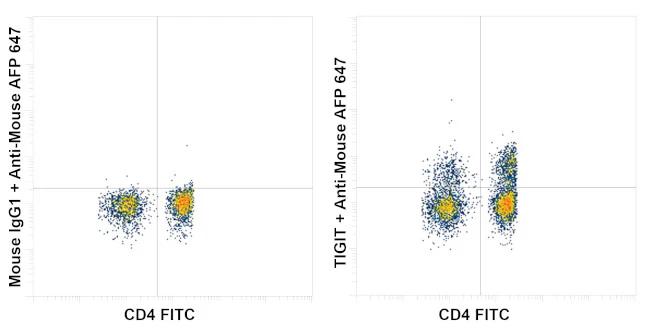
Applications Tested: This MBSA43 antibody has been tested by flow cytometric analysis of human PBMCs. This may be used at less than or equal to 0.25 µg per test. A test is defined as the amount (µg) of antibody that will stain a cell sample in a final volume of 100 µL. Cell number should be determined empirically but can range from 10^5 to 10^8 cells/test. It is recommended that the antibody be carefully titrated for optimal performance in the assay of interest.
Filtration: 0.2 µm post-manufacturing filtered.
For Research Use Only. Not for use in diagnostic procedures. Not for resale without express authorization.
TIGIT Recombinant Mouse Monoclonal Antibody (MBSA43)
PRODUCT DETAILS
Host: Mouse
Isotype: IgG1, kappa
Clonality: Recombinant Monoclonal
Clone: MBSA43
Reactivity: Hu
Application: Flow Cytometry
Tested Dilution: 0.25 µg/test
Concentration: 1.0 mg/mL
Storage: Store at 4°C short term. For long term storage, store at -20°C, avoiding freeze/thaw cycles.
Formulation: PBS with 0.09% sodium azide; pH 7.4
Purification: Protein A/G
Data Sheet: TDS
Specific Information
Recombinant antibodies are produced using specific genes that code for the desired antibodies. These genes are cloned into an expression vector and expressed in vitro. The advantages of recombinant antibodies include better specificity and lot-to-lot consistency.
Description: The MBSA43 mouse monoclonal recombinant antibody reacts with human T cell immunoreceptor with Ig and ITIM domains (TIGIT), which is also known as VSTM3 or WUCAM. This 26 kDa protein is a member of the poliovirus receptor (PVR) family. The expression of TIGIT has been reported on NK cells, regulatory T cells, follicular T helper cells, memory CD4+ T cells, and CD8+ T cells, but it is not expressed on B cells or naive CD4+ T cells. TIGIT may be upregulated on naive CD4+ T cells upon activation. TIGIT can interact with certain members of the PVR and PVR-like families, including CD155, and also mediates the interaction of NK and T cells with antigen presenting cells, fibroblasts, and endothelial cells that express PVR and PVR-like proteins.
MBSA43 is reported to crossreact with Rhesus macaque.
Applications Tested: This MBSA43 antibody has been tested by flow cytometric analysis of human PBMCs. This may be used at less than or equal to 0.25 µg per test. A test is defined as the amount (µg) of antibody that will stain a cell sample in a final volume of 100 µL. Cell number should be determined empirically but can range from 10^5 to 10^8 cells/test. It is recommended that the antibody be carefully titrated for optimal performance in the assay of interest.
Filtration: 0.2 µm post-manufacturing filtered.
For Research Use Only. Not for use in diagnostic procedures. Not for resale without express authorization.
Product Information
Product Information
Shipping & Returns
Shipping & Returns
Description
PRODUCT DETAILS
Host: Mouse
Isotype: IgG1, kappa
Clonality: Recombinant Monoclonal
Clone: MBSA43
Reactivity: Hu
Application: Flow Cytometry
Tested Dilution: 0.25 µg/test
Concentration: 1.0 mg/mL
Storage: Store at 4°C short term. For long term storage, store at -20°C, avoiding freeze/thaw cycles.
Formulation: PBS with 0.09% sodium azide; pH 7.4
Purification: Protein A/G
Data Sheet: TDS
Specific Information
Recombinant antibodies are produced using specific genes that code for the desired antibodies. These genes are cloned into an expression vector and expressed in vitro. The advantages of recombinant antibodies include better specificity and lot-to-lot consistency.
Description: The MBSA43 mouse monoclonal recombinant antibody reacts with human T cell immunoreceptor with Ig and ITIM domains (TIGIT), which is also known as VSTM3 or WUCAM. This 26 kDa protein is a member of the poliovirus receptor (PVR) family. The expression of TIGIT has been reported on NK cells, regulatory T cells, follicular T helper cells, memory CD4+ T cells, and CD8+ T cells, but it is not expressed on B cells or naive CD4+ T cells. TIGIT may be upregulated on naive CD4+ T cells upon activation. TIGIT can interact with certain members of the PVR and PVR-like families, including CD155, and also mediates the interaction of NK and T cells with antigen presenting cells, fibroblasts, and endothelial cells that express PVR and PVR-like proteins.
MBSA43 is reported to crossreact with Rhesus macaque.
Applications Tested: This MBSA43 antibody has been tested by flow cytometric analysis of human PBMCs. This may be used at less than or equal to 0.25 µg per test. A test is defined as the amount (µg) of antibody that will stain a cell sample in a final volume of 100 µL. Cell number should be determined empirically but can range from 10^5 to 10^8 cells/test. It is recommended that the antibody be carefully titrated for optimal performance in the assay of interest.
Filtration: 0.2 µm post-manufacturing filtered.
For Research Use Only. Not for use in diagnostic procedures. Not for resale without express authorization.