TCR V alpha 24 J alpha 18 Monoclonal Antibody (6B11), Biotin, eBioscience
PRODUCT DETAILS
Host: Mouse
Isotype: IgG1, kappa
Clonality: Monoclonal
Clone: 6B11
Format: Biotin
Reactivity: Hu
Application: Flow Cytometry
Tested Dilution: 1 µg/test
Concentration: 0.5 mg/mL
Storage: 4°C, store in dark, DO NOT FREEZE!
Formulation: PBS with 0.09% sodium azide; pH 7.2
Purification: Affinity chromatography
Data Sheet: TDS
Specific Information
Description: The 6B11 monoclonal antibody reacts with an epitope of the CDR3 formed by the germ-line configuration of the V alpha 24 and J alpha 18 of the TCR alpha locus, which results in the expression of an invariant T-cell receptor (TCR) expressed by invariant NK T cells (iNKT). This TCR is homologous to the murine V alpha 14J alpha 18. This TCR alpha chain pairs with a restricted set of rearranged TCR beta chains, with V beta 11 being the most prominent in humans. NK T cells are restricted by the CD1d molecule and are activated by a CD1d-presented glycolipid ligand, which results in the rapid production of IL-4, IL-13 and IFN gamma. Although iNKT cells have NK-like cytolytic activity, they are considered regulators of immune responses because they rapidly produce large amounts of both Th1 and Th2 cytokines in autoimmune disease, infectious disease, and cancer. The number of iNKT cells present in peripheral blood of normal humans shows considerable variability ranging from 0.01-1% of total peripheral T cells.
Applications Reported: This 6B11 antibody has been reported for use in flow cytometric analysis.
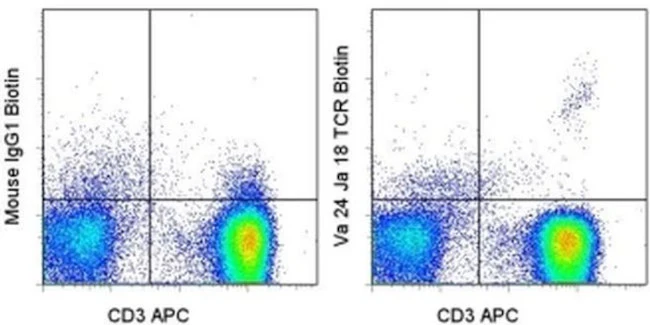
Applications Tested: This 6B11 antibody has been tested by flow cytometric analysis of normal human peripheral blood cells. This can be used at less than or equal to 1 µg per test. A test is defined as the amount (µg) of antibody that will stain a cell sample in a final volume of 100 µL. Cell number should be determined empirically but can range from 10^5 to 10^8 cells/test. It is recommended that the antibody be carefully titrated for optimal performance in the assay of interest.
Filtration: 0.2 µm post-manufacturing filtered.
For Research Use Only. Not for use in diagnostic procedures. Not for resale without express authorization.
TCR V alpha 24 J alpha 18 Monoclonal Antibody (6B11), Biotin, eBioscience
PRODUCT DETAILS
Host: Mouse
Isotype: IgG1, kappa
Clonality: Monoclonal
Clone: 6B11
Format: Biotin
Reactivity: Hu
Application: Flow Cytometry
Tested Dilution: 1 µg/test
Concentration: 0.5 mg/mL
Storage: 4°C, store in dark, DO NOT FREEZE!
Formulation: PBS with 0.09% sodium azide; pH 7.2
Purification: Affinity chromatography
Data Sheet: TDS
Specific Information
Description: The 6B11 monoclonal antibody reacts with an epitope of the CDR3 formed by the germ-line configuration of the V alpha 24 and J alpha 18 of the TCR alpha locus, which results in the expression of an invariant T-cell receptor (TCR) expressed by invariant NK T cells (iNKT). This TCR is homologous to the murine V alpha 14J alpha 18. This TCR alpha chain pairs with a restricted set of rearranged TCR beta chains, with V beta 11 being the most prominent in humans. NK T cells are restricted by the CD1d molecule and are activated by a CD1d-presented glycolipid ligand, which results in the rapid production of IL-4, IL-13 and IFN gamma. Although iNKT cells have NK-like cytolytic activity, they are considered regulators of immune responses because they rapidly produce large amounts of both Th1 and Th2 cytokines in autoimmune disease, infectious disease, and cancer. The number of iNKT cells present in peripheral blood of normal humans shows considerable variability ranging from 0.01-1% of total peripheral T cells.
Applications Reported: This 6B11 antibody has been reported for use in flow cytometric analysis.
Applications Tested: This 6B11 antibody has been tested by flow cytometric analysis of normal human peripheral blood cells. This can be used at less than or equal to 1 µg per test. A test is defined as the amount (µg) of antibody that will stain a cell sample in a final volume of 100 µL. Cell number should be determined empirically but can range from 10^5 to 10^8 cells/test. It is recommended that the antibody be carefully titrated for optimal performance in the assay of interest.
Filtration: 0.2 µm post-manufacturing filtered.
For Research Use Only. Not for use in diagnostic procedures. Not for resale without express authorization.
Product Information
Product Information
Shipping & Returns
Shipping & Returns
Description
PRODUCT DETAILS
Host: Mouse
Isotype: IgG1, kappa
Clonality: Monoclonal
Clone: 6B11
Format: Biotin
Reactivity: Hu
Application: Flow Cytometry
Tested Dilution: 1 µg/test
Concentration: 0.5 mg/mL
Storage: 4°C, store in dark, DO NOT FREEZE!
Formulation: PBS with 0.09% sodium azide; pH 7.2
Purification: Affinity chromatography
Data Sheet: TDS
Specific Information
Description: The 6B11 monoclonal antibody reacts with an epitope of the CDR3 formed by the germ-line configuration of the V alpha 24 and J alpha 18 of the TCR alpha locus, which results in the expression of an invariant T-cell receptor (TCR) expressed by invariant NK T cells (iNKT). This TCR is homologous to the murine V alpha 14J alpha 18. This TCR alpha chain pairs with a restricted set of rearranged TCR beta chains, with V beta 11 being the most prominent in humans. NK T cells are restricted by the CD1d molecule and are activated by a CD1d-presented glycolipid ligand, which results in the rapid production of IL-4, IL-13 and IFN gamma. Although iNKT cells have NK-like cytolytic activity, they are considered regulators of immune responses because they rapidly produce large amounts of both Th1 and Th2 cytokines in autoimmune disease, infectious disease, and cancer. The number of iNKT cells present in peripheral blood of normal humans shows considerable variability ranging from 0.01-1% of total peripheral T cells.
Applications Reported: This 6B11 antibody has been reported for use in flow cytometric analysis.
Applications Tested: This 6B11 antibody has been tested by flow cytometric analysis of normal human peripheral blood cells. This can be used at less than or equal to 1 µg per test. A test is defined as the amount (µg) of antibody that will stain a cell sample in a final volume of 100 µL. Cell number should be determined empirically but can range from 10^5 to 10^8 cells/test. It is recommended that the antibody be carefully titrated for optimal performance in the assay of interest.
Filtration: 0.2 µm post-manufacturing filtered.
For Research Use Only. Not for use in diagnostic procedures. Not for resale without express authorization.