Podoplanin Monoclonal Antibody (eBio8.1.1 (8.1.1)), eFluor 660, eBioscience
PRODUCT DETAILS
Host: Syrian Hamster
Isotype: IgG
Clonality: Monoclonal
Clone: eBio8.1.1 (8.1.1)
Format: eFluor 660
Reactivity: Ms
Application: Flow Cytometry
Tested Dilution: 0.125 µg/test
Concentration: 0.2 mg/mL
Storage: 4°C, store in dark, DO NOT FREEZE!
Formulation: PBS with 0.09% sodium azide; pH 7.2
Purification: Affinity chromatography
Data Sheet: TDS
Specific Information
Description: The 8.1.1 monoclonal antibody reacts with mouse podoplanin (T1a, gp38, aggrus), a 43 kDa transmembrane glycoprotein, named for its expression in kidney glomerular epithelial cells (podocytes). In addition, Podoplanin is expressed in epithelial and mesothelial cells such as intestinal epithelium, alveolar type I cells, podocytes, and mesothelium of the visceral peritoneum. It was also shown to be a potent marker for lymphatic endothelium. Podoplanin is also expressed by subcapsular epithelial cells of the murine thymus. Mice deficient in Podoplanin die at birth because of a respiratory defect and congenital lymphedema due to a failure in lymphatic pattern formation.
Applications Reported: This eBio8.1.1 (8.1.1) antibody has been reported for use in flow cytometric analysis.
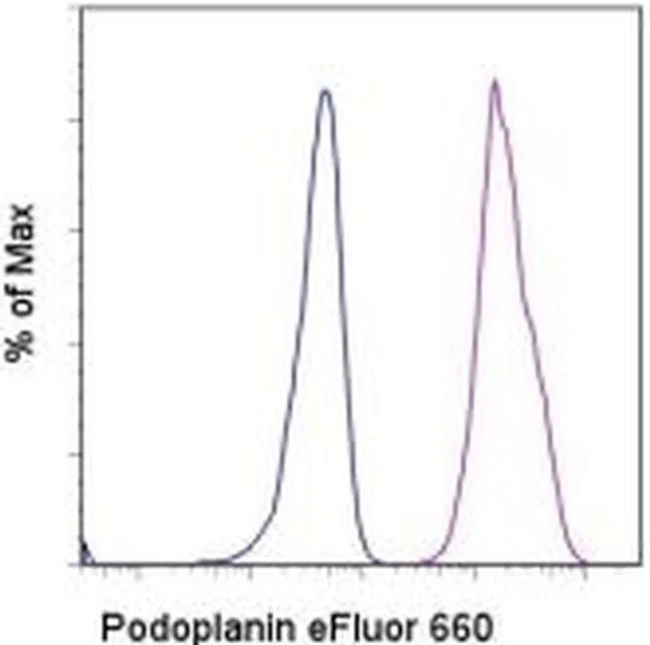
Applications Tested: This eBio8.1.1 (8.1.1) antibody has been tested by flow cytometric analysis of the TE-71 cell line. This can be used at less than or equal to 0.125 µg per test. A test is defined as the amount (µg) of antibody that will stain a cell sample in a final volume of 100 µL. Cell number should be determined empirically but can range from 10^5 to 10^8 cells/test. It is recommended that the antibody be carefully titrated for optimal performance in the assay of interest.
eFluor™ 660 is a replacement for Alexa Fluor™ 647. eFluor™ 660 emits at 659 nm and is excited with the red laser (633 nm). Please make sure that your instrument is capable of detecting this fluorochome.
Excitation: 633-647 nm; Emission: 668 nm; Laser: Red Laser.
Filtration: 0.2 µm post-manufacturing filtered.
For Research Use Only. Not for use in diagnostic procedures. Not for resale without express authorization.
Podoplanin Monoclonal Antibody (eBio8.1.1 (8.1.1)), eFluor 660, eBioscience
PRODUCT DETAILS
Host: Syrian Hamster
Isotype: IgG
Clonality: Monoclonal
Clone: eBio8.1.1 (8.1.1)
Format: eFluor 660
Reactivity: Ms
Application: Flow Cytometry
Tested Dilution: 0.125 µg/test
Concentration: 0.2 mg/mL
Storage: 4°C, store in dark, DO NOT FREEZE!
Formulation: PBS with 0.09% sodium azide; pH 7.2
Purification: Affinity chromatography
Data Sheet: TDS
Specific Information
Description: The 8.1.1 monoclonal antibody reacts with mouse podoplanin (T1a, gp38, aggrus), a 43 kDa transmembrane glycoprotein, named for its expression in kidney glomerular epithelial cells (podocytes). In addition, Podoplanin is expressed in epithelial and mesothelial cells such as intestinal epithelium, alveolar type I cells, podocytes, and mesothelium of the visceral peritoneum. It was also shown to be a potent marker for lymphatic endothelium. Podoplanin is also expressed by subcapsular epithelial cells of the murine thymus. Mice deficient in Podoplanin die at birth because of a respiratory defect and congenital lymphedema due to a failure in lymphatic pattern formation.
Applications Reported: This eBio8.1.1 (8.1.1) antibody has been reported for use in flow cytometric analysis.
Applications Tested: This eBio8.1.1 (8.1.1) antibody has been tested by flow cytometric analysis of the TE-71 cell line. This can be used at less than or equal to 0.125 µg per test. A test is defined as the amount (µg) of antibody that will stain a cell sample in a final volume of 100 µL. Cell number should be determined empirically but can range from 10^5 to 10^8 cells/test. It is recommended that the antibody be carefully titrated for optimal performance in the assay of interest.
eFluor™ 660 is a replacement for Alexa Fluor™ 647. eFluor™ 660 emits at 659 nm and is excited with the red laser (633 nm). Please make sure that your instrument is capable of detecting this fluorochome.
Excitation: 633-647 nm; Emission: 668 nm; Laser: Red Laser.
Filtration: 0.2 µm post-manufacturing filtered.
For Research Use Only. Not for use in diagnostic procedures. Not for resale without express authorization.
Product Information
Product Information
Shipping & Returns
Shipping & Returns
Description
PRODUCT DETAILS
Host: Syrian Hamster
Isotype: IgG
Clonality: Monoclonal
Clone: eBio8.1.1 (8.1.1)
Format: eFluor 660
Reactivity: Ms
Application: Flow Cytometry
Tested Dilution: 0.125 µg/test
Concentration: 0.2 mg/mL
Storage: 4°C, store in dark, DO NOT FREEZE!
Formulation: PBS with 0.09% sodium azide; pH 7.2
Purification: Affinity chromatography
Data Sheet: TDS
Specific Information
Description: The 8.1.1 monoclonal antibody reacts with mouse podoplanin (T1a, gp38, aggrus), a 43 kDa transmembrane glycoprotein, named for its expression in kidney glomerular epithelial cells (podocytes). In addition, Podoplanin is expressed in epithelial and mesothelial cells such as intestinal epithelium, alveolar type I cells, podocytes, and mesothelium of the visceral peritoneum. It was also shown to be a potent marker for lymphatic endothelium. Podoplanin is also expressed by subcapsular epithelial cells of the murine thymus. Mice deficient in Podoplanin die at birth because of a respiratory defect and congenital lymphedema due to a failure in lymphatic pattern formation.
Applications Reported: This eBio8.1.1 (8.1.1) antibody has been reported for use in flow cytometric analysis.
Applications Tested: This eBio8.1.1 (8.1.1) antibody has been tested by flow cytometric analysis of the TE-71 cell line. This can be used at less than or equal to 0.125 µg per test. A test is defined as the amount (µg) of antibody that will stain a cell sample in a final volume of 100 µL. Cell number should be determined empirically but can range from 10^5 to 10^8 cells/test. It is recommended that the antibody be carefully titrated for optimal performance in the assay of interest.
eFluor™ 660 is a replacement for Alexa Fluor™ 647. eFluor™ 660 emits at 659 nm and is excited with the red laser (633 nm). Please make sure that your instrument is capable of detecting this fluorochome.
Excitation: 633-647 nm; Emission: 668 nm; Laser: Red Laser.
Filtration: 0.2 µm post-manufacturing filtered.
For Research Use Only. Not for use in diagnostic procedures. Not for resale without express authorization.