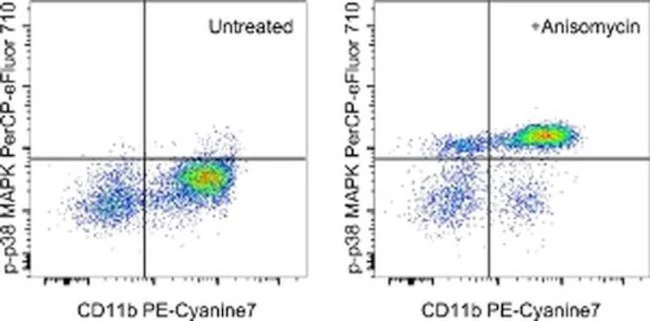
Phospho-p38 MAPK (Thr180, Tyr182) Monoclonal Antibody (4NIT4KK), PerCP-eFluor 710, eBioscience
Phospho-p38 MAPK (Thr180, Tyr182) Monoclonal Antibody (4NIT4KK), PerCP-eFluor 710, eBioscience
PRODUCT DETAILS
Host: Mouse
Isotype: IgG2b, kappa
Clonality: Monoclonal
Clone: 4NIT4KK
Format: PerCP-eFluor 710
Reactivity: Hu, Ms
Application: Flow Cytometry
Tested Dilution: 5 µL (0.03 µg)/test
Concentration: 5 μL/Test
Storage: 4°C, store in dark, DO NOT FREEZE!
Formulation: PBS with BSA and 0.09% sodium azide; pH 7.2
Purification: Affinity chromatography
Data Sheet: TDS
Specific Information
Description: This 4NIT4KK monoclonal antibody recognizes human and mouse p38 mitogen-activated protein kinase (MAPK) when phosphorylated on T180/Y182. p38 MAPK belongs to a family of conserved serine/threonine protein kinases that are phosphorylated and activated in response to numerous stress stimuli including TLR ligands (such as LPS), osmotic shock, heat shock, UV irradiation, and inflammatory cytokines. There are four p38 MAPK members that include p38 alpha, p38 beta, p38 gamma, and p38 delta. The primary activators of p38 MAPK are MKK3/4 and MKK6. Several downstream targets of p38 MAPK have been identified including MK2/3, p53, ATF-2, and ETS1. p38 MAPK can be negatively regulated by the chemical inhibitor SB203580. Specificity of this 4NIT4KK clone was determined by ELISA, flow cytometry, and western blotting.
Applications Reported: This 4NIT4KK antibody has been reported for use in intracellular staining followed by flow cytometric analysis.
Applications Tested: This 4NIT4KK antibody has been pre-titrated and tested by intracellular staining followed by flow cytometric analysis of stimulated normal human peripheral blood cells. This can be used at 5 µL (0.03 µg) per test. A test is defined as the amount (µg) of antibody that will stain a cell sample in a final volume of 100 µL. Cell number should be determined empirically but can range from 10^5 to 10^8 cells/test.
Staining Protocol: All protocols work well for this monoclonal antibody. Use of Protocol A: Two-step protocol: intracellular (cytoplasmic) proteins allows for the greatest flexibility for detection of surface and intracellular (cytoplasmic) proteins. Use of Protocol B: One-step protocol: intracellular (nuclear) proteins is recommended for staining of transcription factors in conjunction with surface and phosphorylated intracellular (cytoplasmic) proteins. Protocol C: Two-step protocol: Fixation/Methanol allows for the greatest discrimination of phospho-specific signaling between unstimulated and stimulated samples, but with limitations on the ability to stain specific surface proteins (refer to "Clone Performance Following Fixation/Permeabilization" located in the BestProtocols Section under the Resources tab online). All Protocols can be found in the Flow Cytometry Protocols: "Staining Intracellular Antigens for Flow Cytometry Protocol" located in the BestProtocols® Section under the Resources tab online.
PerCP-eFluor® 710 emits at 710 nm and is excited with the blue laser (488 nm); it can be used in place of PerCP-Cyanine5.5. We recommend using a 710/50 bandpass filter, however, the 695/40 bandpass filter is an acceptable alternative. Please make sure that your instrument is capable of detecting this fluorochrome.
Light sensitivity: This tandem dye is sensitive to photo-induced oxidation. Please protect this vial and stained samples from light.
Fixation: Samples can be stored in IC Fixation Buffer (Product # 00-8222) (100 µL of cell sample + 100 µL of IC Fixation Buffer) or 1-step Fix/Lyse Solution (Product # 00-5333) for up to 3 days in the dark at 4°C with minimal impact on brightness and FRET efficiency/compensation. Some generalizations regarding fluorophore performance after fixation can be made, but clone specific performance should be determined empirically.
Excitation: 488 nm; Emission: 710 nm; Laser: Blue Laser.
Filtration: 0.2 µm post-manufacturing filtered.
For Research Use Only. Not for use in diagnostic procedures. Not for resale without express authorization.
Original: $429.00
-70%$429.00
$128.70Phospho-p38 MAPK (Thr180, Tyr182) Monoclonal Antibody (4NIT4KK), PerCP-eFluor 710, eBioscience
PRODUCT DETAILS
Host: Mouse
Isotype: IgG2b, kappa
Clonality: Monoclonal
Clone: 4NIT4KK
Format: PerCP-eFluor 710
Reactivity: Hu, Ms
Application: Flow Cytometry
Tested Dilution: 5 µL (0.03 µg)/test
Concentration: 5 μL/Test
Storage: 4°C, store in dark, DO NOT FREEZE!
Formulation: PBS with BSA and 0.09% sodium azide; pH 7.2
Purification: Affinity chromatography
Data Sheet: TDS
Specific Information
Description: This 4NIT4KK monoclonal antibody recognizes human and mouse p38 mitogen-activated protein kinase (MAPK) when phosphorylated on T180/Y182. p38 MAPK belongs to a family of conserved serine/threonine protein kinases that are phosphorylated and activated in response to numerous stress stimuli including TLR ligands (such as LPS), osmotic shock, heat shock, UV irradiation, and inflammatory cytokines. There are four p38 MAPK members that include p38 alpha, p38 beta, p38 gamma, and p38 delta. The primary activators of p38 MAPK are MKK3/4 and MKK6. Several downstream targets of p38 MAPK have been identified including MK2/3, p53, ATF-2, and ETS1. p38 MAPK can be negatively regulated by the chemical inhibitor SB203580. Specificity of this 4NIT4KK clone was determined by ELISA, flow cytometry, and western blotting.
Applications Reported: This 4NIT4KK antibody has been reported for use in intracellular staining followed by flow cytometric analysis.
Applications Tested: This 4NIT4KK antibody has been pre-titrated and tested by intracellular staining followed by flow cytometric analysis of stimulated normal human peripheral blood cells. This can be used at 5 µL (0.03 µg) per test. A test is defined as the amount (µg) of antibody that will stain a cell sample in a final volume of 100 µL. Cell number should be determined empirically but can range from 10^5 to 10^8 cells/test.
Staining Protocol: All protocols work well for this monoclonal antibody. Use of Protocol A: Two-step protocol: intracellular (cytoplasmic) proteins allows for the greatest flexibility for detection of surface and intracellular (cytoplasmic) proteins. Use of Protocol B: One-step protocol: intracellular (nuclear) proteins is recommended for staining of transcription factors in conjunction with surface and phosphorylated intracellular (cytoplasmic) proteins. Protocol C: Two-step protocol: Fixation/Methanol allows for the greatest discrimination of phospho-specific signaling between unstimulated and stimulated samples, but with limitations on the ability to stain specific surface proteins (refer to "Clone Performance Following Fixation/Permeabilization" located in the BestProtocols Section under the Resources tab online). All Protocols can be found in the Flow Cytometry Protocols: "Staining Intracellular Antigens for Flow Cytometry Protocol" located in the BestProtocols® Section under the Resources tab online.
PerCP-eFluor® 710 emits at 710 nm and is excited with the blue laser (488 nm); it can be used in place of PerCP-Cyanine5.5. We recommend using a 710/50 bandpass filter, however, the 695/40 bandpass filter is an acceptable alternative. Please make sure that your instrument is capable of detecting this fluorochrome.
Light sensitivity: This tandem dye is sensitive to photo-induced oxidation. Please protect this vial and stained samples from light.
Fixation: Samples can be stored in IC Fixation Buffer (Product # 00-8222) (100 µL of cell sample + 100 µL of IC Fixation Buffer) or 1-step Fix/Lyse Solution (Product # 00-5333) for up to 3 days in the dark at 4°C with minimal impact on brightness and FRET efficiency/compensation. Some generalizations regarding fluorophore performance after fixation can be made, but clone specific performance should be determined empirically.
Excitation: 488 nm; Emission: 710 nm; Laser: Blue Laser.
Filtration: 0.2 µm post-manufacturing filtered.
For Research Use Only. Not for use in diagnostic procedures. Not for resale without express authorization.
Product Information
Product Information
Shipping & Returns
Shipping & Returns
Description
PRODUCT DETAILS
Host: Mouse
Isotype: IgG2b, kappa
Clonality: Monoclonal
Clone: 4NIT4KK
Format: PerCP-eFluor 710
Reactivity: Hu, Ms
Application: Flow Cytometry
Tested Dilution: 5 µL (0.03 µg)/test
Concentration: 5 μL/Test
Storage: 4°C, store in dark, DO NOT FREEZE!
Formulation: PBS with BSA and 0.09% sodium azide; pH 7.2
Purification: Affinity chromatography
Data Sheet: TDS
Specific Information
Description: This 4NIT4KK monoclonal antibody recognizes human and mouse p38 mitogen-activated protein kinase (MAPK) when phosphorylated on T180/Y182. p38 MAPK belongs to a family of conserved serine/threonine protein kinases that are phosphorylated and activated in response to numerous stress stimuli including TLR ligands (such as LPS), osmotic shock, heat shock, UV irradiation, and inflammatory cytokines. There are four p38 MAPK members that include p38 alpha, p38 beta, p38 gamma, and p38 delta. The primary activators of p38 MAPK are MKK3/4 and MKK6. Several downstream targets of p38 MAPK have been identified including MK2/3, p53, ATF-2, and ETS1. p38 MAPK can be negatively regulated by the chemical inhibitor SB203580. Specificity of this 4NIT4KK clone was determined by ELISA, flow cytometry, and western blotting.
Applications Reported: This 4NIT4KK antibody has been reported for use in intracellular staining followed by flow cytometric analysis.
Applications Tested: This 4NIT4KK antibody has been pre-titrated and tested by intracellular staining followed by flow cytometric analysis of stimulated normal human peripheral blood cells. This can be used at 5 µL (0.03 µg) per test. A test is defined as the amount (µg) of antibody that will stain a cell sample in a final volume of 100 µL. Cell number should be determined empirically but can range from 10^5 to 10^8 cells/test.
Staining Protocol: All protocols work well for this monoclonal antibody. Use of Protocol A: Two-step protocol: intracellular (cytoplasmic) proteins allows for the greatest flexibility for detection of surface and intracellular (cytoplasmic) proteins. Use of Protocol B: One-step protocol: intracellular (nuclear) proteins is recommended for staining of transcription factors in conjunction with surface and phosphorylated intracellular (cytoplasmic) proteins. Protocol C: Two-step protocol: Fixation/Methanol allows for the greatest discrimination of phospho-specific signaling between unstimulated and stimulated samples, but with limitations on the ability to stain specific surface proteins (refer to "Clone Performance Following Fixation/Permeabilization" located in the BestProtocols Section under the Resources tab online). All Protocols can be found in the Flow Cytometry Protocols: "Staining Intracellular Antigens for Flow Cytometry Protocol" located in the BestProtocols® Section under the Resources tab online.
PerCP-eFluor® 710 emits at 710 nm and is excited with the blue laser (488 nm); it can be used in place of PerCP-Cyanine5.5. We recommend using a 710/50 bandpass filter, however, the 695/40 bandpass filter is an acceptable alternative. Please make sure that your instrument is capable of detecting this fluorochrome.
Light sensitivity: This tandem dye is sensitive to photo-induced oxidation. Please protect this vial and stained samples from light.
Fixation: Samples can be stored in IC Fixation Buffer (Product # 00-8222) (100 µL of cell sample + 100 µL of IC Fixation Buffer) or 1-step Fix/Lyse Solution (Product # 00-5333) for up to 3 days in the dark at 4°C with minimal impact on brightness and FRET efficiency/compensation. Some generalizations regarding fluorophore performance after fixation can be made, but clone specific performance should be determined empirically.
Excitation: 488 nm; Emission: 710 nm; Laser: Blue Laser.
Filtration: 0.2 µm post-manufacturing filtered.
For Research Use Only. Not for use in diagnostic procedures. Not for resale without express authorization.