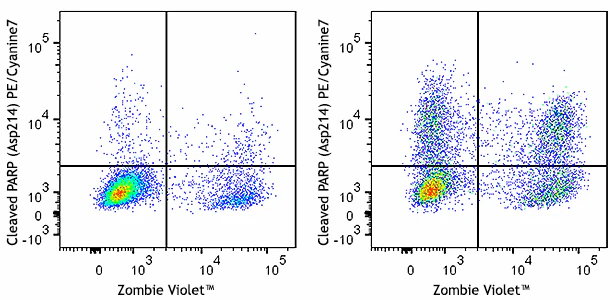
PE/Cyanine7 anti-Cleaved PARP (Asp214) Recombinant
PARP (ADP-Ribose) Polymerase (PARP) is a 113 kD nuclear protein important for mediating the normal cellular response to DNA damage and repair in response to environmental stress. PARP catalyzes the transfer of ADP-ribose units from NAD⁺ to various nuclear proteins, including topoisomerases, histones, and PARP itself, by poly(ADP-ribosyl)ation. Following DNA damage, this protein is cleaved by ICE-like caspases, such as caspase-3 and -7. In humans, this PARP cleavage occurs between Asp214 and Gly215, yielding an 89 kD (from the carboxy-terminal catalytic domain) and a 24 kD fragment (from the amino-terminal DNA binding domain). PARP is an important regulator of cellular differentiation, proliferation, and tumor transformation, and PARP cleavage is considered a classical characteristic of cells undergoing apoptosis. Additionally, this enzyme may be the site of mutation in Fanconi anemia, and may contribute to the pathophysiology of type I diabetes.
PRODUCT DETAILS
Clone: QA17A17
Antibody Type: Recombinant
Reactivity: Human
Format: PE-Cyanine7
Host: Mouse
Isotype: IgG1, κ
Applications: ICFC - Quality tested
Regulatory Status: RUO
Note to Purchaser: This product is manufactured and supplied by BioLegend, Inc. under an agreement between BioLegend, Inc. and Cytek Biosciences, Inc. Information related to this product is provided by BioLegend, Inc.
More Images
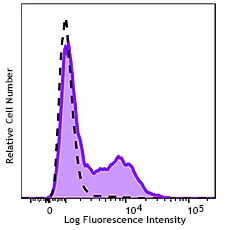
PE/Cyanine7 anti-Cleaved PARP (Asp214) Recombinant
PARP (ADP-Ribose) Polymerase (PARP) is a 113 kD nuclear protein important for mediating the normal cellular response to DNA damage and repair in response to environmental stress. PARP catalyzes the transfer of ADP-ribose units from NAD⁺ to various nuclear proteins, including topoisomerases, histones, and PARP itself, by poly(ADP-ribosyl)ation. Following DNA damage, this protein is cleaved by ICE-like caspases, such as caspase-3 and -7. In humans, this PARP cleavage occurs between Asp214 and Gly215, yielding an 89 kD (from the carboxy-terminal catalytic domain) and a 24 kD fragment (from the amino-terminal DNA binding domain). PARP is an important regulator of cellular differentiation, proliferation, and tumor transformation, and PARP cleavage is considered a classical characteristic of cells undergoing apoptosis. Additionally, this enzyme may be the site of mutation in Fanconi anemia, and may contribute to the pathophysiology of type I diabetes.
PRODUCT DETAILS
Clone: QA17A17
Antibody Type: Recombinant
Reactivity: Human
Format: PE-Cyanine7
Host: Mouse
Isotype: IgG1, κ
Applications: ICFC - Quality tested
Regulatory Status: RUO
Note to Purchaser: This product is manufactured and supplied by BioLegend, Inc. under an agreement between BioLegend, Inc. and Cytek Biosciences, Inc. Information related to this product is provided by BioLegend, Inc.
Product Information
Product Information
Shipping & Returns
Shipping & Returns
Description
PARP (ADP-Ribose) Polymerase (PARP) is a 113 kD nuclear protein important for mediating the normal cellular response to DNA damage and repair in response to environmental stress. PARP catalyzes the transfer of ADP-ribose units from NAD⁺ to various nuclear proteins, including topoisomerases, histones, and PARP itself, by poly(ADP-ribosyl)ation. Following DNA damage, this protein is cleaved by ICE-like caspases, such as caspase-3 and -7. In humans, this PARP cleavage occurs between Asp214 and Gly215, yielding an 89 kD (from the carboxy-terminal catalytic domain) and a 24 kD fragment (from the amino-terminal DNA binding domain). PARP is an important regulator of cellular differentiation, proliferation, and tumor transformation, and PARP cleavage is considered a classical characteristic of cells undergoing apoptosis. Additionally, this enzyme may be the site of mutation in Fanconi anemia, and may contribute to the pathophysiology of type I diabetes.
PRODUCT DETAILS
Clone: QA17A17
Antibody Type: Recombinant
Reactivity: Human
Format: PE-Cyanine7
Host: Mouse
Isotype: IgG1, κ
Applications: ICFC - Quality tested
Regulatory Status: RUO
Note to Purchaser: This product is manufactured and supplied by BioLegend, Inc. under an agreement between BioLegend, Inc. and Cytek Biosciences, Inc. Information related to this product is provided by BioLegend, Inc.