OSMR Monoclonal Antibody (AN-V2), APC, eBioscience
PRODUCT DETAILS
Host: Mouse
Isotype: IgG1
Clonality: Monoclonal
Clone: AN-V2
Format: APC
Reactivity: Hu
Application: Flow Cytometry
Tested Dilution: 5 µL (0.125 µg)/test
Concentration: 5 μL/Test
Storage: 4°C, store in dark, DO NOT FREEZE!
Formulation: PBS with BSA and 0.09% sodium azide; pH 7.2
Purification: Affinity chromatography
Data Sheet: TDS
Specific Information
Description: This monoclonal AN-V2 antibody reacts with the human oncostatin M (OSM) receptor. OSM, which belongs to the interleukin-6 cytokine family, is produced by T cells, activated monocytes, and dendritic cells. In humans, OSM can bind two unique receptor complexes. The type I OSM receptor is composed of the LIFR associated with gp130, and recognizes both LIF and OSM. The type II OSM receptor, which consists of gp130 and the OSMR subunit, specifically binds the cytokine, leading to activation of the JAK/STAT signaling pathway. Reports have also indicated a soluble form of the OSM receptor, which this antibody also recognizes. The OSM receptor is expressed in the bone marrow, endothelium, liver, lung, and numerous tumor cell lines.
The AN-V2 monoclonal antibody recognizes the type II (beta) OSM receptor.
Applications Reported: This AN-V2 antibody has been reported for use in flow cytometric analysis.
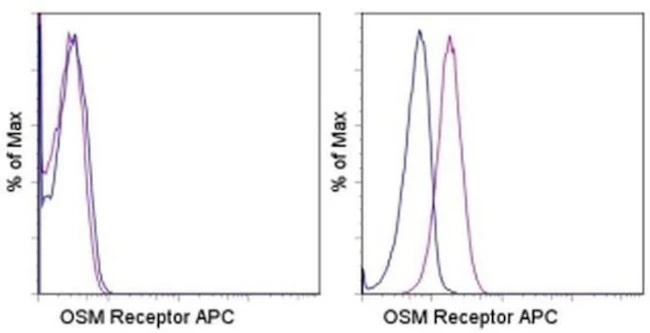
Applications Tested: This AN-V2 antibody has been pre-titrated and tested by flow cytometric analysis of the A375 cell line. This can be used at 5 µL (0.125 µg) per test. A test is defined as the amount (µg) of antibody that will stain a cell sample in a final volume of 100 µL. Cell number should be determined empirically but can range from 10^5 to 10^8 cells/test.
Excitation: 633-647 nm; Emission: 660 nm; Laser: Red Laser.
Filtration: 0.2 µm post-manufacturing filtered.
For Research Use Only. Not for use in diagnostic procedures. Not for resale without express authorization.
OSMR Monoclonal Antibody (AN-V2), APC, eBioscience
PRODUCT DETAILS
Host: Mouse
Isotype: IgG1
Clonality: Monoclonal
Clone: AN-V2
Format: APC
Reactivity: Hu
Application: Flow Cytometry
Tested Dilution: 5 µL (0.125 µg)/test
Concentration: 5 μL/Test
Storage: 4°C, store in dark, DO NOT FREEZE!
Formulation: PBS with BSA and 0.09% sodium azide; pH 7.2
Purification: Affinity chromatography
Data Sheet: TDS
Specific Information
Description: This monoclonal AN-V2 antibody reacts with the human oncostatin M (OSM) receptor. OSM, which belongs to the interleukin-6 cytokine family, is produced by T cells, activated monocytes, and dendritic cells. In humans, OSM can bind two unique receptor complexes. The type I OSM receptor is composed of the LIFR associated with gp130, and recognizes both LIF and OSM. The type II OSM receptor, which consists of gp130 and the OSMR subunit, specifically binds the cytokine, leading to activation of the JAK/STAT signaling pathway. Reports have also indicated a soluble form of the OSM receptor, which this antibody also recognizes. The OSM receptor is expressed in the bone marrow, endothelium, liver, lung, and numerous tumor cell lines.
The AN-V2 monoclonal antibody recognizes the type II (beta) OSM receptor.
Applications Reported: This AN-V2 antibody has been reported for use in flow cytometric analysis.
Applications Tested: This AN-V2 antibody has been pre-titrated and tested by flow cytometric analysis of the A375 cell line. This can be used at 5 µL (0.125 µg) per test. A test is defined as the amount (µg) of antibody that will stain a cell sample in a final volume of 100 µL. Cell number should be determined empirically but can range from 10^5 to 10^8 cells/test.
Excitation: 633-647 nm; Emission: 660 nm; Laser: Red Laser.
Filtration: 0.2 µm post-manufacturing filtered.
For Research Use Only. Not for use in diagnostic procedures. Not for resale without express authorization.
Product Information
Product Information
Shipping & Returns
Shipping & Returns
Description
PRODUCT DETAILS
Host: Mouse
Isotype: IgG1
Clonality: Monoclonal
Clone: AN-V2
Format: APC
Reactivity: Hu
Application: Flow Cytometry
Tested Dilution: 5 µL (0.125 µg)/test
Concentration: 5 μL/Test
Storage: 4°C, store in dark, DO NOT FREEZE!
Formulation: PBS with BSA and 0.09% sodium azide; pH 7.2
Purification: Affinity chromatography
Data Sheet: TDS
Specific Information
Description: This monoclonal AN-V2 antibody reacts with the human oncostatin M (OSM) receptor. OSM, which belongs to the interleukin-6 cytokine family, is produced by T cells, activated monocytes, and dendritic cells. In humans, OSM can bind two unique receptor complexes. The type I OSM receptor is composed of the LIFR associated with gp130, and recognizes both LIF and OSM. The type II OSM receptor, which consists of gp130 and the OSMR subunit, specifically binds the cytokine, leading to activation of the JAK/STAT signaling pathway. Reports have also indicated a soluble form of the OSM receptor, which this antibody also recognizes. The OSM receptor is expressed in the bone marrow, endothelium, liver, lung, and numerous tumor cell lines.
The AN-V2 monoclonal antibody recognizes the type II (beta) OSM receptor.
Applications Reported: This AN-V2 antibody has been reported for use in flow cytometric analysis.
Applications Tested: This AN-V2 antibody has been pre-titrated and tested by flow cytometric analysis of the A375 cell line. This can be used at 5 µL (0.125 µg) per test. A test is defined as the amount (µg) of antibody that will stain a cell sample in a final volume of 100 µL. Cell number should be determined empirically but can range from 10^5 to 10^8 cells/test.
Excitation: 633-647 nm; Emission: 660 nm; Laser: Red Laser.
Filtration: 0.2 µm post-manufacturing filtered.
For Research Use Only. Not for use in diagnostic procedures. Not for resale without express authorization.