MERTK Monoclonal Antibody (HMER5DS), APC, eBioscience
PRODUCT DETAILS
Host: Mouse
Isotype: IgG1, kappa
Clonality: Monoclonal
Clone: HMER5DS
Format: APC
Reactivity: Hu
Application: Flow Cytometry
Tested Dilution: 5 µL (0.06 µg)/test
Concentration: 5 μL/Test
Storage: 4°C, store in dark, DO NOT FREEZE!
Formulation: PBS with BSA and 0.09% sodium azide; pH 7.2
Purification: Affinity chromatography
Data Sheet: TDS
Specific Information
Description: This HMER5DS antibody recognizes human MerTK, known also as Mer or c-mer, a 170-210 kDa member of the TAM family of tyrosine kinase receptors that also includes Axl and Tyro3. MerTK is expressed on a subset of anti-inflammatory macrophages and is involved in the removal of apoptotic cells. This process relies on two soluble ligands of Mer,TK Protein S and Gas6, that coat the surface of cells undergoing apoptosis. Upon binding these ligands, MerTK undergoes autophosphorylation at multiple tyrosine residues that activate the PI3K and Akt pathways. This results in the phagocytosis of target cells and also the direct inhibition of TLR-induced production of pro-inflammatory cytokines by the phagocytes. Mer may also function as a putative entry receptor for filoviruses. Deficiency of MerTK causes general autoimmunity, inflammation, and accumulation of apoptotic bodies. MerTK can be released from the cell surface by metalloproteinases, and this process is significantly enhanced when macrophages are stimulated, e.g. with LPS. MerTK is often expressed on malignant cells, and may be implicated in immune evasion.
Applications Reported: This HMER5DS antibody has been reported for use in flow cytometric analysis.
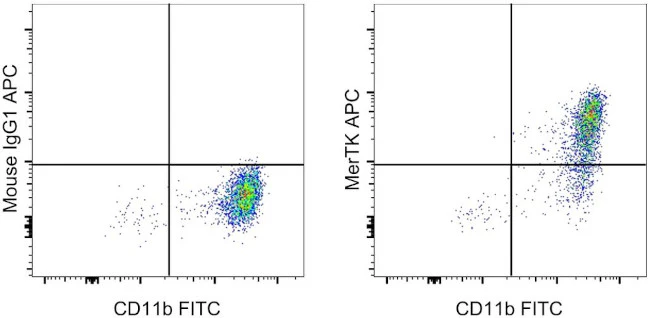
Applications Tested: This HMER5DS antibody has been pre-titrated and tested by flow cytometric analysis of human monocyte-derived macrophages. This can be used at 5 µL (0.06 µg) per test. A test is defined as the amount (µg) of antibody that will stain a cell sample in a final volume of 100 µL. Cell number should be determined empirically but can range from 10^5 to 10^8 cells/test.
Excitation: 633-647 nm; Emission: 660 nm; Laser: Red Laser
For Research Use Only. Not for use in diagnostic procedures. Not for resale without express authorization.
Original: $467.00
-70%$467.00
$140.10MERTK Monoclonal Antibody (HMER5DS), APC, eBioscience
PRODUCT DETAILS
Host: Mouse
Isotype: IgG1, kappa
Clonality: Monoclonal
Clone: HMER5DS
Format: APC
Reactivity: Hu
Application: Flow Cytometry
Tested Dilution: 5 µL (0.06 µg)/test
Concentration: 5 μL/Test
Storage: 4°C, store in dark, DO NOT FREEZE!
Formulation: PBS with BSA and 0.09% sodium azide; pH 7.2
Purification: Affinity chromatography
Data Sheet: TDS
Specific Information
Description: This HMER5DS antibody recognizes human MerTK, known also as Mer or c-mer, a 170-210 kDa member of the TAM family of tyrosine kinase receptors that also includes Axl and Tyro3. MerTK is expressed on a subset of anti-inflammatory macrophages and is involved in the removal of apoptotic cells. This process relies on two soluble ligands of Mer,TK Protein S and Gas6, that coat the surface of cells undergoing apoptosis. Upon binding these ligands, MerTK undergoes autophosphorylation at multiple tyrosine residues that activate the PI3K and Akt pathways. This results in the phagocytosis of target cells and also the direct inhibition of TLR-induced production of pro-inflammatory cytokines by the phagocytes. Mer may also function as a putative entry receptor for filoviruses. Deficiency of MerTK causes general autoimmunity, inflammation, and accumulation of apoptotic bodies. MerTK can be released from the cell surface by metalloproteinases, and this process is significantly enhanced when macrophages are stimulated, e.g. with LPS. MerTK is often expressed on malignant cells, and may be implicated in immune evasion.
Applications Reported: This HMER5DS antibody has been reported for use in flow cytometric analysis.
Applications Tested: This HMER5DS antibody has been pre-titrated and tested by flow cytometric analysis of human monocyte-derived macrophages. This can be used at 5 µL (0.06 µg) per test. A test is defined as the amount (µg) of antibody that will stain a cell sample in a final volume of 100 µL. Cell number should be determined empirically but can range from 10^5 to 10^8 cells/test.
Excitation: 633-647 nm; Emission: 660 nm; Laser: Red Laser
For Research Use Only. Not for use in diagnostic procedures. Not for resale without express authorization.
Product Information
Product Information
Shipping & Returns
Shipping & Returns
Description
PRODUCT DETAILS
Host: Mouse
Isotype: IgG1, kappa
Clonality: Monoclonal
Clone: HMER5DS
Format: APC
Reactivity: Hu
Application: Flow Cytometry
Tested Dilution: 5 µL (0.06 µg)/test
Concentration: 5 μL/Test
Storage: 4°C, store in dark, DO NOT FREEZE!
Formulation: PBS with BSA and 0.09% sodium azide; pH 7.2
Purification: Affinity chromatography
Data Sheet: TDS
Specific Information
Description: This HMER5DS antibody recognizes human MerTK, known also as Mer or c-mer, a 170-210 kDa member of the TAM family of tyrosine kinase receptors that also includes Axl and Tyro3. MerTK is expressed on a subset of anti-inflammatory macrophages and is involved in the removal of apoptotic cells. This process relies on two soluble ligands of Mer,TK Protein S and Gas6, that coat the surface of cells undergoing apoptosis. Upon binding these ligands, MerTK undergoes autophosphorylation at multiple tyrosine residues that activate the PI3K and Akt pathways. This results in the phagocytosis of target cells and also the direct inhibition of TLR-induced production of pro-inflammatory cytokines by the phagocytes. Mer may also function as a putative entry receptor for filoviruses. Deficiency of MerTK causes general autoimmunity, inflammation, and accumulation of apoptotic bodies. MerTK can be released from the cell surface by metalloproteinases, and this process is significantly enhanced when macrophages are stimulated, e.g. with LPS. MerTK is often expressed on malignant cells, and may be implicated in immune evasion.
Applications Reported: This HMER5DS antibody has been reported for use in flow cytometric analysis.
Applications Tested: This HMER5DS antibody has been pre-titrated and tested by flow cytometric analysis of human monocyte-derived macrophages. This can be used at 5 µL (0.06 µg) per test. A test is defined as the amount (µg) of antibody that will stain a cell sample in a final volume of 100 µL. Cell number should be determined empirically but can range from 10^5 to 10^8 cells/test.
Excitation: 633-647 nm; Emission: 660 nm; Laser: Red Laser
For Research Use Only. Not for use in diagnostic procedures. Not for resale without express authorization.