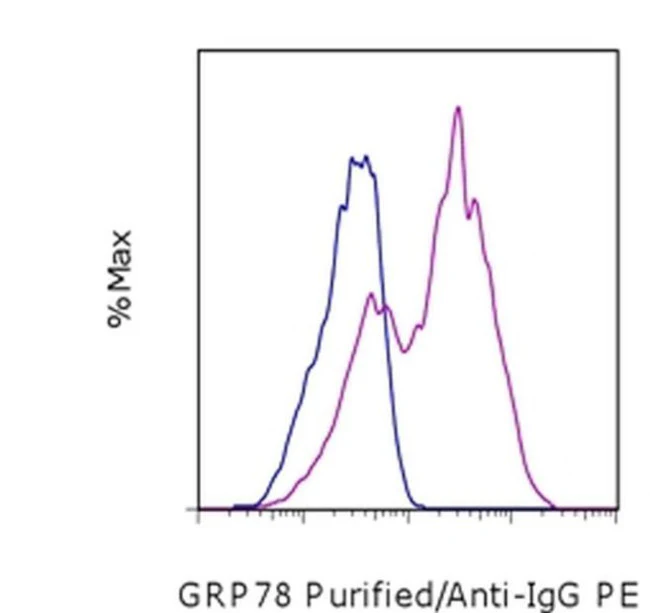
GRP78 Monoclonal Antibody (C38), eBioscience
PRODUCT DETAILS
Host: Mouse
Isotype: IgG2b, kappa
Clonality: Monoclonal
Clone: C38
Reactivity: Hu
Application: Flow Cytometry
Tested Dilution: Assay-Dependent
Concentration: 0.5 mg/mL
Storage: 4°C
Formulation: PBS with 0.09% sodium azide; pH 7.2
Purification: Affinity chromatography
Data Sheet: TDS
Specific Information
Description: The monoclonal antibody C38 recognizes human glucose-related protein 78 (GRP78). The GRP78 is encoded by the HSPA5 gene and functions as an endoplasmic reticulum (ER) chaperone protein and is a member of the heat shock protein 70 family. GRP78 functions within the ER lumen to facilitate proper protein folding, to prevent intermediates from aggregating, to target misfolded proteins for degradation, and as a calcium binding protein capable of recognizing ER stress and inducing the Unfolded Protein Response (UPR). During normal cellular function, GRP78 is bound to the transmembrane sensor proteins PERK, IRE1, and ATF6, keeping them in an inactive state. During ER stress, GRP78 binds to the hydrophobic residues of unfolded proteins within the ER and releases the sensor proteins, allowing signaling to the nucleus and the initiation of the UPR. During the UPR, protein synthesis is slowed and the transcription of ER chaperones is upregulated, increasing the capacity of the ER.
GRP78 is normally expressed at basal levels in all adult organs and is required for the proliferation and survival of embryonic stem cells. GRP78 expression is upregulated in cancer cells due to the increased numbers of underglycosylated and misfolded proteins responsible for triggering the UPR. In addition to being expressed in the ER, GRP78 is also expressed on the surface of cancer cells. Evidence also suggests that GRP78 plays a role in promoting tumor growth and metastasis by inhibiting apoptosis. GRP78 overexpression confers drug-resistance to chemotherapeutic agents and the level of expression can be correlated with pathologic grade and survival in breast, liver, prostate, colon and gastric cancers.
Applications Reported: This C38 antibody has been reported for use in flow cytometric analysis, immunohistochemical staining of formalin-fixed paraffin embedded tissue sections, microscopy, ELISA, and immunocytochemistry.
Applications Tested: This C38 antibody has been tested by immunocytochemistry of fixed and permeabilized cells and can be used at less than or equal to 5 µg/mL. This C38 antibody has been tested by immunohistochemistry of formalin-fixed paraffin embedded human tissue using low or high pH antigen retrieval and can be used at less than or equal to 5 µg/mL. It is recommended that the antibody be carefully titrated for optimal performance in the assay of interest.
Purity: Greater than 90%, as determined by SDS-PAGE.
Aggregation: Less than 10%, as determined by HPLC.
Filtration: 0.2 µm post-manufacturing filtered.
For Research Use Only. Not for use in diagnostic procedures. Not for resale without express authorization.
Original: $369.00
-70%$369.00
$110.70GRP78 Monoclonal Antibody (C38), eBioscience
PRODUCT DETAILS
Host: Mouse
Isotype: IgG2b, kappa
Clonality: Monoclonal
Clone: C38
Reactivity: Hu
Application: Flow Cytometry
Tested Dilution: Assay-Dependent
Concentration: 0.5 mg/mL
Storage: 4°C
Formulation: PBS with 0.09% sodium azide; pH 7.2
Purification: Affinity chromatography
Data Sheet: TDS
Specific Information
Description: The monoclonal antibody C38 recognizes human glucose-related protein 78 (GRP78). The GRP78 is encoded by the HSPA5 gene and functions as an endoplasmic reticulum (ER) chaperone protein and is a member of the heat shock protein 70 family. GRP78 functions within the ER lumen to facilitate proper protein folding, to prevent intermediates from aggregating, to target misfolded proteins for degradation, and as a calcium binding protein capable of recognizing ER stress and inducing the Unfolded Protein Response (UPR). During normal cellular function, GRP78 is bound to the transmembrane sensor proteins PERK, IRE1, and ATF6, keeping them in an inactive state. During ER stress, GRP78 binds to the hydrophobic residues of unfolded proteins within the ER and releases the sensor proteins, allowing signaling to the nucleus and the initiation of the UPR. During the UPR, protein synthesis is slowed and the transcription of ER chaperones is upregulated, increasing the capacity of the ER.
GRP78 is normally expressed at basal levels in all adult organs and is required for the proliferation and survival of embryonic stem cells. GRP78 expression is upregulated in cancer cells due to the increased numbers of underglycosylated and misfolded proteins responsible for triggering the UPR. In addition to being expressed in the ER, GRP78 is also expressed on the surface of cancer cells. Evidence also suggests that GRP78 plays a role in promoting tumor growth and metastasis by inhibiting apoptosis. GRP78 overexpression confers drug-resistance to chemotherapeutic agents and the level of expression can be correlated with pathologic grade and survival in breast, liver, prostate, colon and gastric cancers.
Applications Reported: This C38 antibody has been reported for use in flow cytometric analysis, immunohistochemical staining of formalin-fixed paraffin embedded tissue sections, microscopy, ELISA, and immunocytochemistry.
Applications Tested: This C38 antibody has been tested by immunocytochemistry of fixed and permeabilized cells and can be used at less than or equal to 5 µg/mL. This C38 antibody has been tested by immunohistochemistry of formalin-fixed paraffin embedded human tissue using low or high pH antigen retrieval and can be used at less than or equal to 5 µg/mL. It is recommended that the antibody be carefully titrated for optimal performance in the assay of interest.
Purity: Greater than 90%, as determined by SDS-PAGE.
Aggregation: Less than 10%, as determined by HPLC.
Filtration: 0.2 µm post-manufacturing filtered.
For Research Use Only. Not for use in diagnostic procedures. Not for resale without express authorization.
Product Information
Product Information
Shipping & Returns
Shipping & Returns
Description
PRODUCT DETAILS
Host: Mouse
Isotype: IgG2b, kappa
Clonality: Monoclonal
Clone: C38
Reactivity: Hu
Application: Flow Cytometry
Tested Dilution: Assay-Dependent
Concentration: 0.5 mg/mL
Storage: 4°C
Formulation: PBS with 0.09% sodium azide; pH 7.2
Purification: Affinity chromatography
Data Sheet: TDS
Specific Information
Description: The monoclonal antibody C38 recognizes human glucose-related protein 78 (GRP78). The GRP78 is encoded by the HSPA5 gene and functions as an endoplasmic reticulum (ER) chaperone protein and is a member of the heat shock protein 70 family. GRP78 functions within the ER lumen to facilitate proper protein folding, to prevent intermediates from aggregating, to target misfolded proteins for degradation, and as a calcium binding protein capable of recognizing ER stress and inducing the Unfolded Protein Response (UPR). During normal cellular function, GRP78 is bound to the transmembrane sensor proteins PERK, IRE1, and ATF6, keeping them in an inactive state. During ER stress, GRP78 binds to the hydrophobic residues of unfolded proteins within the ER and releases the sensor proteins, allowing signaling to the nucleus and the initiation of the UPR. During the UPR, protein synthesis is slowed and the transcription of ER chaperones is upregulated, increasing the capacity of the ER.
GRP78 is normally expressed at basal levels in all adult organs and is required for the proliferation and survival of embryonic stem cells. GRP78 expression is upregulated in cancer cells due to the increased numbers of underglycosylated and misfolded proteins responsible for triggering the UPR. In addition to being expressed in the ER, GRP78 is also expressed on the surface of cancer cells. Evidence also suggests that GRP78 plays a role in promoting tumor growth and metastasis by inhibiting apoptosis. GRP78 overexpression confers drug-resistance to chemotherapeutic agents and the level of expression can be correlated with pathologic grade and survival in breast, liver, prostate, colon and gastric cancers.
Applications Reported: This C38 antibody has been reported for use in flow cytometric analysis, immunohistochemical staining of formalin-fixed paraffin embedded tissue sections, microscopy, ELISA, and immunocytochemistry.
Applications Tested: This C38 antibody has been tested by immunocytochemistry of fixed and permeabilized cells and can be used at less than or equal to 5 µg/mL. This C38 antibody has been tested by immunohistochemistry of formalin-fixed paraffin embedded human tissue using low or high pH antigen retrieval and can be used at less than or equal to 5 µg/mL. It is recommended that the antibody be carefully titrated for optimal performance in the assay of interest.
Purity: Greater than 90%, as determined by SDS-PAGE.
Aggregation: Less than 10%, as determined by HPLC.
Filtration: 0.2 µm post-manufacturing filtered.
For Research Use Only. Not for use in diagnostic procedures. Not for resale without express authorization.