Granzyme B Monoclonal Antibody (GB11), PE, eBioscience
PRODUCT DETAILS
Host: Mouse
Isotype: IgG1
Clonality: Monoclonal
Clone: GB11
Format: PE
Reactivity: Hu
Application: Flow Cytometry
Tested Dilution: 5 µL (0.06 µg)/test
Concentration: 5 μL/Test
Storage: 4°C, store in dark, DO NOT FREEZE!
Formulation: PBS with BSA and 0.09% sodium azide; pH 7.2
Purification: Affinity chromatography
Data Sheet: TDS
Specific Information
Description: The GB11 antibody reacts with human Granzyme B (GrB). GrB is one of the family of serine proteases, known as granzymes, that is located in the granules of cytotoxic T cells and NK cells. Granzyme B has been described also as CGL1 (cathepsin G-like-1), a serine protease expressed only in cytotoxic T-lymphocytes after cell activation. GrB has been called CTLA-1 (cytotoxic T lymphocyte-associated serine esterase 1) based on identification of mRNA in various cytotoxic T cells, but not observed in non-cytotoxic lymphoid cells. GrB is crucial for the rapid induction of target cell death by apoptosis, induced by interaction with cytotoxic T cells. The receptor involved has been identified as mannose 6-phosphate receptor. This receptor functions as a death receptor for granzyme B during cytotoxic T cell-induced apoptosis.
Applications Reported: The GB11 antibody has been reported useful for intracellular staining followed by flow cytometric analysis.
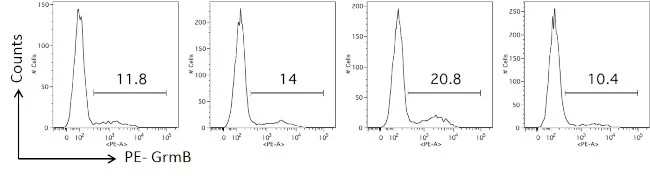
Applications Tested: This GB11 antibody has been pre-titrated and tested on by intracellular staining and flow cytometric analysis of both cultured normal human peripheral blood cells and mouse splenocytes. This can be used at test size: 5 µL (0.06 µg) per test. A test is defined as the amount (µg) of antibody that will stain a cell sample in a final volume of 100 µL. Cell number should be determined empirically but can range from 10^5 to 10^8 cells/test.
Excitation: 488-561 nm; Emission: 578 nm; Laser: Blue Laser, Green Laser, Yellow-Green Laser.
Filtration: 0.2 µm post-manufacturing filtered.
For Research Use Only. Not for use in diagnostic procedures. Not for resale without express authorization.
Original: $193.00
-70%$193.00
$57.90Granzyme B Monoclonal Antibody (GB11), PE, eBioscience
PRODUCT DETAILS
Host: Mouse
Isotype: IgG1
Clonality: Monoclonal
Clone: GB11
Format: PE
Reactivity: Hu
Application: Flow Cytometry
Tested Dilution: 5 µL (0.06 µg)/test
Concentration: 5 μL/Test
Storage: 4°C, store in dark, DO NOT FREEZE!
Formulation: PBS with BSA and 0.09% sodium azide; pH 7.2
Purification: Affinity chromatography
Data Sheet: TDS
Specific Information
Description: The GB11 antibody reacts with human Granzyme B (GrB). GrB is one of the family of serine proteases, known as granzymes, that is located in the granules of cytotoxic T cells and NK cells. Granzyme B has been described also as CGL1 (cathepsin G-like-1), a serine protease expressed only in cytotoxic T-lymphocytes after cell activation. GrB has been called CTLA-1 (cytotoxic T lymphocyte-associated serine esterase 1) based on identification of mRNA in various cytotoxic T cells, but not observed in non-cytotoxic lymphoid cells. GrB is crucial for the rapid induction of target cell death by apoptosis, induced by interaction with cytotoxic T cells. The receptor involved has been identified as mannose 6-phosphate receptor. This receptor functions as a death receptor for granzyme B during cytotoxic T cell-induced apoptosis.
Applications Reported: The GB11 antibody has been reported useful for intracellular staining followed by flow cytometric analysis.
Applications Tested: This GB11 antibody has been pre-titrated and tested on by intracellular staining and flow cytometric analysis of both cultured normal human peripheral blood cells and mouse splenocytes. This can be used at test size: 5 µL (0.06 µg) per test. A test is defined as the amount (µg) of antibody that will stain a cell sample in a final volume of 100 µL. Cell number should be determined empirically but can range from 10^5 to 10^8 cells/test.
Excitation: 488-561 nm; Emission: 578 nm; Laser: Blue Laser, Green Laser, Yellow-Green Laser.
Filtration: 0.2 µm post-manufacturing filtered.
For Research Use Only. Not for use in diagnostic procedures. Not for resale without express authorization.
Product Information
Product Information
Shipping & Returns
Shipping & Returns
Description
PRODUCT DETAILS
Host: Mouse
Isotype: IgG1
Clonality: Monoclonal
Clone: GB11
Format: PE
Reactivity: Hu
Application: Flow Cytometry
Tested Dilution: 5 µL (0.06 µg)/test
Concentration: 5 μL/Test
Storage: 4°C, store in dark, DO NOT FREEZE!
Formulation: PBS with BSA and 0.09% sodium azide; pH 7.2
Purification: Affinity chromatography
Data Sheet: TDS
Specific Information
Description: The GB11 antibody reacts with human Granzyme B (GrB). GrB is one of the family of serine proteases, known as granzymes, that is located in the granules of cytotoxic T cells and NK cells. Granzyme B has been described also as CGL1 (cathepsin G-like-1), a serine protease expressed only in cytotoxic T-lymphocytes after cell activation. GrB has been called CTLA-1 (cytotoxic T lymphocyte-associated serine esterase 1) based on identification of mRNA in various cytotoxic T cells, but not observed in non-cytotoxic lymphoid cells. GrB is crucial for the rapid induction of target cell death by apoptosis, induced by interaction with cytotoxic T cells. The receptor involved has been identified as mannose 6-phosphate receptor. This receptor functions as a death receptor for granzyme B during cytotoxic T cell-induced apoptosis.
Applications Reported: The GB11 antibody has been reported useful for intracellular staining followed by flow cytometric analysis.
Applications Tested: This GB11 antibody has been pre-titrated and tested on by intracellular staining and flow cytometric analysis of both cultured normal human peripheral blood cells and mouse splenocytes. This can be used at test size: 5 µL (0.06 µg) per test. A test is defined as the amount (µg) of antibody that will stain a cell sample in a final volume of 100 µL. Cell number should be determined empirically but can range from 10^5 to 10^8 cells/test.
Excitation: 488-561 nm; Emission: 578 nm; Laser: Blue Laser, Green Laser, Yellow-Green Laser.
Filtration: 0.2 µm post-manufacturing filtered.
For Research Use Only. Not for use in diagnostic procedures. Not for resale without express authorization.