GARP Monoclonal Antibody (G14D9), PE-Cyanine7, eBioscience
PRODUCT DETAILS
Host: Rat
Isotype: IgG2a, kappa
Clonality: Monoclonal
Clone: G14D9
Format: PE-Cyanine7
Reactivity: Hu
Application: Flow Cytometry
Tested Dilution: 5 µL (1 µg)/test
Concentration: 5 μL/Test
Storage: 4°C, store in dark, DO NOT FREEZE!
Formulation: PBS with BSA and 0.09% sodium azide; pH 7.2
Purification: Affinity chromatography
Data Sheet: TDS
Specific Information
Description: The G14D9 monoclonal antibody reacts with human Glycoprotein A Repetitions Predominant (GARP, also known as LRRC32 or Garpin). GARP is an approximately 80 kDa glycoprotein that is expressed on the cell surface. Using northern blot, RT-PCR or microarray analyses, the expression of GARP has been reported in placenta, lung, kidney, heart, ovary, liver, skeletal muscle, and pancreas. Protein expression has been observed on megakaryocytes, platelets and activated regulatory T (Treg) cells. The expression of GARP on the surface of activated Treg cells has been reported to be necessary for their suppressive function, possibly related to its role as a cell surface receptor for LAP/TGF beta.
Applications Reported: This G14D9 antibody has been reported for use in flow cytometric analysis.
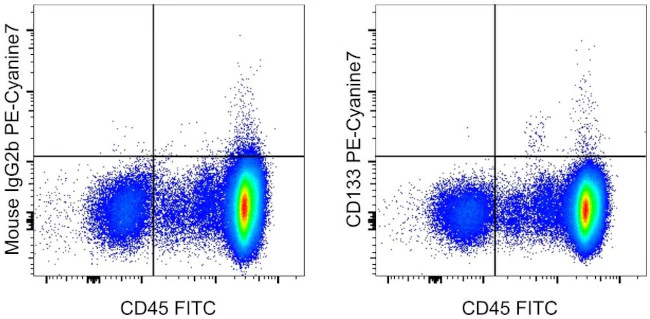
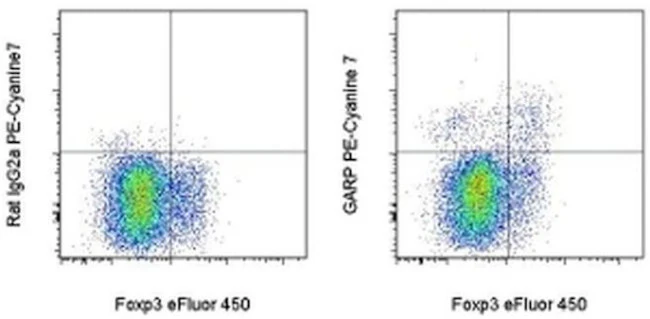
Applications Tested: This G14D9 antibody has been pre-titrated and tested by flow cytometric analysis of stimulated normal human peripheral blood cells. This can be used at 5 µL (1 µg) per test. A test is defined as the amount (µg) of antibody that will stain a cell sample in a final volume of 100 µL. Cell number should be determined empirically but can range from 10^5 to 10^8 cells/test.
Light sensitivity: This tandem dye is sensitive to photo-induced oxidation. Please protect this vial and stained samples from light.
Fixation: Samples can be stored in IC Fixation Buffer (Product # 00-822-49) (100 µL cell sample + 100 µL IC Fixation Buffer) or 1-step Fix/Lyse Solution (Product # 00-5333-54) for up to 3 days in the dark at 4°C with minimal impact on brightness and FRET efficiency/compensation. Some generalizations regarding fluorophore performance after fixation can be made, but clone specific performance should be determined empirically.
Excitation: 488-561 nm; Emission: 775 nm; Laser: Blue Laser, Green Laser, Yellow-Green Laser.
Filtration: 0.2 µm post-manufacturing filtered.
For Research Use Only. Not for use in diagnostic procedures. Not for resale without express authorization.
Original: $504.00
-70%$504.00
$151.20GARP Monoclonal Antibody (G14D9), PE-Cyanine7, eBioscience
PRODUCT DETAILS
Host: Rat
Isotype: IgG2a, kappa
Clonality: Monoclonal
Clone: G14D9
Format: PE-Cyanine7
Reactivity: Hu
Application: Flow Cytometry
Tested Dilution: 5 µL (1 µg)/test
Concentration: 5 μL/Test
Storage: 4°C, store in dark, DO NOT FREEZE!
Formulation: PBS with BSA and 0.09% sodium azide; pH 7.2
Purification: Affinity chromatography
Data Sheet: TDS
Specific Information
Description: The G14D9 monoclonal antibody reacts with human Glycoprotein A Repetitions Predominant (GARP, also known as LRRC32 or Garpin). GARP is an approximately 80 kDa glycoprotein that is expressed on the cell surface. Using northern blot, RT-PCR or microarray analyses, the expression of GARP has been reported in placenta, lung, kidney, heart, ovary, liver, skeletal muscle, and pancreas. Protein expression has been observed on megakaryocytes, platelets and activated regulatory T (Treg) cells. The expression of GARP on the surface of activated Treg cells has been reported to be necessary for their suppressive function, possibly related to its role as a cell surface receptor for LAP/TGF beta.
Applications Reported: This G14D9 antibody has been reported for use in flow cytometric analysis.
Applications Tested: This G14D9 antibody has been pre-titrated and tested by flow cytometric analysis of stimulated normal human peripheral blood cells. This can be used at 5 µL (1 µg) per test. A test is defined as the amount (µg) of antibody that will stain a cell sample in a final volume of 100 µL. Cell number should be determined empirically but can range from 10^5 to 10^8 cells/test.
Light sensitivity: This tandem dye is sensitive to photo-induced oxidation. Please protect this vial and stained samples from light.
Fixation: Samples can be stored in IC Fixation Buffer (Product # 00-822-49) (100 µL cell sample + 100 µL IC Fixation Buffer) or 1-step Fix/Lyse Solution (Product # 00-5333-54) for up to 3 days in the dark at 4°C with minimal impact on brightness and FRET efficiency/compensation. Some generalizations regarding fluorophore performance after fixation can be made, but clone specific performance should be determined empirically.
Excitation: 488-561 nm; Emission: 775 nm; Laser: Blue Laser, Green Laser, Yellow-Green Laser.
Filtration: 0.2 µm post-manufacturing filtered.
For Research Use Only. Not for use in diagnostic procedures. Not for resale without express authorization.
Product Information
Product Information
Shipping & Returns
Shipping & Returns
Description
PRODUCT DETAILS
Host: Rat
Isotype: IgG2a, kappa
Clonality: Monoclonal
Clone: G14D9
Format: PE-Cyanine7
Reactivity: Hu
Application: Flow Cytometry
Tested Dilution: 5 µL (1 µg)/test
Concentration: 5 μL/Test
Storage: 4°C, store in dark, DO NOT FREEZE!
Formulation: PBS with BSA and 0.09% sodium azide; pH 7.2
Purification: Affinity chromatography
Data Sheet: TDS
Specific Information
Description: The G14D9 monoclonal antibody reacts with human Glycoprotein A Repetitions Predominant (GARP, also known as LRRC32 or Garpin). GARP is an approximately 80 kDa glycoprotein that is expressed on the cell surface. Using northern blot, RT-PCR or microarray analyses, the expression of GARP has been reported in placenta, lung, kidney, heart, ovary, liver, skeletal muscle, and pancreas. Protein expression has been observed on megakaryocytes, platelets and activated regulatory T (Treg) cells. The expression of GARP on the surface of activated Treg cells has been reported to be necessary for their suppressive function, possibly related to its role as a cell surface receptor for LAP/TGF beta.
Applications Reported: This G14D9 antibody has been reported for use in flow cytometric analysis.
Applications Tested: This G14D9 antibody has been pre-titrated and tested by flow cytometric analysis of stimulated normal human peripheral blood cells. This can be used at 5 µL (1 µg) per test. A test is defined as the amount (µg) of antibody that will stain a cell sample in a final volume of 100 µL. Cell number should be determined empirically but can range from 10^5 to 10^8 cells/test.
Light sensitivity: This tandem dye is sensitive to photo-induced oxidation. Please protect this vial and stained samples from light.
Fixation: Samples can be stored in IC Fixation Buffer (Product # 00-822-49) (100 µL cell sample + 100 µL IC Fixation Buffer) or 1-step Fix/Lyse Solution (Product # 00-5333-54) for up to 3 days in the dark at 4°C with minimal impact on brightness and FRET efficiency/compensation. Some generalizations regarding fluorophore performance after fixation can be made, but clone specific performance should be determined empirically.
Excitation: 488-561 nm; Emission: 775 nm; Laser: Blue Laser, Green Laser, Yellow-Green Laser.
Filtration: 0.2 µm post-manufacturing filtered.
For Research Use Only. Not for use in diagnostic procedures. Not for resale without express authorization.