CD93 (AA4.1) Monoclonal Antibody (R3), PE, eBioscience
PRODUCT DETAILS
Host: Mouse
Isotype: IgM
Clonality: Monoclonal
Clone: R3
Format: PE
Reactivity: Hu
Application: Flow Cytometry
Tested Dilution: 5 µL (0.125 µg)/test
Concentration: 5 μL/Test
Storage: 4°C, store in dark, DO NOT FREEZE!
Formulation: PBS with BSA and 0.09% sodium azide; pH 7.2
Purification: Affinity chromatography
Data Sheet: TDS
Specific Information
Description: The monoclonal antibody R3 recognizes human CD93, also known as C1qRp. The glycoprotein CD93 binds to C1q, the subunit of the complement protein, mannose binding lectin and pulmonary surfactant protein A. CD93 is predicted to play a role in the clearance of apoptotic cells. Expression of CD93 is confined to myeloid cells with higher expression on monocytes than neutrophils, eosinophils, platelets and endothelial cells. Expression on DC's is downregulated upon maturation. Additionally, CD93 has been shown to define an early bone marrow stem cell population of hematopoietic and hepatic precursors.
The R3 antibody has been shown to have activating function by increasing phagocytosis when presented in an immobilized state and inhibitory functions when presented in a soluble state. CD93 can be shed from the cell surface. This phenomenon can be measures using R3 antibody as detection with R139 as capture to detect soluble CD93 by ELISA. The epitope for R3 lies in the CRD domain.\\The R3 antibody has been shown to have activating function by increasing phagocytosis when presented in an immobilized state and inhibitory functions when presented in a soluble state. CD93 can be shed from the cell surface. This phenomenon can be measures using R3 antibody as detection with R139 as capture to detect soluble CD93 by ELISA. The epitope for R3 lies in the CRD domain.
Applications Reported: This R3 antibody has been reported for use in flow cytometric analysis.
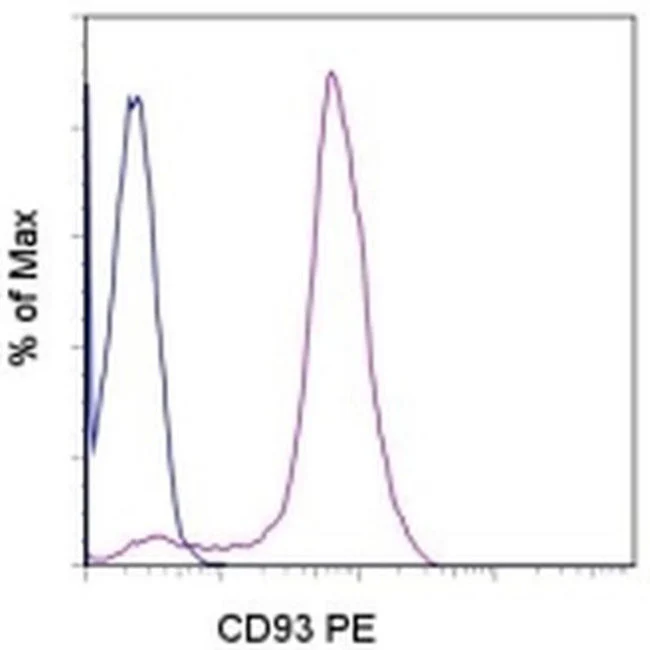
Applications Tested: This R3 antibody has been pre-titrated and tested by flow cytometric analysis of normal human peripheral blood cells. This can be used at 5 µL (0.125 µg) per test. A test is defined as the amount (µg) of antibody that will stain a cell sample in a final volume of 100 µL. Cell number should be determined empirically but can range from 10^5 to 10^8 cells/test.
Excitation: 488-561 nm; Emission: 578 nm; Laser: Blue Laser, Green Laser, Yellow-Green Laser.
Filtration: 0.2 µm post-manufacturing filtered.
For Research Use Only. Not for use in diagnostic procedures. Not for resale without express authorization.
Original: $353.00
-70%$353.00
$105.90CD93 (AA4.1) Monoclonal Antibody (R3), PE, eBioscience
PRODUCT DETAILS
Host: Mouse
Isotype: IgM
Clonality: Monoclonal
Clone: R3
Format: PE
Reactivity: Hu
Application: Flow Cytometry
Tested Dilution: 5 µL (0.125 µg)/test
Concentration: 5 μL/Test
Storage: 4°C, store in dark, DO NOT FREEZE!
Formulation: PBS with BSA and 0.09% sodium azide; pH 7.2
Purification: Affinity chromatography
Data Sheet: TDS
Specific Information
Description: The monoclonal antibody R3 recognizes human CD93, also known as C1qRp. The glycoprotein CD93 binds to C1q, the subunit of the complement protein, mannose binding lectin and pulmonary surfactant protein A. CD93 is predicted to play a role in the clearance of apoptotic cells. Expression of CD93 is confined to myeloid cells with higher expression on monocytes than neutrophils, eosinophils, platelets and endothelial cells. Expression on DC's is downregulated upon maturation. Additionally, CD93 has been shown to define an early bone marrow stem cell population of hematopoietic and hepatic precursors.
The R3 antibody has been shown to have activating function by increasing phagocytosis when presented in an immobilized state and inhibitory functions when presented in a soluble state. CD93 can be shed from the cell surface. This phenomenon can be measures using R3 antibody as detection with R139 as capture to detect soluble CD93 by ELISA. The epitope for R3 lies in the CRD domain.\\The R3 antibody has been shown to have activating function by increasing phagocytosis when presented in an immobilized state and inhibitory functions when presented in a soluble state. CD93 can be shed from the cell surface. This phenomenon can be measures using R3 antibody as detection with R139 as capture to detect soluble CD93 by ELISA. The epitope for R3 lies in the CRD domain.
Applications Reported: This R3 antibody has been reported for use in flow cytometric analysis.
Applications Tested: This R3 antibody has been pre-titrated and tested by flow cytometric analysis of normal human peripheral blood cells. This can be used at 5 µL (0.125 µg) per test. A test is defined as the amount (µg) of antibody that will stain a cell sample in a final volume of 100 µL. Cell number should be determined empirically but can range from 10^5 to 10^8 cells/test.
Excitation: 488-561 nm; Emission: 578 nm; Laser: Blue Laser, Green Laser, Yellow-Green Laser.
Filtration: 0.2 µm post-manufacturing filtered.
For Research Use Only. Not for use in diagnostic procedures. Not for resale without express authorization.
Product Information
Product Information
Shipping & Returns
Shipping & Returns
Description
PRODUCT DETAILS
Host: Mouse
Isotype: IgM
Clonality: Monoclonal
Clone: R3
Format: PE
Reactivity: Hu
Application: Flow Cytometry
Tested Dilution: 5 µL (0.125 µg)/test
Concentration: 5 μL/Test
Storage: 4°C, store in dark, DO NOT FREEZE!
Formulation: PBS with BSA and 0.09% sodium azide; pH 7.2
Purification: Affinity chromatography
Data Sheet: TDS
Specific Information
Description: The monoclonal antibody R3 recognizes human CD93, also known as C1qRp. The glycoprotein CD93 binds to C1q, the subunit of the complement protein, mannose binding lectin and pulmonary surfactant protein A. CD93 is predicted to play a role in the clearance of apoptotic cells. Expression of CD93 is confined to myeloid cells with higher expression on monocytes than neutrophils, eosinophils, platelets and endothelial cells. Expression on DC's is downregulated upon maturation. Additionally, CD93 has been shown to define an early bone marrow stem cell population of hematopoietic and hepatic precursors.
The R3 antibody has been shown to have activating function by increasing phagocytosis when presented in an immobilized state and inhibitory functions when presented in a soluble state. CD93 can be shed from the cell surface. This phenomenon can be measures using R3 antibody as detection with R139 as capture to detect soluble CD93 by ELISA. The epitope for R3 lies in the CRD domain.\\The R3 antibody has been shown to have activating function by increasing phagocytosis when presented in an immobilized state and inhibitory functions when presented in a soluble state. CD93 can be shed from the cell surface. This phenomenon can be measures using R3 antibody as detection with R139 as capture to detect soluble CD93 by ELISA. The epitope for R3 lies in the CRD domain.
Applications Reported: This R3 antibody has been reported for use in flow cytometric analysis.
Applications Tested: This R3 antibody has been pre-titrated and tested by flow cytometric analysis of normal human peripheral blood cells. This can be used at 5 µL (0.125 µg) per test. A test is defined as the amount (µg) of antibody that will stain a cell sample in a final volume of 100 µL. Cell number should be determined empirically but can range from 10^5 to 10^8 cells/test.
Excitation: 488-561 nm; Emission: 578 nm; Laser: Blue Laser, Green Laser, Yellow-Green Laser.
Filtration: 0.2 µm post-manufacturing filtered.
For Research Use Only. Not for use in diagnostic procedures. Not for resale without express authorization.