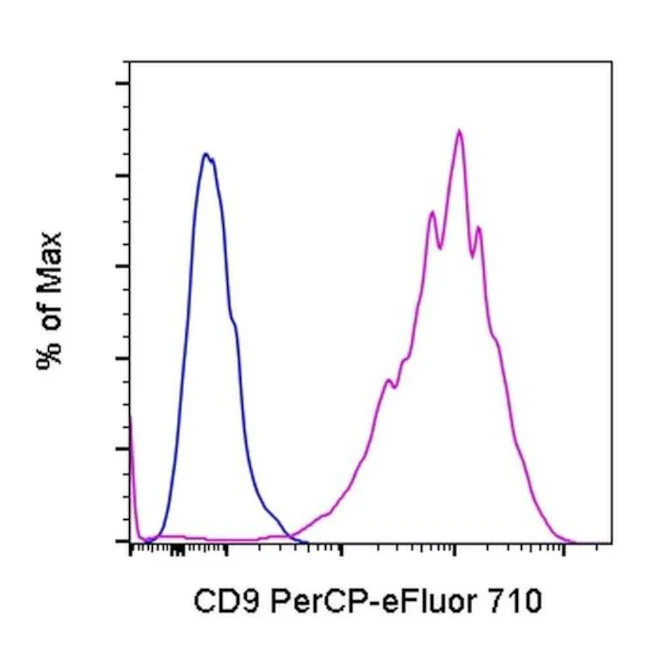
CD9 Monoclonal Antibody (eBioSN4 (SN4 C3-3A2)), PerCP-eFluor 710, eBioscience
PRODUCT DETAILS
Host: Mouse
Isotype: IgG1, kappa
Clonality: Monoclonal
Clone: eBioSN4 (SN4 C3-3A2)
Format: PerCP-eFluor 710
Reactivity: Hu
Application: Flow Cytometry
Tested Dilution: 5 µL (0.25 µg)/test
Concentration: 5 μL/Test
Storage: 4°C, store in dark, DO NOT FREEZE!
Formulation: PBS with BSA and 0.09% sodium azide; pH 7.2
Purification: Affinity chromatography
Data Sheet: TDS
Specific Information
Description: The eBioSN4 monoclonal antibody reacts with human CD9. CD9 is a 24 kDa member of the tetraspanin family, whose members are characterized by the presence of 4 hydrophobic transmembrane domains. CD9 is expressed in platelets, eosinophils, basophils, pre-B cells, activated T cells and neural cell lines. Furthermore, CD9 expression has been associated with a malignant phenotype, including expression on 90% of non T cell acute lymphoblastic leukemia cells and on 50% of chronic lymphocytic and acute myeloblastic leukemias. In platelets, CD9 is expressed in alpha-granules and through association with the integrin alphaIIb/betaIII plays a role in platelet aggregation, as demonstrated by the use of anti-human CD9 antibodies. CD9 has also been shown to induce the aggregation of pre-B cell lines, and the adhesion and migration of pre-B cells and Schwann cells. Additionally, it has been demonstrated that CD9 is able to provide a co-stimulatory signal for T cells independently of CD28, in the absence of antigen-presenting cells. Binding of the eBioSN4 monoclonal antibody partially cross-blocks binding of another anti-human CD9 monoclonal antibody, MM2/57.
Applications Reported: This eBioSN4 (SN4 C3-3A2) antibody has been reported for use in flow cytometric analysis.
Applications Tested: This eBioSN4 (SN4 C3-3A2) antibody has been pre-titrated and tested by flow cytometric analysis of normal human platelets. This can be used at 5 µL (0.25 µg) per test. A test is defined as the amount (µg) of antibody that will stain a cell sample in a final volume of 100 µL. Cell number should be determined empirically but can range from 10^5 to 10^8 cells/test.
PerCP-eFluor® 710 emits at 710 nm and is excited with the blue laser (488 nm); it can be used in place of PerCP-Cyanine5.5. We recommend using a 710/50 bandpass filter, however, the 695/40 bandpass filter is an acceptable alternative. Please make sure that your instrument is capable of detecting this fluorochrome.
Fixation: Samples can be stored in IC Fixation Buffer (Product # 00-822-49) (100 µL cell sample + 100 µL IC Fixation Buffer) or 1-step Fix/Lyse Solution (Product # 00-5333-54) for up to 3 days in the dark at 4°C with minimal impact on brightness and FRET efficiency/compensation. Some generalizations regarding fluorophore performance after fixation can be made, but clone specific performance should be determined empirically.
Excitation: 488 nm; Emission: 710 nm; Laser: Blue Laser.
For Research Use Only. Not for use in diagnostic procedures. Not for resale without express authorization.
Original: $429.00
-70%$429.00
$128.70CD9 Monoclonal Antibody (eBioSN4 (SN4 C3-3A2)), PerCP-eFluor 710, eBioscience
PRODUCT DETAILS
Host: Mouse
Isotype: IgG1, kappa
Clonality: Monoclonal
Clone: eBioSN4 (SN4 C3-3A2)
Format: PerCP-eFluor 710
Reactivity: Hu
Application: Flow Cytometry
Tested Dilution: 5 µL (0.25 µg)/test
Concentration: 5 μL/Test
Storage: 4°C, store in dark, DO NOT FREEZE!
Formulation: PBS with BSA and 0.09% sodium azide; pH 7.2
Purification: Affinity chromatography
Data Sheet: TDS
Specific Information
Description: The eBioSN4 monoclonal antibody reacts with human CD9. CD9 is a 24 kDa member of the tetraspanin family, whose members are characterized by the presence of 4 hydrophobic transmembrane domains. CD9 is expressed in platelets, eosinophils, basophils, pre-B cells, activated T cells and neural cell lines. Furthermore, CD9 expression has been associated with a malignant phenotype, including expression on 90% of non T cell acute lymphoblastic leukemia cells and on 50% of chronic lymphocytic and acute myeloblastic leukemias. In platelets, CD9 is expressed in alpha-granules and through association with the integrin alphaIIb/betaIII plays a role in platelet aggregation, as demonstrated by the use of anti-human CD9 antibodies. CD9 has also been shown to induce the aggregation of pre-B cell lines, and the adhesion and migration of pre-B cells and Schwann cells. Additionally, it has been demonstrated that CD9 is able to provide a co-stimulatory signal for T cells independently of CD28, in the absence of antigen-presenting cells. Binding of the eBioSN4 monoclonal antibody partially cross-blocks binding of another anti-human CD9 monoclonal antibody, MM2/57.
Applications Reported: This eBioSN4 (SN4 C3-3A2) antibody has been reported for use in flow cytometric analysis.
Applications Tested: This eBioSN4 (SN4 C3-3A2) antibody has been pre-titrated and tested by flow cytometric analysis of normal human platelets. This can be used at 5 µL (0.25 µg) per test. A test is defined as the amount (µg) of antibody that will stain a cell sample in a final volume of 100 µL. Cell number should be determined empirically but can range from 10^5 to 10^8 cells/test.
PerCP-eFluor® 710 emits at 710 nm and is excited with the blue laser (488 nm); it can be used in place of PerCP-Cyanine5.5. We recommend using a 710/50 bandpass filter, however, the 695/40 bandpass filter is an acceptable alternative. Please make sure that your instrument is capable of detecting this fluorochrome.
Fixation: Samples can be stored in IC Fixation Buffer (Product # 00-822-49) (100 µL cell sample + 100 µL IC Fixation Buffer) or 1-step Fix/Lyse Solution (Product # 00-5333-54) for up to 3 days in the dark at 4°C with minimal impact on brightness and FRET efficiency/compensation. Some generalizations regarding fluorophore performance after fixation can be made, but clone specific performance should be determined empirically.
Excitation: 488 nm; Emission: 710 nm; Laser: Blue Laser.
For Research Use Only. Not for use in diagnostic procedures. Not for resale without express authorization.
Product Information
Product Information
Shipping & Returns
Shipping & Returns
Description
PRODUCT DETAILS
Host: Mouse
Isotype: IgG1, kappa
Clonality: Monoclonal
Clone: eBioSN4 (SN4 C3-3A2)
Format: PerCP-eFluor 710
Reactivity: Hu
Application: Flow Cytometry
Tested Dilution: 5 µL (0.25 µg)/test
Concentration: 5 μL/Test
Storage: 4°C, store in dark, DO NOT FREEZE!
Formulation: PBS with BSA and 0.09% sodium azide; pH 7.2
Purification: Affinity chromatography
Data Sheet: TDS
Specific Information
Description: The eBioSN4 monoclonal antibody reacts with human CD9. CD9 is a 24 kDa member of the tetraspanin family, whose members are characterized by the presence of 4 hydrophobic transmembrane domains. CD9 is expressed in platelets, eosinophils, basophils, pre-B cells, activated T cells and neural cell lines. Furthermore, CD9 expression has been associated with a malignant phenotype, including expression on 90% of non T cell acute lymphoblastic leukemia cells and on 50% of chronic lymphocytic and acute myeloblastic leukemias. In platelets, CD9 is expressed in alpha-granules and through association with the integrin alphaIIb/betaIII plays a role in platelet aggregation, as demonstrated by the use of anti-human CD9 antibodies. CD9 has also been shown to induce the aggregation of pre-B cell lines, and the adhesion and migration of pre-B cells and Schwann cells. Additionally, it has been demonstrated that CD9 is able to provide a co-stimulatory signal for T cells independently of CD28, in the absence of antigen-presenting cells. Binding of the eBioSN4 monoclonal antibody partially cross-blocks binding of another anti-human CD9 monoclonal antibody, MM2/57.
Applications Reported: This eBioSN4 (SN4 C3-3A2) antibody has been reported for use in flow cytometric analysis.
Applications Tested: This eBioSN4 (SN4 C3-3A2) antibody has been pre-titrated and tested by flow cytometric analysis of normal human platelets. This can be used at 5 µL (0.25 µg) per test. A test is defined as the amount (µg) of antibody that will stain a cell sample in a final volume of 100 µL. Cell number should be determined empirically but can range from 10^5 to 10^8 cells/test.
PerCP-eFluor® 710 emits at 710 nm and is excited with the blue laser (488 nm); it can be used in place of PerCP-Cyanine5.5. We recommend using a 710/50 bandpass filter, however, the 695/40 bandpass filter is an acceptable alternative. Please make sure that your instrument is capable of detecting this fluorochrome.
Fixation: Samples can be stored in IC Fixation Buffer (Product # 00-822-49) (100 µL cell sample + 100 µL IC Fixation Buffer) or 1-step Fix/Lyse Solution (Product # 00-5333-54) for up to 3 days in the dark at 4°C with minimal impact on brightness and FRET efficiency/compensation. Some generalizations regarding fluorophore performance after fixation can be made, but clone specific performance should be determined empirically.
Excitation: 488 nm; Emission: 710 nm; Laser: Blue Laser.
For Research Use Only. Not for use in diagnostic procedures. Not for resale without express authorization.