CD8a Monoclonal Antibody (OKT8 (OKT-8)), Biotin, eBioscience
PRODUCT DETAILS
Host: Mouse
Isotype: IgG2a, kappa
Clonality: Monoclonal
Clone: OKT8 (OKT-8)
Format: Biotin
Reactivity: Hu
Application: Flow Cytometry
Tested Dilution: 0.06 µg/test
Concentration: 0.5 mg/mL
Storage: 4°C, store in dark, DO NOT FREEZE!
Formulation: PBS with 0.09% sodium azide; pH 7.2
Purification: Affinity chromatography
Data Sheet: TDS
Specific Information
Description: The OKT8 monoclonal antibody reacts with the human CD8a molecule, an approximately 32-34 kDa cell surface receptor expressed either as a heterodimer with the CD8 beta chain (CD8 alpha beta) or as a homodimer (CD8 alpha alpha). A majority of thymocytes and a subpopulation of mature T cells and NK cells express CD8a. CD8 binds to MHC class I and through its association with protein tyrosine kinase p56lck plays a role in T-cell development and activation of mature T cells. Preliminary testing indicates that OKT8 and two other mouse anti-human CD8 antibodies (clone RPA-T8, Product # 14-0088 and clone HIT8a, Product # 14-0089) do not compete with each other for binding to human peripheral blood leukocytes by flow cytometric analysis, suggesting that they do not bind to similar epitopes or block each other by steric hindrance.
Applications Reported: This OKT8 (OKT-8) antibody has been reported for use in flow cytometric analysis.
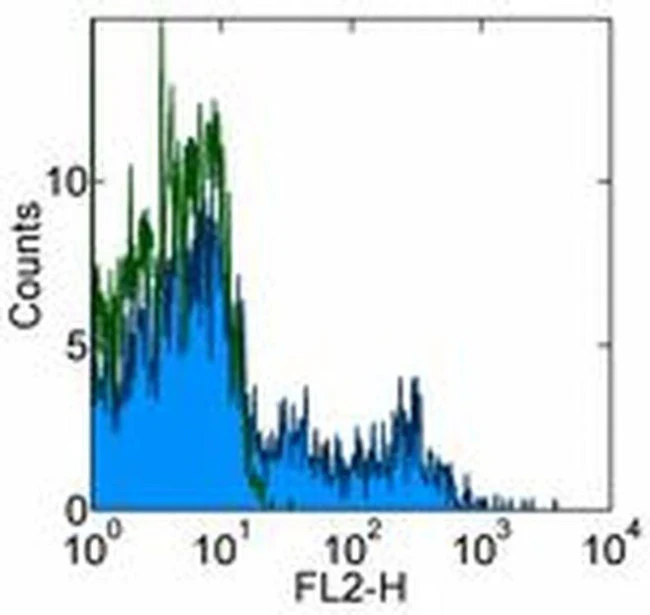
Applications Tested: This OKT8 (OKT-8) antibody has been tested by flow cytometric analysis of normal human peripheral blood cells. This can be used at less than or equal to 0.06 µg per test. A test is defined as the amount (µg) of antibody that will stain a cell sample in a final volume of 100 µL. Cell number should be determined empirically but can range from 10^5 to 10^8 cells/test. It is recommended that the antibody be carefully titrated for optimal performance in the assay of interest.
Filtration: 0.2 µm post-manufacturing filtered.
For Research Use Only. Not for use in diagnostic procedures. Not for resale without express authorization.
Original: $232.00
-70%$232.00
$69.60CD8a Monoclonal Antibody (OKT8 (OKT-8)), Biotin, eBioscience
PRODUCT DETAILS
Host: Mouse
Isotype: IgG2a, kappa
Clonality: Monoclonal
Clone: OKT8 (OKT-8)
Format: Biotin
Reactivity: Hu
Application: Flow Cytometry
Tested Dilution: 0.06 µg/test
Concentration: 0.5 mg/mL
Storage: 4°C, store in dark, DO NOT FREEZE!
Formulation: PBS with 0.09% sodium azide; pH 7.2
Purification: Affinity chromatography
Data Sheet: TDS
Specific Information
Description: The OKT8 monoclonal antibody reacts with the human CD8a molecule, an approximately 32-34 kDa cell surface receptor expressed either as a heterodimer with the CD8 beta chain (CD8 alpha beta) or as a homodimer (CD8 alpha alpha). A majority of thymocytes and a subpopulation of mature T cells and NK cells express CD8a. CD8 binds to MHC class I and through its association with protein tyrosine kinase p56lck plays a role in T-cell development and activation of mature T cells. Preliminary testing indicates that OKT8 and two other mouse anti-human CD8 antibodies (clone RPA-T8, Product # 14-0088 and clone HIT8a, Product # 14-0089) do not compete with each other for binding to human peripheral blood leukocytes by flow cytometric analysis, suggesting that they do not bind to similar epitopes or block each other by steric hindrance.
Applications Reported: This OKT8 (OKT-8) antibody has been reported for use in flow cytometric analysis.
Applications Tested: This OKT8 (OKT-8) antibody has been tested by flow cytometric analysis of normal human peripheral blood cells. This can be used at less than or equal to 0.06 µg per test. A test is defined as the amount (µg) of antibody that will stain a cell sample in a final volume of 100 µL. Cell number should be determined empirically but can range from 10^5 to 10^8 cells/test. It is recommended that the antibody be carefully titrated for optimal performance in the assay of interest.
Filtration: 0.2 µm post-manufacturing filtered.
For Research Use Only. Not for use in diagnostic procedures. Not for resale without express authorization.
Product Information
Product Information
Shipping & Returns
Shipping & Returns
Description
PRODUCT DETAILS
Host: Mouse
Isotype: IgG2a, kappa
Clonality: Monoclonal
Clone: OKT8 (OKT-8)
Format: Biotin
Reactivity: Hu
Application: Flow Cytometry
Tested Dilution: 0.06 µg/test
Concentration: 0.5 mg/mL
Storage: 4°C, store in dark, DO NOT FREEZE!
Formulation: PBS with 0.09% sodium azide; pH 7.2
Purification: Affinity chromatography
Data Sheet: TDS
Specific Information
Description: The OKT8 monoclonal antibody reacts with the human CD8a molecule, an approximately 32-34 kDa cell surface receptor expressed either as a heterodimer with the CD8 beta chain (CD8 alpha beta) or as a homodimer (CD8 alpha alpha). A majority of thymocytes and a subpopulation of mature T cells and NK cells express CD8a. CD8 binds to MHC class I and through its association with protein tyrosine kinase p56lck plays a role in T-cell development and activation of mature T cells. Preliminary testing indicates that OKT8 and two other mouse anti-human CD8 antibodies (clone RPA-T8, Product # 14-0088 and clone HIT8a, Product # 14-0089) do not compete with each other for binding to human peripheral blood leukocytes by flow cytometric analysis, suggesting that they do not bind to similar epitopes or block each other by steric hindrance.
Applications Reported: This OKT8 (OKT-8) antibody has been reported for use in flow cytometric analysis.
Applications Tested: This OKT8 (OKT-8) antibody has been tested by flow cytometric analysis of normal human peripheral blood cells. This can be used at less than or equal to 0.06 µg per test. A test is defined as the amount (µg) of antibody that will stain a cell sample in a final volume of 100 µL. Cell number should be determined empirically but can range from 10^5 to 10^8 cells/test. It is recommended that the antibody be carefully titrated for optimal performance in the assay of interest.
Filtration: 0.2 µm post-manufacturing filtered.
For Research Use Only. Not for use in diagnostic procedures. Not for resale without express authorization.