CD86 (B7-2) Monoclonal Antibody (GL1), Alexa Fluor 700, eBioscience
PRODUCT DETAILS
Host: Rat
Isotype: IgG2a, kappa
Clonality: Monoclonal
Clone: GL1
Format: Alexa Fluor 700
Reactivity: Ms
Application: Flow Cytometry
Tested Dilution: 0.125 µg/test
Concentration: 0.2 mg/mL
Storage: 4°C, store in dark, DO NOT FREEZE!
Formulation: PBS with 0.09% sodium azide; pH 7.2
Purification: Affinity chromatography
Data Sheet: TDS
Specific Information
Description: The GL1 monoclonal antibody reacts with mouse CD86, an approximately 80 kDa surface receptor also known as B7-2. CD86 and CD80 are members of the B7 family of costimulatory molecules. CD86 is expressed at low level on B cells, macrophages, and dendritic cells and is upregulated on B cells through a variety of surface stimuli including the BCR complex, CD40 and some cytokine receptors. CD86 is also expressed by activated mouse T cells and thioglycolate-elicited peritoneal cells. In addition to CD80 (B7-1), CD86 is a counter-receptor for the T cell surface molecules CD28 and CD152 (CTLA-4). This interaction plays a critical role in T-B crosstalk, T cell costimulation, autoantibody production and Th2-mediated Ig production. The kinetics of upregulation of CD86 upon stimulation, supports its major contribution during the primary phase of an immune response.
Applications Reported: This GL1 antibody has been reported for use in flow cytometric analysis.
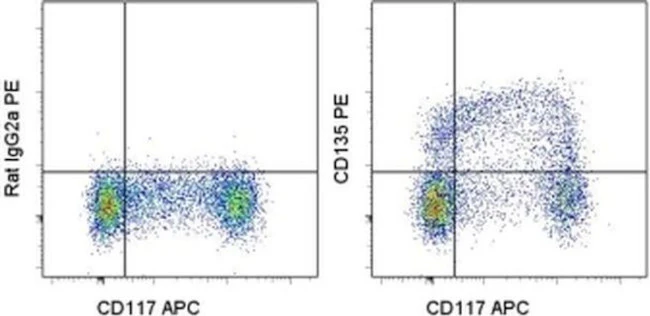
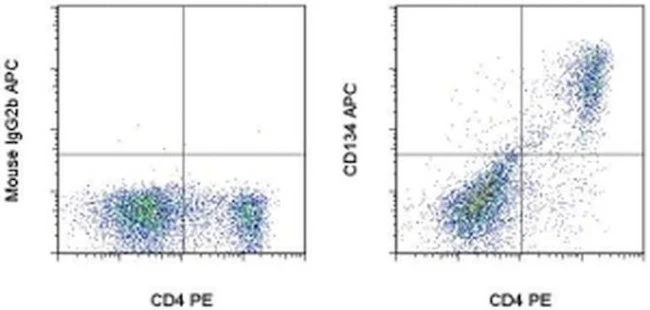
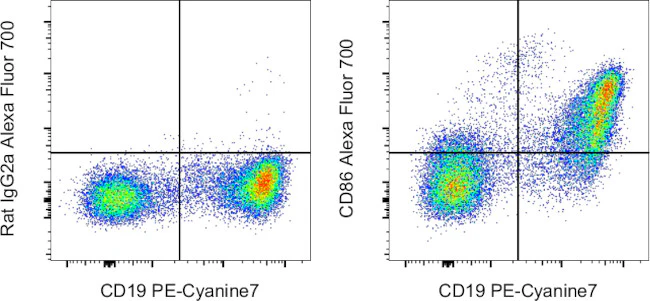
Applications Tested: This GL1 antibody has been tested by flow cytometric analysis of stimulated mouse splenocytes. This may be used at less than or equal to 0.125 µg per test. A test is defined as the amount (µg) of antibody that will stain a cell sample in a final volume of 100 µL. Cell number should be determined empirically but can range from 10^5 to 10^8 cells/test. It is recommended that the antibody be carefully titrated for optimal performance in the assay of interest.
Alexa Fluor 700 emits at 723 nm and can be excited with the red laser (633-647 nm). Most instruments will require a 685 LP mirror and 710/20 band pass filter. Please make sure that your instrument is capable of detecting this fluorochrome.
Excitation: 633-647 nm; Emission: 723 nm; Laser: Red Laser
For Research Use Only. Not for use in diagnostic procedures. Not for resale without express authorization.
CD86 (B7-2) Monoclonal Antibody (GL1), Alexa Fluor 700, eBioscience
PRODUCT DETAILS
Host: Rat
Isotype: IgG2a, kappa
Clonality: Monoclonal
Clone: GL1
Format: Alexa Fluor 700
Reactivity: Ms
Application: Flow Cytometry
Tested Dilution: 0.125 µg/test
Concentration: 0.2 mg/mL
Storage: 4°C, store in dark, DO NOT FREEZE!
Formulation: PBS with 0.09% sodium azide; pH 7.2
Purification: Affinity chromatography
Data Sheet: TDS
Specific Information
Description: The GL1 monoclonal antibody reacts with mouse CD86, an approximately 80 kDa surface receptor also known as B7-2. CD86 and CD80 are members of the B7 family of costimulatory molecules. CD86 is expressed at low level on B cells, macrophages, and dendritic cells and is upregulated on B cells through a variety of surface stimuli including the BCR complex, CD40 and some cytokine receptors. CD86 is also expressed by activated mouse T cells and thioglycolate-elicited peritoneal cells. In addition to CD80 (B7-1), CD86 is a counter-receptor for the T cell surface molecules CD28 and CD152 (CTLA-4). This interaction plays a critical role in T-B crosstalk, T cell costimulation, autoantibody production and Th2-mediated Ig production. The kinetics of upregulation of CD86 upon stimulation, supports its major contribution during the primary phase of an immune response.
Applications Reported: This GL1 antibody has been reported for use in flow cytometric analysis.
Applications Tested: This GL1 antibody has been tested by flow cytometric analysis of stimulated mouse splenocytes. This may be used at less than or equal to 0.125 µg per test. A test is defined as the amount (µg) of antibody that will stain a cell sample in a final volume of 100 µL. Cell number should be determined empirically but can range from 10^5 to 10^8 cells/test. It is recommended that the antibody be carefully titrated for optimal performance in the assay of interest.
Alexa Fluor 700 emits at 723 nm and can be excited with the red laser (633-647 nm). Most instruments will require a 685 LP mirror and 710/20 band pass filter. Please make sure that your instrument is capable of detecting this fluorochrome.
Excitation: 633-647 nm; Emission: 723 nm; Laser: Red Laser
For Research Use Only. Not for use in diagnostic procedures. Not for resale without express authorization.
Product Information
Product Information
Shipping & Returns
Shipping & Returns
Description
PRODUCT DETAILS
Host: Rat
Isotype: IgG2a, kappa
Clonality: Monoclonal
Clone: GL1
Format: Alexa Fluor 700
Reactivity: Ms
Application: Flow Cytometry
Tested Dilution: 0.125 µg/test
Concentration: 0.2 mg/mL
Storage: 4°C, store in dark, DO NOT FREEZE!
Formulation: PBS with 0.09% sodium azide; pH 7.2
Purification: Affinity chromatography
Data Sheet: TDS
Specific Information
Description: The GL1 monoclonal antibody reacts with mouse CD86, an approximately 80 kDa surface receptor also known as B7-2. CD86 and CD80 are members of the B7 family of costimulatory molecules. CD86 is expressed at low level on B cells, macrophages, and dendritic cells and is upregulated on B cells through a variety of surface stimuli including the BCR complex, CD40 and some cytokine receptors. CD86 is also expressed by activated mouse T cells and thioglycolate-elicited peritoneal cells. In addition to CD80 (B7-1), CD86 is a counter-receptor for the T cell surface molecules CD28 and CD152 (CTLA-4). This interaction plays a critical role in T-B crosstalk, T cell costimulation, autoantibody production and Th2-mediated Ig production. The kinetics of upregulation of CD86 upon stimulation, supports its major contribution during the primary phase of an immune response.
Applications Reported: This GL1 antibody has been reported for use in flow cytometric analysis.
Applications Tested: This GL1 antibody has been tested by flow cytometric analysis of stimulated mouse splenocytes. This may be used at less than or equal to 0.125 µg per test. A test is defined as the amount (µg) of antibody that will stain a cell sample in a final volume of 100 µL. Cell number should be determined empirically but can range from 10^5 to 10^8 cells/test. It is recommended that the antibody be carefully titrated for optimal performance in the assay of interest.
Alexa Fluor 700 emits at 723 nm and can be excited with the red laser (633-647 nm). Most instruments will require a 685 LP mirror and 710/20 band pass filter. Please make sure that your instrument is capable of detecting this fluorochrome.
Excitation: 633-647 nm; Emission: 723 nm; Laser: Red Laser
For Research Use Only. Not for use in diagnostic procedures. Not for resale without express authorization.