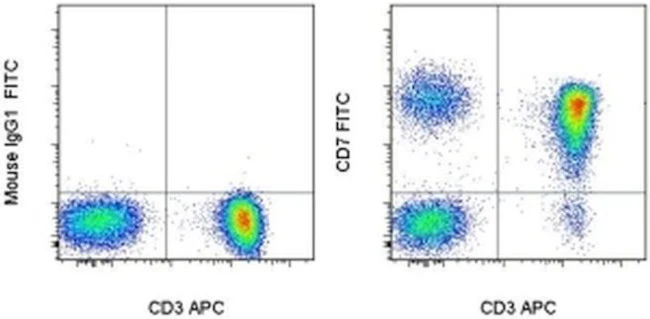
CD7 Monoclonal Antibody (eBio124-1D1 (124-1D1)), FITC, eBioscience
PRODUCT DETAILS
Host: Mouse
Isotype: IgG1, kappa
Clonality: Monoclonal
Clone: eBio124-1D1 (124-1D1)
Format: FITC
Reactivity: Hu
Application: Flow Cytometry
Tested Dilution: 5 µL (0.25 µg)/test
Concentration: 5 μL/Test
Storage: 4°C, store in dark, DO NOT FREEZE!
Formulation: PBS with BSA and 0.09% sodium azide; pH 7.2
Purification: Affinity chromatography
Data Sheet: TDS
Specific Information
Description: The eBio124-1D1 monoclonal antibody reacts with human CD7, also known as gp40 and Leu9. CD7, a 40 kD receptor, is a member of the immunoglobulin gene superfamily. The N-terminal amino acid sequence (aa1-107) is highly homologous to Ig kappa light chain sequence; while the carboxyl-terminal region of the extracellular domain is proline-rich and has been postulated to form a stalk from which the Ig domain projects. CD7 is expressed on the majority of immature and mature T lymphocytes, and T cell leukemias. It is also found on natural killer cells, a small suppopulation of normal B cells and on maligant B cells. Cross-linking surface CD7 positively modulates T cell and NK cell activity, as measured by calcium flux, expression of adhesion molecules, cytokine secretion and proliferation. CD7 associates directly with phosphoinositol 3'-kinase. CD7 ligation induces production of D-3 phosphoinositides and tyrosine phosphorylation.
A clonogenic subpopulation of human CD34(+) CD38(-) cord blood cells that express CD45RA and HLA-DR and high levels of the CD7 has been reported. These cells possess the capacity for lymphopoiesis. They can generate B-cells, natural killer cells, and dendritic cells but do not possess the capacity to develop into myeloid cells or erythroid cells. The CD7(+) phenotype distinguishes primitive human lymphoid progenitors from pluripotent stem cells.
Furthermore, it has been suggested that CD7 co-operates with CD28 during Treg function, as mice deficient in both CD28 and CD7 have reduced total numbers of Tregs and these Tregs have reduced suppressive activity.
Applications Reported: This eBio124-1D1 (124-1D1) antibody has been reported for use in flow cytometric analysis.
Applications Tested: This eBio124-1D1 (124-1D1) antibody has been pre-titrated and tested by flow cytometric analysis of normal human peripheral blood cells. This can be used at 5 µL (0.25 µg) per test. A test is defined as the amount (µg) of antibody that will stain a cell sample in a final volume of 100 µL. Cell number should be determined empirically but can range from 10^5 to 10^8 cells/test.
Excitation: 488 nm; Emission: 520 nm; Laser: Blue Laser.
Filtration: 0.2 µm post-manufacturing filtered.
For Research Use Only. Not for use in diagnostic procedures. Not for resale without express authorization.
CD7 Monoclonal Antibody (eBio124-1D1 (124-1D1)), FITC, eBioscience
PRODUCT DETAILS
Host: Mouse
Isotype: IgG1, kappa
Clonality: Monoclonal
Clone: eBio124-1D1 (124-1D1)
Format: FITC
Reactivity: Hu
Application: Flow Cytometry
Tested Dilution: 5 µL (0.25 µg)/test
Concentration: 5 μL/Test
Storage: 4°C, store in dark, DO NOT FREEZE!
Formulation: PBS with BSA and 0.09% sodium azide; pH 7.2
Purification: Affinity chromatography
Data Sheet: TDS
Specific Information
Description: The eBio124-1D1 monoclonal antibody reacts with human CD7, also known as gp40 and Leu9. CD7, a 40 kD receptor, is a member of the immunoglobulin gene superfamily. The N-terminal amino acid sequence (aa1-107) is highly homologous to Ig kappa light chain sequence; while the carboxyl-terminal region of the extracellular domain is proline-rich and has been postulated to form a stalk from which the Ig domain projects. CD7 is expressed on the majority of immature and mature T lymphocytes, and T cell leukemias. It is also found on natural killer cells, a small suppopulation of normal B cells and on maligant B cells. Cross-linking surface CD7 positively modulates T cell and NK cell activity, as measured by calcium flux, expression of adhesion molecules, cytokine secretion and proliferation. CD7 associates directly with phosphoinositol 3'-kinase. CD7 ligation induces production of D-3 phosphoinositides and tyrosine phosphorylation.
A clonogenic subpopulation of human CD34(+) CD38(-) cord blood cells that express CD45RA and HLA-DR and high levels of the CD7 has been reported. These cells possess the capacity for lymphopoiesis. They can generate B-cells, natural killer cells, and dendritic cells but do not possess the capacity to develop into myeloid cells or erythroid cells. The CD7(+) phenotype distinguishes primitive human lymphoid progenitors from pluripotent stem cells.
Furthermore, it has been suggested that CD7 co-operates with CD28 during Treg function, as mice deficient in both CD28 and CD7 have reduced total numbers of Tregs and these Tregs have reduced suppressive activity.
Applications Reported: This eBio124-1D1 (124-1D1) antibody has been reported for use in flow cytometric analysis.
Applications Tested: This eBio124-1D1 (124-1D1) antibody has been pre-titrated and tested by flow cytometric analysis of normal human peripheral blood cells. This can be used at 5 µL (0.25 µg) per test. A test is defined as the amount (µg) of antibody that will stain a cell sample in a final volume of 100 µL. Cell number should be determined empirically but can range from 10^5 to 10^8 cells/test.
Excitation: 488 nm; Emission: 520 nm; Laser: Blue Laser.
Filtration: 0.2 µm post-manufacturing filtered.
For Research Use Only. Not for use in diagnostic procedures. Not for resale without express authorization.
Product Information
Product Information
Shipping & Returns
Shipping & Returns
Description
PRODUCT DETAILS
Host: Mouse
Isotype: IgG1, kappa
Clonality: Monoclonal
Clone: eBio124-1D1 (124-1D1)
Format: FITC
Reactivity: Hu
Application: Flow Cytometry
Tested Dilution: 5 µL (0.25 µg)/test
Concentration: 5 μL/Test
Storage: 4°C, store in dark, DO NOT FREEZE!
Formulation: PBS with BSA and 0.09% sodium azide; pH 7.2
Purification: Affinity chromatography
Data Sheet: TDS
Specific Information
Description: The eBio124-1D1 monoclonal antibody reacts with human CD7, also known as gp40 and Leu9. CD7, a 40 kD receptor, is a member of the immunoglobulin gene superfamily. The N-terminal amino acid sequence (aa1-107) is highly homologous to Ig kappa light chain sequence; while the carboxyl-terminal region of the extracellular domain is proline-rich and has been postulated to form a stalk from which the Ig domain projects. CD7 is expressed on the majority of immature and mature T lymphocytes, and T cell leukemias. It is also found on natural killer cells, a small suppopulation of normal B cells and on maligant B cells. Cross-linking surface CD7 positively modulates T cell and NK cell activity, as measured by calcium flux, expression of adhesion molecules, cytokine secretion and proliferation. CD7 associates directly with phosphoinositol 3'-kinase. CD7 ligation induces production of D-3 phosphoinositides and tyrosine phosphorylation.
A clonogenic subpopulation of human CD34(+) CD38(-) cord blood cells that express CD45RA and HLA-DR and high levels of the CD7 has been reported. These cells possess the capacity for lymphopoiesis. They can generate B-cells, natural killer cells, and dendritic cells but do not possess the capacity to develop into myeloid cells or erythroid cells. The CD7(+) phenotype distinguishes primitive human lymphoid progenitors from pluripotent stem cells.
Furthermore, it has been suggested that CD7 co-operates with CD28 during Treg function, as mice deficient in both CD28 and CD7 have reduced total numbers of Tregs and these Tregs have reduced suppressive activity.
Applications Reported: This eBio124-1D1 (124-1D1) antibody has been reported for use in flow cytometric analysis.
Applications Tested: This eBio124-1D1 (124-1D1) antibody has been pre-titrated and tested by flow cytometric analysis of normal human peripheral blood cells. This can be used at 5 µL (0.25 µg) per test. A test is defined as the amount (µg) of antibody that will stain a cell sample in a final volume of 100 µL. Cell number should be determined empirically but can range from 10^5 to 10^8 cells/test.
Excitation: 488 nm; Emission: 520 nm; Laser: Blue Laser.
Filtration: 0.2 µm post-manufacturing filtered.
For Research Use Only. Not for use in diagnostic procedures. Not for resale without express authorization.