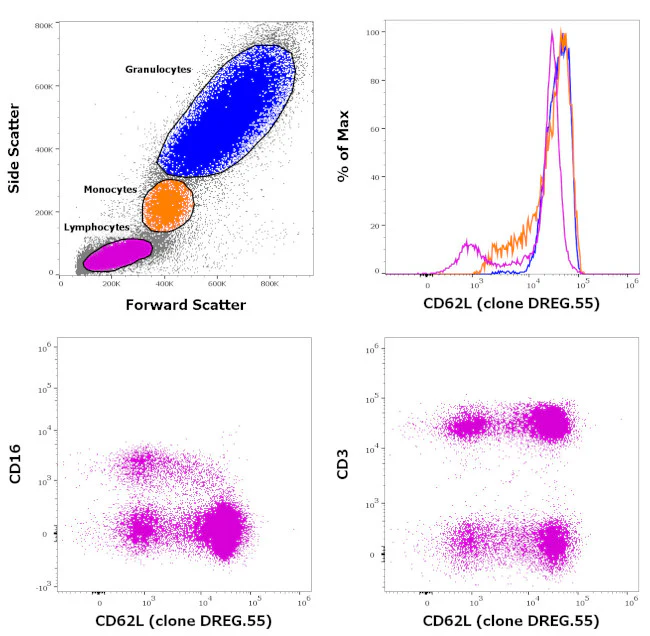
CD62L (L-Selectin) Monoclonal Antibody (DREG.55), FITC, eBioscience
PRODUCT DETAILS
Host: Mouse
Isotype: IgG1
Clonality: Monoclonal
Clone: DREG.55
Format: FITC
Reactivity: Hu
Application: Flow Cytometry
Tested Dilution: Assay-Dependent
Concentration: 10 μL/Test
Storage: 4°C, store in dark
Formulation: TBS with 1% BSA and 0.02% sodium azide; pH 7.2-7.4
Purification: Affinity chromatography
Data Sheet: TDS
Specific Information
Description: The antibody can be used to stain acetone-fixed cryostat sections or cell smears. BMS121 is not suitable for paraffin sections but is suitable as primary antibody in staining for FACS analysis.
BMS121FI can be used for direct staining of cells, BMS121BT can be used in a 2-step procedure using the biotin-(strept)avidin system.
BMS121 has not been tested in functional assays but is suitable for ELISA application.
Leukocyte-Endothelial Cell Adhesion Molecule-1 belongs to the selectin family of adhesion molecule. Together with E-selectin, P-selectin and L-selectin mediates the initial interactions of leukocytes with endothelial cells.
Selectins guide non-activated polymorphonuclear cells to the areas of inflammation in creating first, loose contacts with the endothelial layer. L-selectin in this aspect mediates rolling of PMN's on endothelial cells. The potential binding partners of L-selectin carry a negative charge, probably a sialic acid and/or sulphate, and may contain mannose and fucose. In addition, L-selectin may also interact with E-selectin which is expressed on cytokine-activated endothelial cells. L-selectin is constitutively expressed on most leukocytes in a seemingly functional form. It is required for the binding of lymphocytes to the high endothelial venules of peripheral lymph nodes and for the invasion of neutrophils into sites of inflammation.
When neutrophils are activated, L-selectin is shed by proteolytic cleveage near the transmembrane span. Lymphocytes and monocytes can also shed L-selectin upon activation although the kinetics are significantly lower. A broad range of activating agents are effective in inducing this response. The shed form of sL-selectin is functionally active and at high concentrations can inhibit leukocyte attachment to endothelium. The main source for sL-selectin in serum seems to be tissue localized leukocytes.
Applications Tested: Flow Cytometry.
Purity: >95%.
Excitation: 488 nm; Emission: 520 nm; Laser: Blue Laser
For Research Use Only. Not for use in diagnostic procedures. Not for resale without express authorization.
CD62L (L-Selectin) Monoclonal Antibody (DREG.55), FITC, eBioscience
PRODUCT DETAILS
Host: Mouse
Isotype: IgG1
Clonality: Monoclonal
Clone: DREG.55
Format: FITC
Reactivity: Hu
Application: Flow Cytometry
Tested Dilution: Assay-Dependent
Concentration: 10 μL/Test
Storage: 4°C, store in dark
Formulation: TBS with 1% BSA and 0.02% sodium azide; pH 7.2-7.4
Purification: Affinity chromatography
Data Sheet: TDS
Specific Information
Description: The antibody can be used to stain acetone-fixed cryostat sections or cell smears. BMS121 is not suitable for paraffin sections but is suitable as primary antibody in staining for FACS analysis.
BMS121FI can be used for direct staining of cells, BMS121BT can be used in a 2-step procedure using the biotin-(strept)avidin system.
BMS121 has not been tested in functional assays but is suitable for ELISA application.
Leukocyte-Endothelial Cell Adhesion Molecule-1 belongs to the selectin family of adhesion molecule. Together with E-selectin, P-selectin and L-selectin mediates the initial interactions of leukocytes with endothelial cells.
Selectins guide non-activated polymorphonuclear cells to the areas of inflammation in creating first, loose contacts with the endothelial layer. L-selectin in this aspect mediates rolling of PMN's on endothelial cells. The potential binding partners of L-selectin carry a negative charge, probably a sialic acid and/or sulphate, and may contain mannose and fucose. In addition, L-selectin may also interact with E-selectin which is expressed on cytokine-activated endothelial cells. L-selectin is constitutively expressed on most leukocytes in a seemingly functional form. It is required for the binding of lymphocytes to the high endothelial venules of peripheral lymph nodes and for the invasion of neutrophils into sites of inflammation.
When neutrophils are activated, L-selectin is shed by proteolytic cleveage near the transmembrane span. Lymphocytes and monocytes can also shed L-selectin upon activation although the kinetics are significantly lower. A broad range of activating agents are effective in inducing this response. The shed form of sL-selectin is functionally active and at high concentrations can inhibit leukocyte attachment to endothelium. The main source for sL-selectin in serum seems to be tissue localized leukocytes.
Applications Tested: Flow Cytometry.
Purity: >95%.
Excitation: 488 nm; Emission: 520 nm; Laser: Blue Laser
For Research Use Only. Not for use in diagnostic procedures. Not for resale without express authorization.
Product Information
Product Information
Shipping & Returns
Shipping & Returns
Description
PRODUCT DETAILS
Host: Mouse
Isotype: IgG1
Clonality: Monoclonal
Clone: DREG.55
Format: FITC
Reactivity: Hu
Application: Flow Cytometry
Tested Dilution: Assay-Dependent
Concentration: 10 μL/Test
Storage: 4°C, store in dark
Formulation: TBS with 1% BSA and 0.02% sodium azide; pH 7.2-7.4
Purification: Affinity chromatography
Data Sheet: TDS
Specific Information
Description: The antibody can be used to stain acetone-fixed cryostat sections or cell smears. BMS121 is not suitable for paraffin sections but is suitable as primary antibody in staining for FACS analysis.
BMS121FI can be used for direct staining of cells, BMS121BT can be used in a 2-step procedure using the biotin-(strept)avidin system.
BMS121 has not been tested in functional assays but is suitable for ELISA application.
Leukocyte-Endothelial Cell Adhesion Molecule-1 belongs to the selectin family of adhesion molecule. Together with E-selectin, P-selectin and L-selectin mediates the initial interactions of leukocytes with endothelial cells.
Selectins guide non-activated polymorphonuclear cells to the areas of inflammation in creating first, loose contacts with the endothelial layer. L-selectin in this aspect mediates rolling of PMN's on endothelial cells. The potential binding partners of L-selectin carry a negative charge, probably a sialic acid and/or sulphate, and may contain mannose and fucose. In addition, L-selectin may also interact with E-selectin which is expressed on cytokine-activated endothelial cells. L-selectin is constitutively expressed on most leukocytes in a seemingly functional form. It is required for the binding of lymphocytes to the high endothelial venules of peripheral lymph nodes and for the invasion of neutrophils into sites of inflammation.
When neutrophils are activated, L-selectin is shed by proteolytic cleveage near the transmembrane span. Lymphocytes and monocytes can also shed L-selectin upon activation although the kinetics are significantly lower. A broad range of activating agents are effective in inducing this response. The shed form of sL-selectin is functionally active and at high concentrations can inhibit leukocyte attachment to endothelium. The main source for sL-selectin in serum seems to be tissue localized leukocytes.
Applications Tested: Flow Cytometry.
Purity: >95%.
Excitation: 488 nm; Emission: 520 nm; Laser: Blue Laser
For Research Use Only. Not for use in diagnostic procedures. Not for resale without express authorization.