CD61 (Integrin beta 3) Monoclonal Antibody (VI-PL2), Super Bright™ 645, eBioscience™
PRODUCT DETAILS
Host: Mouse
Isotype: IgG1, kappa
Clonality: Monoclonal
Clone: VI-PL2
Format: Super Bright™ 645
Reactivity: Baboon, Canine, Cynomolgus Monkey, Human, Rhesus Monkey
Application: Flow Cytometry
Tested Dilution: 5 µL (0.5 µg)/test
Concentration: 5 µL/Test
Storage: 4° C, store in dark, DO NOT FREEZE!
Formulation: PBS, pH 7.2, containing 0.09% sodium azide
Purification: Affinity chromatography
Data Sheet: TDS
Specific Information
Description: The VI-PL2 monoclonal antibody reacts with human CD61, also known as integrin beta 3 and GPIIIa. CD61 is a 90-110 kDa member of the beta integrin family expressed by a wide variety of cells, including leukocytes, platelets, endothelial and smooth muscle cells. CD61 binds non-covalently with the alpha integrins CD41 and CD51, to form the alpha IIb beta3 (CD41/CD61) and alpha v beta3 (CD51/CD61) complexes. These alpha beta heterodimers are capable of mediating a variety of cellular responses including adhesion, trafficking, proliferaton and differentiation. The CD41/CD61 integrin has been shown to be involved in platelet aggregation, and binds to fibrinogen, von Willebrand Factor (vWF) and fibronectin. The CD51/CD61 integrin binds to matrix proteins including vitronectin, fibronectin, vWF and fibrinogen, and has been shown to have a strong role in modulating the migration and survival of angiogenic endothelial cells.
This VI-PL2 antibody has also been shown to crossreact with canine and several non-human primate species, including baboon, rhesus, and cynomologus monkey.
Applications Reported: This VI-PL2 antibody has been reported for use in flow cytometric analysis.
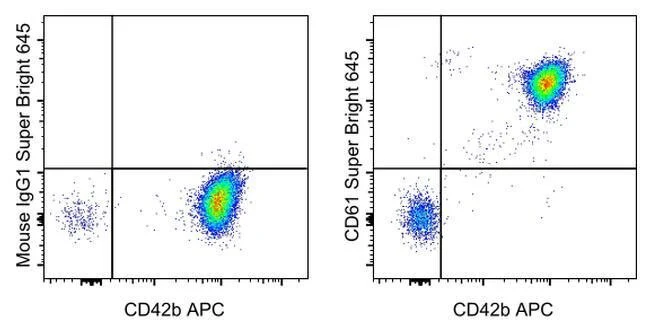
Applications Tested: This VI-PL2 antibody has been pre-diluted and tested by flow cytometric analysis of normal human platelets. This may be used at 5 µL (0.5 µg) per test. A test is defined as the amount (µg) of antibody that will stain a cell sample in a final volume of 100 µL. Cell number should be determined empirically but can range from 10^5 to 10^8 cells/test.
Super Bright 645 is a tandem dye that can be excited with the violet laser line (405 nm) and emits at 645 nm. We recommend using a 660/20 bandpass filter. Please make sure that your instrument is capable of detecting this fluorochrome.
When using two or more Super Bright dye-conjugated antibodies in a staining panel, it is recommended to use Super Bright Complete Staining Buffer (Product # SB-4401) to minimize any non-specific polymer interactions. Please refer to the datasheet for Super Bright Staining Buffer for more information.
Light sensitivity: This tandem dye is sensitive to photo-induced oxidation. Please protect this vial and stained samples from light.
Fixation: Samples can be stored in IC Fixation Buffer (Product # 00-8222) (100 µL of cell sample + 100 µL of IC Fixation Buffer) or 1-step Fix/Lyse Solution (Product # 00-5333) for up to 3 days in the dark at 4°C with minimal impact on brightness and FRET efficiency/compensation. Some generalizations regarding fluorophore performance after fixation can be made, but clone specific performance should be determined empirically.
Excitation: 405 nm; Emission: 645 nm; Laser: Violet Laser
Super Bright Polymer Dyes are sold under license from Becton, Dickinson and Company.
For Research Use Only. Not for use in diagnostic procedures. Not for resale without express authorization.
Original: $150.00
-70%$150.00
$45.00CD61 (Integrin beta 3) Monoclonal Antibody (VI-PL2), Super Bright™ 645, eBioscience™
PRODUCT DETAILS
Host: Mouse
Isotype: IgG1, kappa
Clonality: Monoclonal
Clone: VI-PL2
Format: Super Bright™ 645
Reactivity: Baboon, Canine, Cynomolgus Monkey, Human, Rhesus Monkey
Application: Flow Cytometry
Tested Dilution: 5 µL (0.5 µg)/test
Concentration: 5 µL/Test
Storage: 4° C, store in dark, DO NOT FREEZE!
Formulation: PBS, pH 7.2, containing 0.09% sodium azide
Purification: Affinity chromatography
Data Sheet: TDS
Specific Information
Description: The VI-PL2 monoclonal antibody reacts with human CD61, also known as integrin beta 3 and GPIIIa. CD61 is a 90-110 kDa member of the beta integrin family expressed by a wide variety of cells, including leukocytes, platelets, endothelial and smooth muscle cells. CD61 binds non-covalently with the alpha integrins CD41 and CD51, to form the alpha IIb beta3 (CD41/CD61) and alpha v beta3 (CD51/CD61) complexes. These alpha beta heterodimers are capable of mediating a variety of cellular responses including adhesion, trafficking, proliferaton and differentiation. The CD41/CD61 integrin has been shown to be involved in platelet aggregation, and binds to fibrinogen, von Willebrand Factor (vWF) and fibronectin. The CD51/CD61 integrin binds to matrix proteins including vitronectin, fibronectin, vWF and fibrinogen, and has been shown to have a strong role in modulating the migration and survival of angiogenic endothelial cells.
This VI-PL2 antibody has also been shown to crossreact with canine and several non-human primate species, including baboon, rhesus, and cynomologus monkey.
Applications Reported: This VI-PL2 antibody has been reported for use in flow cytometric analysis.
Applications Tested: This VI-PL2 antibody has been pre-diluted and tested by flow cytometric analysis of normal human platelets. This may be used at 5 µL (0.5 µg) per test. A test is defined as the amount (µg) of antibody that will stain a cell sample in a final volume of 100 µL. Cell number should be determined empirically but can range from 10^5 to 10^8 cells/test.
Super Bright 645 is a tandem dye that can be excited with the violet laser line (405 nm) and emits at 645 nm. We recommend using a 660/20 bandpass filter. Please make sure that your instrument is capable of detecting this fluorochrome.
When using two or more Super Bright dye-conjugated antibodies in a staining panel, it is recommended to use Super Bright Complete Staining Buffer (Product # SB-4401) to minimize any non-specific polymer interactions. Please refer to the datasheet for Super Bright Staining Buffer for more information.
Light sensitivity: This tandem dye is sensitive to photo-induced oxidation. Please protect this vial and stained samples from light.
Fixation: Samples can be stored in IC Fixation Buffer (Product # 00-8222) (100 µL of cell sample + 100 µL of IC Fixation Buffer) or 1-step Fix/Lyse Solution (Product # 00-5333) for up to 3 days in the dark at 4°C with minimal impact on brightness and FRET efficiency/compensation. Some generalizations regarding fluorophore performance after fixation can be made, but clone specific performance should be determined empirically.
Excitation: 405 nm; Emission: 645 nm; Laser: Violet Laser
Super Bright Polymer Dyes are sold under license from Becton, Dickinson and Company.
For Research Use Only. Not for use in diagnostic procedures. Not for resale without express authorization.
Product Information
Product Information
Shipping & Returns
Shipping & Returns
Description
PRODUCT DETAILS
Host: Mouse
Isotype: IgG1, kappa
Clonality: Monoclonal
Clone: VI-PL2
Format: Super Bright™ 645
Reactivity: Baboon, Canine, Cynomolgus Monkey, Human, Rhesus Monkey
Application: Flow Cytometry
Tested Dilution: 5 µL (0.5 µg)/test
Concentration: 5 µL/Test
Storage: 4° C, store in dark, DO NOT FREEZE!
Formulation: PBS, pH 7.2, containing 0.09% sodium azide
Purification: Affinity chromatography
Data Sheet: TDS
Specific Information
Description: The VI-PL2 monoclonal antibody reacts with human CD61, also known as integrin beta 3 and GPIIIa. CD61 is a 90-110 kDa member of the beta integrin family expressed by a wide variety of cells, including leukocytes, platelets, endothelial and smooth muscle cells. CD61 binds non-covalently with the alpha integrins CD41 and CD51, to form the alpha IIb beta3 (CD41/CD61) and alpha v beta3 (CD51/CD61) complexes. These alpha beta heterodimers are capable of mediating a variety of cellular responses including adhesion, trafficking, proliferaton and differentiation. The CD41/CD61 integrin has been shown to be involved in platelet aggregation, and binds to fibrinogen, von Willebrand Factor (vWF) and fibronectin. The CD51/CD61 integrin binds to matrix proteins including vitronectin, fibronectin, vWF and fibrinogen, and has been shown to have a strong role in modulating the migration and survival of angiogenic endothelial cells.
This VI-PL2 antibody has also been shown to crossreact with canine and several non-human primate species, including baboon, rhesus, and cynomologus monkey.
Applications Reported: This VI-PL2 antibody has been reported for use in flow cytometric analysis.
Applications Tested: This VI-PL2 antibody has been pre-diluted and tested by flow cytometric analysis of normal human platelets. This may be used at 5 µL (0.5 µg) per test. A test is defined as the amount (µg) of antibody that will stain a cell sample in a final volume of 100 µL. Cell number should be determined empirically but can range from 10^5 to 10^8 cells/test.
Super Bright 645 is a tandem dye that can be excited with the violet laser line (405 nm) and emits at 645 nm. We recommend using a 660/20 bandpass filter. Please make sure that your instrument is capable of detecting this fluorochrome.
When using two or more Super Bright dye-conjugated antibodies in a staining panel, it is recommended to use Super Bright Complete Staining Buffer (Product # SB-4401) to minimize any non-specific polymer interactions. Please refer to the datasheet for Super Bright Staining Buffer for more information.
Light sensitivity: This tandem dye is sensitive to photo-induced oxidation. Please protect this vial and stained samples from light.
Fixation: Samples can be stored in IC Fixation Buffer (Product # 00-8222) (100 µL of cell sample + 100 µL of IC Fixation Buffer) or 1-step Fix/Lyse Solution (Product # 00-5333) for up to 3 days in the dark at 4°C with minimal impact on brightness and FRET efficiency/compensation. Some generalizations regarding fluorophore performance after fixation can be made, but clone specific performance should be determined empirically.
Excitation: 405 nm; Emission: 645 nm; Laser: Violet Laser
Super Bright Polymer Dyes are sold under license from Becton, Dickinson and Company.
For Research Use Only. Not for use in diagnostic procedures. Not for resale without express authorization.