CD36 Monoclonal Antibody (eBioNL07 (NL07)), eBioscience
PRODUCT DETAILS
Host: Mouse
Isotype: IgM
Clonality: Monoclonal
Clone: eBioNL07 (NL07)
Reactivity: Hu
Application: Flow Cytometry
Tested Dilution: 0.5 µg/test
Concentration: 0.5 mg/mL
Storage: 4°C
Formulation: PBS with 0.09% sodium azide; pH 7.2
Purification: Affinity chromatography
Data Sheet: TDS
Specific Information
Description: The monoclonal antibody eBioNL07 recognizes human CD36, which is a member of the class B scavenger receptor family. CD36 was originally identified as a platelet-membrane glycoprotein also called glycoprotein IV and a receptor for thrombospondin-1 (TSP-1) and extracellular matrix proteins. Binding to TSP-1 is in the CLESH (CD36 LIMP-II Emp sequence homology) domain of CD36. CD36 expression is broad and includes microvascular (but not large vessel) endothelium, adipocytes, skeletal muscle, dendritic cells, epithelia of the retina, breast, and intestine, smooth muscle cells, and hematopoietic cells, including erythroid precursors, platelets, monocytes/macrophages, DCs and megakaryocytes. Expression on platelets is absent on Nak^a negative donors. Unlike other scavenger receptor, CD36 binds LDL that has been exposed to "minimally" oxidizing conditions. CD36 is also a fatty acid translocase (FAT) necessary for the transport of long-chain fatty acids (LCFAs) and therefore may play a role in atherosclerosis.
Applications Reported: This eBioNL07 (NL07) antibody has been reported for use in flow cytometric analysis.
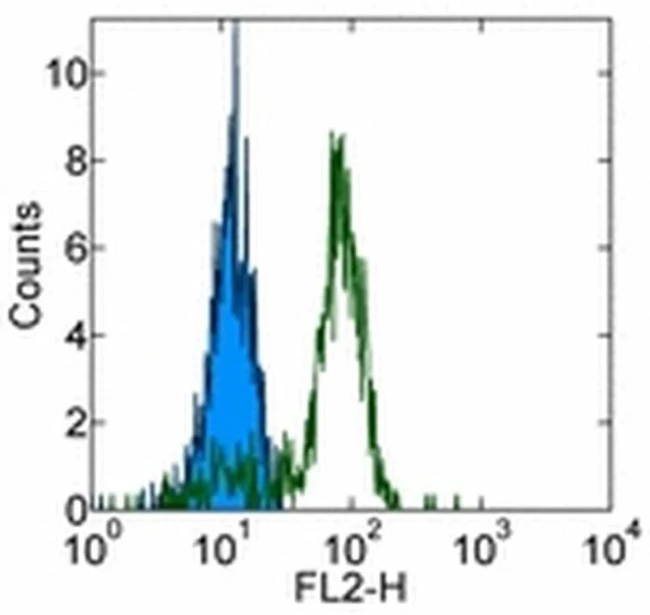
Applications Tested: This eBioNL07 (NL07) antibody has been tested by flow cytometric analysis of human peripheral blood cells. This can be used at less than or equal to 0.5 µg per test. A test is defined as the amount (µg) of antibody that will stain a cell sample in a final volume of 100 µL. Cell number should be determined empirically but can range from 10^5 to 10^8 cells/test. It is recommended that the antibody be carefully titrated for optimal performance in the assay of interest.
Purity: Greater than 90%, as determined by SDS-PAGE.
Aggregation: Less than 10%, as determined by HPLC.
Filtration: 0.2 µm post-manufacturing filtered.
For Research Use Only. Not for use in diagnostic procedures. Not for resale without express authorization.
CD36 Monoclonal Antibody (eBioNL07 (NL07)), eBioscience
PRODUCT DETAILS
Host: Mouse
Isotype: IgM
Clonality: Monoclonal
Clone: eBioNL07 (NL07)
Reactivity: Hu
Application: Flow Cytometry
Tested Dilution: 0.5 µg/test
Concentration: 0.5 mg/mL
Storage: 4°C
Formulation: PBS with 0.09% sodium azide; pH 7.2
Purification: Affinity chromatography
Data Sheet: TDS
Specific Information
Description: The monoclonal antibody eBioNL07 recognizes human CD36, which is a member of the class B scavenger receptor family. CD36 was originally identified as a platelet-membrane glycoprotein also called glycoprotein IV and a receptor for thrombospondin-1 (TSP-1) and extracellular matrix proteins. Binding to TSP-1 is in the CLESH (CD36 LIMP-II Emp sequence homology) domain of CD36. CD36 expression is broad and includes microvascular (but not large vessel) endothelium, adipocytes, skeletal muscle, dendritic cells, epithelia of the retina, breast, and intestine, smooth muscle cells, and hematopoietic cells, including erythroid precursors, platelets, monocytes/macrophages, DCs and megakaryocytes. Expression on platelets is absent on Nak^a negative donors. Unlike other scavenger receptor, CD36 binds LDL that has been exposed to "minimally" oxidizing conditions. CD36 is also a fatty acid translocase (FAT) necessary for the transport of long-chain fatty acids (LCFAs) and therefore may play a role in atherosclerosis.
Applications Reported: This eBioNL07 (NL07) antibody has been reported for use in flow cytometric analysis.
Applications Tested: This eBioNL07 (NL07) antibody has been tested by flow cytometric analysis of human peripheral blood cells. This can be used at less than or equal to 0.5 µg per test. A test is defined as the amount (µg) of antibody that will stain a cell sample in a final volume of 100 µL. Cell number should be determined empirically but can range from 10^5 to 10^8 cells/test. It is recommended that the antibody be carefully titrated for optimal performance in the assay of interest.
Purity: Greater than 90%, as determined by SDS-PAGE.
Aggregation: Less than 10%, as determined by HPLC.
Filtration: 0.2 µm post-manufacturing filtered.
For Research Use Only. Not for use in diagnostic procedures. Not for resale without express authorization.
Product Information
Product Information
Shipping & Returns
Shipping & Returns
Description
PRODUCT DETAILS
Host: Mouse
Isotype: IgM
Clonality: Monoclonal
Clone: eBioNL07 (NL07)
Reactivity: Hu
Application: Flow Cytometry
Tested Dilution: 0.5 µg/test
Concentration: 0.5 mg/mL
Storage: 4°C
Formulation: PBS with 0.09% sodium azide; pH 7.2
Purification: Affinity chromatography
Data Sheet: TDS
Specific Information
Description: The monoclonal antibody eBioNL07 recognizes human CD36, which is a member of the class B scavenger receptor family. CD36 was originally identified as a platelet-membrane glycoprotein also called glycoprotein IV and a receptor for thrombospondin-1 (TSP-1) and extracellular matrix proteins. Binding to TSP-1 is in the CLESH (CD36 LIMP-II Emp sequence homology) domain of CD36. CD36 expression is broad and includes microvascular (but not large vessel) endothelium, adipocytes, skeletal muscle, dendritic cells, epithelia of the retina, breast, and intestine, smooth muscle cells, and hematopoietic cells, including erythroid precursors, platelets, monocytes/macrophages, DCs and megakaryocytes. Expression on platelets is absent on Nak^a negative donors. Unlike other scavenger receptor, CD36 binds LDL that has been exposed to "minimally" oxidizing conditions. CD36 is also a fatty acid translocase (FAT) necessary for the transport of long-chain fatty acids (LCFAs) and therefore may play a role in atherosclerosis.
Applications Reported: This eBioNL07 (NL07) antibody has been reported for use in flow cytometric analysis.
Applications Tested: This eBioNL07 (NL07) antibody has been tested by flow cytometric analysis of human peripheral blood cells. This can be used at less than or equal to 0.5 µg per test. A test is defined as the amount (µg) of antibody that will stain a cell sample in a final volume of 100 µL. Cell number should be determined empirically but can range from 10^5 to 10^8 cells/test. It is recommended that the antibody be carefully titrated for optimal performance in the assay of interest.
Purity: Greater than 90%, as determined by SDS-PAGE.
Aggregation: Less than 10%, as determined by HPLC.
Filtration: 0.2 µm post-manufacturing filtered.
For Research Use Only. Not for use in diagnostic procedures. Not for resale without express authorization.