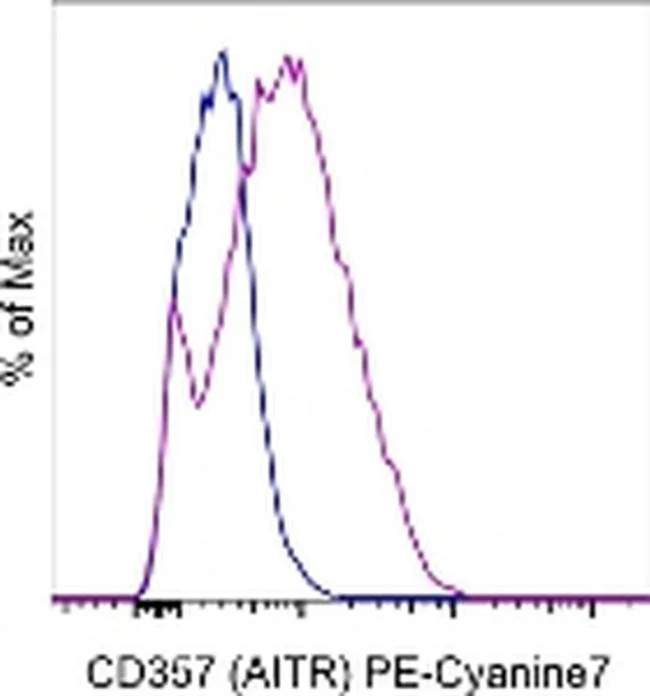
CD357 (AITR/GITR) Monoclonal Antibody (eBioAITR), PE-Cyanine7, eBioscience
PRODUCT DETAILS
Host: Mouse
Isotype: IgG1, kappa
Clonality: Monoclonal
Clone: eBioAITR
Format: PE-Cyanine7
Reactivity: Hu
Application: Flow Cytometry
Tested Dilution: 5 µL (1 µg)/test
Concentration: 5 μL/Test
Storage: 4°C, store in dark, DO NOT FREEZE!
Formulation: PBS with BSA and 0.09% sodium azide; pH 7.2
Purification: Affinity chromatography
Data Sheet: TDS
Specific Information
Description: The monoclonal antibody reacts with human AITR, Activation Inducible TNFR family member, an approximately 25 kDa member of the TNFR superfamily. AITR mRNA is detected in lymph node, peripheral blood leukocytes and weakly in spleen. AITR mRNA expression was upregulated within 24 hour on PMA/ionomycin or PHA stimulated PBMC. At the protein level, AITR is expressed by a small population of activated PBMC. AITR associates with TRAF1, TRAF2 and TRAF3 and induces nuclear factor NF-kappaB activation via TRAF2. Recently TL6 (AITRL) has been reported as the ligand for AITR. Interaction of AITR with AITRL is important for cross-talk between T lymphocytes and endothelial cells.
Applications Reported: This eBioAITR antibody has been reported for use in flow cytometric analysis.
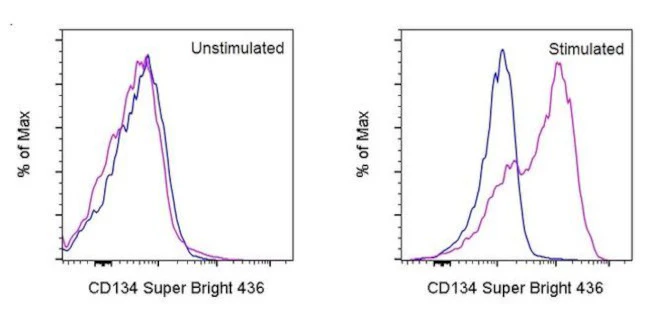
Applications Tested: This eBioAITR antibody has been pre-titrated and tested by flow cytometric analysis of stimulated normal human peripheral blood cells. This can be used at 5 µL (1.0 µg) per test. A test is defined as the amount (µg) of antibody that will stain a cell sample in a final volume of 100 µL. Cell number should be determined empirically but can range from 10^5 to 10^8 cells/test.
Light sensitivity: This tandem dye is sensitive to photo-induced oxidation. Please protect this vial and stained samples from light.
Fixation: Samples can be stored in IC Fixation Buffer (Product # 00-822-49) (100 µL of cell sample + 100 µL of IC Fixation Buffer) or 1-step Fix/Lyse Solution (Product # 00-5333-54) for up to 3 days in the dark at 4°C with minimal impact on brightness and FRET efficiency/compensation. Some generalizations regarding fluorophore performance after fixation can be made, but clone specific performance should be determined empirically.
Excitation: 488-561 nm; Emission: 775 nm; Laser: Blue Laser, Green Laser, Yellow-Green Laser.
Filtration: 0.2 µm post-manufacturing filtered.
For Research Use Only. Not for use in diagnostic procedures. Not for resale without express authorization.
CD357 (AITR/GITR) Monoclonal Antibody (eBioAITR), PE-Cyanine7, eBioscience
PRODUCT DETAILS
Host: Mouse
Isotype: IgG1, kappa
Clonality: Monoclonal
Clone: eBioAITR
Format: PE-Cyanine7
Reactivity: Hu
Application: Flow Cytometry
Tested Dilution: 5 µL (1 µg)/test
Concentration: 5 μL/Test
Storage: 4°C, store in dark, DO NOT FREEZE!
Formulation: PBS with BSA and 0.09% sodium azide; pH 7.2
Purification: Affinity chromatography
Data Sheet: TDS
Specific Information
Description: The monoclonal antibody reacts with human AITR, Activation Inducible TNFR family member, an approximately 25 kDa member of the TNFR superfamily. AITR mRNA is detected in lymph node, peripheral blood leukocytes and weakly in spleen. AITR mRNA expression was upregulated within 24 hour on PMA/ionomycin or PHA stimulated PBMC. At the protein level, AITR is expressed by a small population of activated PBMC. AITR associates with TRAF1, TRAF2 and TRAF3 and induces nuclear factor NF-kappaB activation via TRAF2. Recently TL6 (AITRL) has been reported as the ligand for AITR. Interaction of AITR with AITRL is important for cross-talk between T lymphocytes and endothelial cells.
Applications Reported: This eBioAITR antibody has been reported for use in flow cytometric analysis.
Applications Tested: This eBioAITR antibody has been pre-titrated and tested by flow cytometric analysis of stimulated normal human peripheral blood cells. This can be used at 5 µL (1.0 µg) per test. A test is defined as the amount (µg) of antibody that will stain a cell sample in a final volume of 100 µL. Cell number should be determined empirically but can range from 10^5 to 10^8 cells/test.
Light sensitivity: This tandem dye is sensitive to photo-induced oxidation. Please protect this vial and stained samples from light.
Fixation: Samples can be stored in IC Fixation Buffer (Product # 00-822-49) (100 µL of cell sample + 100 µL of IC Fixation Buffer) or 1-step Fix/Lyse Solution (Product # 00-5333-54) for up to 3 days in the dark at 4°C with minimal impact on brightness and FRET efficiency/compensation. Some generalizations regarding fluorophore performance after fixation can be made, but clone specific performance should be determined empirically.
Excitation: 488-561 nm; Emission: 775 nm; Laser: Blue Laser, Green Laser, Yellow-Green Laser.
Filtration: 0.2 µm post-manufacturing filtered.
For Research Use Only. Not for use in diagnostic procedures. Not for resale without express authorization.
Product Information
Product Information
Shipping & Returns
Shipping & Returns
Description
PRODUCT DETAILS
Host: Mouse
Isotype: IgG1, kappa
Clonality: Monoclonal
Clone: eBioAITR
Format: PE-Cyanine7
Reactivity: Hu
Application: Flow Cytometry
Tested Dilution: 5 µL (1 µg)/test
Concentration: 5 μL/Test
Storage: 4°C, store in dark, DO NOT FREEZE!
Formulation: PBS with BSA and 0.09% sodium azide; pH 7.2
Purification: Affinity chromatography
Data Sheet: TDS
Specific Information
Description: The monoclonal antibody reacts with human AITR, Activation Inducible TNFR family member, an approximately 25 kDa member of the TNFR superfamily. AITR mRNA is detected in lymph node, peripheral blood leukocytes and weakly in spleen. AITR mRNA expression was upregulated within 24 hour on PMA/ionomycin or PHA stimulated PBMC. At the protein level, AITR is expressed by a small population of activated PBMC. AITR associates with TRAF1, TRAF2 and TRAF3 and induces nuclear factor NF-kappaB activation via TRAF2. Recently TL6 (AITRL) has been reported as the ligand for AITR. Interaction of AITR with AITRL is important for cross-talk between T lymphocytes and endothelial cells.
Applications Reported: This eBioAITR antibody has been reported for use in flow cytometric analysis.
Applications Tested: This eBioAITR antibody has been pre-titrated and tested by flow cytometric analysis of stimulated normal human peripheral blood cells. This can be used at 5 µL (1.0 µg) per test. A test is defined as the amount (µg) of antibody that will stain a cell sample in a final volume of 100 µL. Cell number should be determined empirically but can range from 10^5 to 10^8 cells/test.
Light sensitivity: This tandem dye is sensitive to photo-induced oxidation. Please protect this vial and stained samples from light.
Fixation: Samples can be stored in IC Fixation Buffer (Product # 00-822-49) (100 µL of cell sample + 100 µL of IC Fixation Buffer) or 1-step Fix/Lyse Solution (Product # 00-5333-54) for up to 3 days in the dark at 4°C with minimal impact on brightness and FRET efficiency/compensation. Some generalizations regarding fluorophore performance after fixation can be made, but clone specific performance should be determined empirically.
Excitation: 488-561 nm; Emission: 775 nm; Laser: Blue Laser, Green Laser, Yellow-Green Laser.
Filtration: 0.2 µm post-manufacturing filtered.
For Research Use Only. Not for use in diagnostic procedures. Not for resale without express authorization.