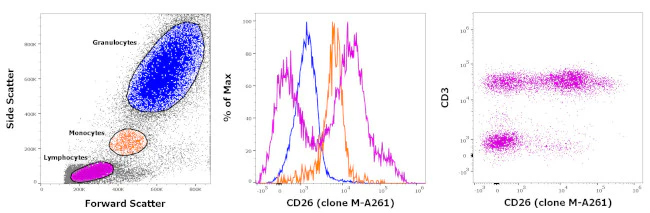
CD26 Monoclonal Antibody (M-A261), Biotin, eBioscience
PRODUCT DETAILS
Host: Mouse
Isotype: IgG1
Clonality: Monoclonal
Clone: M-A261
Format: Biotin
Reactivity: Hu
Application: Flow Cytometry
Tested Dilution: Assay-Dependent
Concentration: 10 μL/Test
Storage: 2-8°C
Formulation: TBS with 1% BSA and 0.02% sodium azide; pH 7.2-7.4
Purification: Affinity chromatography
Data Sheet: TDS
Specific Information
Description: CD26 is a 110 kD type II membrane protein encoded by the DPP4 gene. It is an antigenic enzyme expressed on the surface of most cell types and is associated with immune regulation, signal transduction and apoptosis. It also plays an integral role as a costimulatory molecule in T cell activation. CD26 may interact with extracellular matrix proteins such as fibronectin or collagen, CD45 and ADA.
Immunohistochemistry:
The antibody can be used to stain cryostat sections. Recommended for BMS143 is the alkaline phosphatase-anti-alkaline-phosphatase (APAAP), or peroxidase anti-peroxidase (PAP) procedures or the three stage immunoperoxidase technique on acetone-fixed cryostat sections.
Flow cytometry:
BMS143 is also suitable as primary antibody in staining for FACS analysis, BMS143FI can be used for direct staining of cells, BMS143BT can be used in a two-step procedure using the biotin-(strept-)avidin system. Recommended dilution is 1:20 as determined on A704 cells.
Immunoprecipitation:
BMS143 is also suitable for immunoprecipitation. Optimal dilutions should be determined by the individual laboratory for each application.
Applications Tested: Flow Cytometry.
Purity: >95%.
For Research Use Only. Not for use in diagnostic procedures. Not for resale without express authorization.
CD26 Monoclonal Antibody (M-A261), Biotin, eBioscience
PRODUCT DETAILS
Host: Mouse
Isotype: IgG1
Clonality: Monoclonal
Clone: M-A261
Format: Biotin
Reactivity: Hu
Application: Flow Cytometry
Tested Dilution: Assay-Dependent
Concentration: 10 μL/Test
Storage: 2-8°C
Formulation: TBS with 1% BSA and 0.02% sodium azide; pH 7.2-7.4
Purification: Affinity chromatography
Data Sheet: TDS
Specific Information
Description: CD26 is a 110 kD type II membrane protein encoded by the DPP4 gene. It is an antigenic enzyme expressed on the surface of most cell types and is associated with immune regulation, signal transduction and apoptosis. It also plays an integral role as a costimulatory molecule in T cell activation. CD26 may interact with extracellular matrix proteins such as fibronectin or collagen, CD45 and ADA.
Immunohistochemistry:
The antibody can be used to stain cryostat sections. Recommended for BMS143 is the alkaline phosphatase-anti-alkaline-phosphatase (APAAP), or peroxidase anti-peroxidase (PAP) procedures or the three stage immunoperoxidase technique on acetone-fixed cryostat sections.
Flow cytometry:
BMS143 is also suitable as primary antibody in staining for FACS analysis, BMS143FI can be used for direct staining of cells, BMS143BT can be used in a two-step procedure using the biotin-(strept-)avidin system. Recommended dilution is 1:20 as determined on A704 cells.
Immunoprecipitation:
BMS143 is also suitable for immunoprecipitation. Optimal dilutions should be determined by the individual laboratory for each application.
Applications Tested: Flow Cytometry.
Purity: >95%.
For Research Use Only. Not for use in diagnostic procedures. Not for resale without express authorization.
Product Information
Product Information
Shipping & Returns
Shipping & Returns
Description
PRODUCT DETAILS
Host: Mouse
Isotype: IgG1
Clonality: Monoclonal
Clone: M-A261
Format: Biotin
Reactivity: Hu
Application: Flow Cytometry
Tested Dilution: Assay-Dependent
Concentration: 10 μL/Test
Storage: 2-8°C
Formulation: TBS with 1% BSA and 0.02% sodium azide; pH 7.2-7.4
Purification: Affinity chromatography
Data Sheet: TDS
Specific Information
Description: CD26 is a 110 kD type II membrane protein encoded by the DPP4 gene. It is an antigenic enzyme expressed on the surface of most cell types and is associated with immune regulation, signal transduction and apoptosis. It also plays an integral role as a costimulatory molecule in T cell activation. CD26 may interact with extracellular matrix proteins such as fibronectin or collagen, CD45 and ADA.
Immunohistochemistry:
The antibody can be used to stain cryostat sections. Recommended for BMS143 is the alkaline phosphatase-anti-alkaline-phosphatase (APAAP), or peroxidase anti-peroxidase (PAP) procedures or the three stage immunoperoxidase technique on acetone-fixed cryostat sections.
Flow cytometry:
BMS143 is also suitable as primary antibody in staining for FACS analysis, BMS143FI can be used for direct staining of cells, BMS143BT can be used in a two-step procedure using the biotin-(strept-)avidin system. Recommended dilution is 1:20 as determined on A704 cells.
Immunoprecipitation:
BMS143 is also suitable for immunoprecipitation. Optimal dilutions should be determined by the individual laboratory for each application.
Applications Tested: Flow Cytometry.
Purity: >95%.
For Research Use Only. Not for use in diagnostic procedures. Not for resale without express authorization.