CD22 Monoclonal Antibody (S-HCL-1), APC, eBioscience
PRODUCT DETAILS
Host: Mouse
Isotype: IgG2b, kappa
Clonality: Monoclonal
Clone: S-HCL-1
Format: APC
Reactivity: Hu
Application: Flow Cytometry
Tested Dilution: 5 µL (0.125 µg)/test
Concentration: 5 μL/Test
Storage: 4°C, store in dark, DO NOT FREEZE!
Formulation: PBS with BSA and 0.09% sodium azide; pH 7.2
Purification: Affinity chromatography
Data Sheet: TDS
Specific Information
Description: The S-HCl-1 monoclonal antibody recognizes human CD22 (Siglec-2), which is a member of the siglec subgroup of the Ig superfamily. CD22 is a type I transmembrane glycoprotein composed of two polypeptide chains, CD22a and CD22β, of 130 and 140 kDa respectively, produced by alternative splicing of the CD22 gene. CD22 is expressed at high levels on mature B cells and B cell lymphomas. The extracellular portion of CD22 contains seven Ig-like domains, some of which are capable of binding ligands with sialic acid moieties expressed on epithelial, endothelial, B and T cells. The intracellular portion of CD22 contains 6 tyrosine residues contained within immunotyrosine-based inhibitory motifs (ITIM) and immunotyrosine-based activation-like motifs, which are phosphorylated upon B-cell receptor engagement, which enables CD22 to participate in the positive and negative regulation of B-cell receptor signaling.
Applications Reported: This S-HCL-1 antibody has been reported for use in flow cytometric analysis.
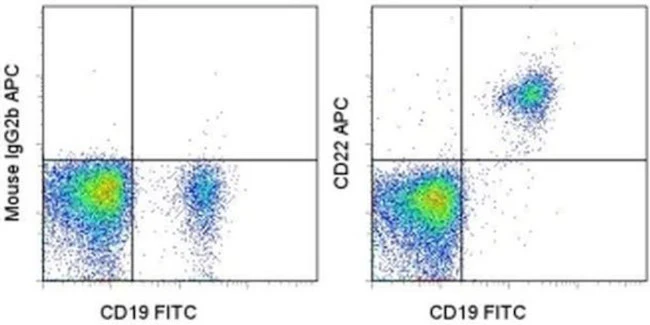
Applications Tested: This S-HCL-1 antibody has been pre-titrated and tested by flow cytometric analysis of normal human peripheral blood cells. This can be used at 5 µL (0.125 µg) per test. A test is defined as the amount (µg) of antibody that will stain a cell sample in a final volume of 100 µL. Cell number should be determined empirically but can range from 10^5 to 10^8 cells/test.
Excitation: 633-647 nm; Emission: 660 nm; Laser: Red Laser.
Filtration: 0.2 µm post-manufacturing filtered.
For Research Use Only. Not for use in diagnostic procedures. Not for resale without express authorization.
CD22 Monoclonal Antibody (S-HCL-1), APC, eBioscience
PRODUCT DETAILS
Host: Mouse
Isotype: IgG2b, kappa
Clonality: Monoclonal
Clone: S-HCL-1
Format: APC
Reactivity: Hu
Application: Flow Cytometry
Tested Dilution: 5 µL (0.125 µg)/test
Concentration: 5 μL/Test
Storage: 4°C, store in dark, DO NOT FREEZE!
Formulation: PBS with BSA and 0.09% sodium azide; pH 7.2
Purification: Affinity chromatography
Data Sheet: TDS
Specific Information
Description: The S-HCl-1 monoclonal antibody recognizes human CD22 (Siglec-2), which is a member of the siglec subgroup of the Ig superfamily. CD22 is a type I transmembrane glycoprotein composed of two polypeptide chains, CD22a and CD22β, of 130 and 140 kDa respectively, produced by alternative splicing of the CD22 gene. CD22 is expressed at high levels on mature B cells and B cell lymphomas. The extracellular portion of CD22 contains seven Ig-like domains, some of which are capable of binding ligands with sialic acid moieties expressed on epithelial, endothelial, B and T cells. The intracellular portion of CD22 contains 6 tyrosine residues contained within immunotyrosine-based inhibitory motifs (ITIM) and immunotyrosine-based activation-like motifs, which are phosphorylated upon B-cell receptor engagement, which enables CD22 to participate in the positive and negative regulation of B-cell receptor signaling.
Applications Reported: This S-HCL-1 antibody has been reported for use in flow cytometric analysis.
Applications Tested: This S-HCL-1 antibody has been pre-titrated and tested by flow cytometric analysis of normal human peripheral blood cells. This can be used at 5 µL (0.125 µg) per test. A test is defined as the amount (µg) of antibody that will stain a cell sample in a final volume of 100 µL. Cell number should be determined empirically but can range from 10^5 to 10^8 cells/test.
Excitation: 633-647 nm; Emission: 660 nm; Laser: Red Laser.
Filtration: 0.2 µm post-manufacturing filtered.
For Research Use Only. Not for use in diagnostic procedures. Not for resale without express authorization.
Product Information
Product Information
Shipping & Returns
Shipping & Returns
Description
PRODUCT DETAILS
Host: Mouse
Isotype: IgG2b, kappa
Clonality: Monoclonal
Clone: S-HCL-1
Format: APC
Reactivity: Hu
Application: Flow Cytometry
Tested Dilution: 5 µL (0.125 µg)/test
Concentration: 5 μL/Test
Storage: 4°C, store in dark, DO NOT FREEZE!
Formulation: PBS with BSA and 0.09% sodium azide; pH 7.2
Purification: Affinity chromatography
Data Sheet: TDS
Specific Information
Description: The S-HCl-1 monoclonal antibody recognizes human CD22 (Siglec-2), which is a member of the siglec subgroup of the Ig superfamily. CD22 is a type I transmembrane glycoprotein composed of two polypeptide chains, CD22a and CD22β, of 130 and 140 kDa respectively, produced by alternative splicing of the CD22 gene. CD22 is expressed at high levels on mature B cells and B cell lymphomas. The extracellular portion of CD22 contains seven Ig-like domains, some of which are capable of binding ligands with sialic acid moieties expressed on epithelial, endothelial, B and T cells. The intracellular portion of CD22 contains 6 tyrosine residues contained within immunotyrosine-based inhibitory motifs (ITIM) and immunotyrosine-based activation-like motifs, which are phosphorylated upon B-cell receptor engagement, which enables CD22 to participate in the positive and negative regulation of B-cell receptor signaling.
Applications Reported: This S-HCL-1 antibody has been reported for use in flow cytometric analysis.
Applications Tested: This S-HCL-1 antibody has been pre-titrated and tested by flow cytometric analysis of normal human peripheral blood cells. This can be used at 5 µL (0.125 µg) per test. A test is defined as the amount (µg) of antibody that will stain a cell sample in a final volume of 100 µL. Cell number should be determined empirically but can range from 10^5 to 10^8 cells/test.
Excitation: 633-647 nm; Emission: 660 nm; Laser: Red Laser.
Filtration: 0.2 µm post-manufacturing filtered.
For Research Use Only. Not for use in diagnostic procedures. Not for resale without express authorization.