CD207 (Langerin) Monoclonal Antibody (eBioRMUL.2), eFluor 660, eBioscience
PRODUCT DETAILS
Host: Rat
Isotype: IgG2a, kappa
Clonality: Monoclonal
Clone: eBioRMUL.2
Format: eFluor 660
Reactivity: Ms
Application: Flow Cytometry
Tested Dilution: 0.5 µg/test
Concentration: 0.2 mg/mL
Storage: 4°C, store in dark, DO NOT FREEZE!
Formulation: PBS with 0.09% sodium azide; pH 7.2
Purification: Affinity chromatography
Data Sheet: TDS
Specific Information
Description: eBioRMUL.2 is a monoclonal antibody that reacts with the predicted extracellular domain of mouse CD207, also known as Langerin. Mouse CD207 is expressed in a distinct subset of dendritic cells called Langerhans cells (LC). Mouse CD207 is a 48 kDa, C-type lectin and putative transmembrane protein that likely plays a role in antigen recognition and uptake. LC are located in the epidermis and upon activation reduce expression of CD207 and begin migrating through the dermis towards lymphatic vessels. Expression of mouse CD207 in LC has been correlated to the presence of Birbeck Granules. Furthermore, the formation of Birbeck Granules has been observed upon transfection of CD207 cDNA into fibroblast cell lines.
Western Blotting with RMUL.2 reveals a 48 kDa band in lysate from mouse ear epidermis as well as in lysates from cells transfected with mouse CD207 cDNA. Cross reactivity of this antibody with other proteins has not been determined. Preliminary data from mouse CD207 cDNA transfected cells suggests that RMUL.2 can be used for intracellular staining followed by flow cytometric analysis. We have observed in our transfectants the majority of protein is expressed intracellularly with a small percentage on the cell surface. In addition, RMUL.2 has also been tested by immunohistology on mouse ear epidermal sheets and shows specific staining.
Applications Reported: This eBioRMUL.2 antibody has been reported for use in flow cytometric analysis.
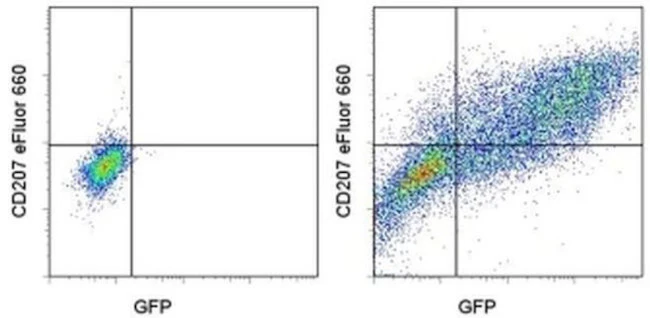
Applications Tested: This eBioRMUL.2 antibody has been tested by intracellular staining and flow cytometric analysis of mouse CD207-transfected HEK-293T cells. This can be used at less than or equal to 0.5 µg per test. A test is defined as the amount (µg) of antibody that will stain a cell sample in a final volume of 100 µL. Cell number should be determined empirically but can range from 10^5 to 10^8 cells/test. It is recommended that the antibody be carefully titrated for optimal performance in the assay of interest.
eFluor® 660 is a replacement for Alexa Fluor® 647. eFluor® 660 emits at 659 nm and is excited with the red laser (633 nm). Please make sure that your instrument is capable of detecting this fluorochome.
Excitation: 633-647 nm; Emission: 668 nm; Laser: Red Laser.
Filtration: 0.2 µm post-manufacturing filtered.
For Research Use Only. Not for use in diagnostic procedures. Not for resale without express authorization.
Original: $438.00
-70%$438.00
$131.40CD207 (Langerin) Monoclonal Antibody (eBioRMUL.2), eFluor 660, eBioscience
PRODUCT DETAILS
Host: Rat
Isotype: IgG2a, kappa
Clonality: Monoclonal
Clone: eBioRMUL.2
Format: eFluor 660
Reactivity: Ms
Application: Flow Cytometry
Tested Dilution: 0.5 µg/test
Concentration: 0.2 mg/mL
Storage: 4°C, store in dark, DO NOT FREEZE!
Formulation: PBS with 0.09% sodium azide; pH 7.2
Purification: Affinity chromatography
Data Sheet: TDS
Specific Information
Description: eBioRMUL.2 is a monoclonal antibody that reacts with the predicted extracellular domain of mouse CD207, also known as Langerin. Mouse CD207 is expressed in a distinct subset of dendritic cells called Langerhans cells (LC). Mouse CD207 is a 48 kDa, C-type lectin and putative transmembrane protein that likely plays a role in antigen recognition and uptake. LC are located in the epidermis and upon activation reduce expression of CD207 and begin migrating through the dermis towards lymphatic vessels. Expression of mouse CD207 in LC has been correlated to the presence of Birbeck Granules. Furthermore, the formation of Birbeck Granules has been observed upon transfection of CD207 cDNA into fibroblast cell lines.
Western Blotting with RMUL.2 reveals a 48 kDa band in lysate from mouse ear epidermis as well as in lysates from cells transfected with mouse CD207 cDNA. Cross reactivity of this antibody with other proteins has not been determined. Preliminary data from mouse CD207 cDNA transfected cells suggests that RMUL.2 can be used for intracellular staining followed by flow cytometric analysis. We have observed in our transfectants the majority of protein is expressed intracellularly with a small percentage on the cell surface. In addition, RMUL.2 has also been tested by immunohistology on mouse ear epidermal sheets and shows specific staining.
Applications Reported: This eBioRMUL.2 antibody has been reported for use in flow cytometric analysis.
Applications Tested: This eBioRMUL.2 antibody has been tested by intracellular staining and flow cytometric analysis of mouse CD207-transfected HEK-293T cells. This can be used at less than or equal to 0.5 µg per test. A test is defined as the amount (µg) of antibody that will stain a cell sample in a final volume of 100 µL. Cell number should be determined empirically but can range from 10^5 to 10^8 cells/test. It is recommended that the antibody be carefully titrated for optimal performance in the assay of interest.
eFluor® 660 is a replacement for Alexa Fluor® 647. eFluor® 660 emits at 659 nm and is excited with the red laser (633 nm). Please make sure that your instrument is capable of detecting this fluorochome.
Excitation: 633-647 nm; Emission: 668 nm; Laser: Red Laser.
Filtration: 0.2 µm post-manufacturing filtered.
For Research Use Only. Not for use in diagnostic procedures. Not for resale without express authorization.
Product Information
Product Information
Shipping & Returns
Shipping & Returns
Description
PRODUCT DETAILS
Host: Rat
Isotype: IgG2a, kappa
Clonality: Monoclonal
Clone: eBioRMUL.2
Format: eFluor 660
Reactivity: Ms
Application: Flow Cytometry
Tested Dilution: 0.5 µg/test
Concentration: 0.2 mg/mL
Storage: 4°C, store in dark, DO NOT FREEZE!
Formulation: PBS with 0.09% sodium azide; pH 7.2
Purification: Affinity chromatography
Data Sheet: TDS
Specific Information
Description: eBioRMUL.2 is a monoclonal antibody that reacts with the predicted extracellular domain of mouse CD207, also known as Langerin. Mouse CD207 is expressed in a distinct subset of dendritic cells called Langerhans cells (LC). Mouse CD207 is a 48 kDa, C-type lectin and putative transmembrane protein that likely plays a role in antigen recognition and uptake. LC are located in the epidermis and upon activation reduce expression of CD207 and begin migrating through the dermis towards lymphatic vessels. Expression of mouse CD207 in LC has been correlated to the presence of Birbeck Granules. Furthermore, the formation of Birbeck Granules has been observed upon transfection of CD207 cDNA into fibroblast cell lines.
Western Blotting with RMUL.2 reveals a 48 kDa band in lysate from mouse ear epidermis as well as in lysates from cells transfected with mouse CD207 cDNA. Cross reactivity of this antibody with other proteins has not been determined. Preliminary data from mouse CD207 cDNA transfected cells suggests that RMUL.2 can be used for intracellular staining followed by flow cytometric analysis. We have observed in our transfectants the majority of protein is expressed intracellularly with a small percentage on the cell surface. In addition, RMUL.2 has also been tested by immunohistology on mouse ear epidermal sheets and shows specific staining.
Applications Reported: This eBioRMUL.2 antibody has been reported for use in flow cytometric analysis.
Applications Tested: This eBioRMUL.2 antibody has been tested by intracellular staining and flow cytometric analysis of mouse CD207-transfected HEK-293T cells. This can be used at less than or equal to 0.5 µg per test. A test is defined as the amount (µg) of antibody that will stain a cell sample in a final volume of 100 µL. Cell number should be determined empirically but can range from 10^5 to 10^8 cells/test. It is recommended that the antibody be carefully titrated for optimal performance in the assay of interest.
eFluor® 660 is a replacement for Alexa Fluor® 647. eFluor® 660 emits at 659 nm and is excited with the red laser (633 nm). Please make sure that your instrument is capable of detecting this fluorochome.
Excitation: 633-647 nm; Emission: 668 nm; Laser: Red Laser.
Filtration: 0.2 µm post-manufacturing filtered.
For Research Use Only. Not for use in diagnostic procedures. Not for resale without express authorization.