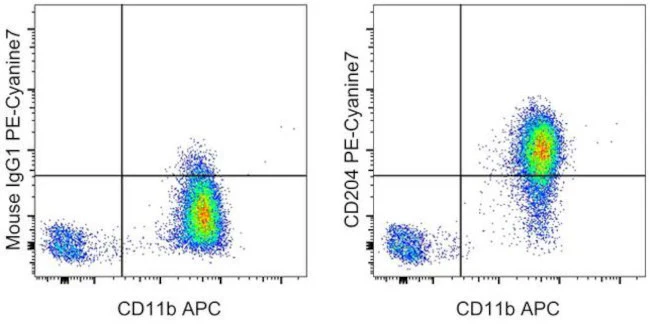
CD204 Monoclonal Antibody (PSL204), PE-Cyanine7, eBioscience
PRODUCT DETAILS
Host: Mouse
Isotype: IgG1, kappa
Clonality: Monoclonal
Clone: PSL204
Format: PE-Cyanine7
Reactivity: Hu
Application: Flow Cytometry
Tested Dilution: 5 µL (0.06 µg)/Test
Concentration: 5 μL/Test
Storage: 4°C, store in dark, DO NOT FREEZE!
Formulation: PBS with BSA and 0.09% sodium azide
Purification: Affinity chromatography
Data Sheet: TDS
Specific Information
This monoclonal antibody PSL204 reacts with human CD204, also known as Macrophage Scavenger Receptor 1 (MSR1), Scavenger Receptor Type A (SR-A), or SCARA1. It is expressed by multiple populations of macrophages and dendritic cells. CD204 belongs to the class A family of scavenger receptors, a group of five homotrimetric transmembrane proteins that contain a short cytoplasmic tail and extracellular C -terminus. Other members of this family include: MARCO (SCARA2), CSR (SCARA3), SRCL (SCARA4) and SCARA5. CD204 binds and internalizes oxidized low density lipoproteins (LDL), which drives macrophage differentiation into foam cells, secretion of inflammatory cytokines, and development of atherosclerotic lesions. In addition to oxidized LDL, CD204 binds and uptakes a wide variety of macromolecules, including bacterial cell wall components, viral DNA, calciprotein complexes, apoptotic cells, and beta-amyloid fibrils. This broad binding specificity implicates CD204-expressing macrophages in a number of physiological processes and pathologies, such as host defense, inflammation, bone remodeling, atherosclerosis, sepsis, and Alzheimer's disease.
In humans, CD204 exists as 3 splice variants. The more ubiquitous full length isoform (type I, SR-AI), a shorter isoform (type II, SR-AII) that lacks the C-terminal cysteine-rich domain, and the shortest isoform (type III, SR-AIII). Isoforms I and II bind modified LDL with similar affinity, whereas isoform III is not expressed on the cell surface. This monoclonal antibody PSL204 binds only the long (type I, SR-AI) isoform. The PSL204 will recognize CD204 on cells that have been formaldehyde-fixed and permeabilized. This antibody does not cross-react with mouse or rat CD204.
This PSL204 antibody has been pre-titrated and tested by flow cytometric analysis of human monocyte-derived macrophages. This can be used at 5 µL (0.06 µg) per test. A test is defined as the amount (µg) of antibody that will stain a cell sample in a final volume of 100 µL. Cell number should be determined empirically but can range from 10^5 to 10^8 cells/test.
Light sensitivity: This tandem dye is sensitive to photo-induced oxidation. Please protect this vial and stained samples from light.
Fixation: Samples can be stored in IC Fixation Buffer (Product # 00-822-49) (100 µL of cell sample + 100 µL of IC Fixation Buffer) or 1-step Fix/Lyse Solution (Product # 00-5333-54) for up to 3 days in the dark at 4°C with minimal impact on brightness and FRET efficiency/compensation. Some generalizations regarding fluorophore performance after fixation can be made, but clone specific performance should be determined empirically.
Filtration: 0.2 µm post-manufacturing filtered.
For Research Use Only. Not for use in diagnostic procedures. Not for resale without express authorization.
Original: $467.00
-70%$467.00
$140.10CD204 Monoclonal Antibody (PSL204), PE-Cyanine7, eBioscience
PRODUCT DETAILS
Host: Mouse
Isotype: IgG1, kappa
Clonality: Monoclonal
Clone: PSL204
Format: PE-Cyanine7
Reactivity: Hu
Application: Flow Cytometry
Tested Dilution: 5 µL (0.06 µg)/Test
Concentration: 5 μL/Test
Storage: 4°C, store in dark, DO NOT FREEZE!
Formulation: PBS with BSA and 0.09% sodium azide
Purification: Affinity chromatography
Data Sheet: TDS
Specific Information
This monoclonal antibody PSL204 reacts with human CD204, also known as Macrophage Scavenger Receptor 1 (MSR1), Scavenger Receptor Type A (SR-A), or SCARA1. It is expressed by multiple populations of macrophages and dendritic cells. CD204 belongs to the class A family of scavenger receptors, a group of five homotrimetric transmembrane proteins that contain a short cytoplasmic tail and extracellular C -terminus. Other members of this family include: MARCO (SCARA2), CSR (SCARA3), SRCL (SCARA4) and SCARA5. CD204 binds and internalizes oxidized low density lipoproteins (LDL), which drives macrophage differentiation into foam cells, secretion of inflammatory cytokines, and development of atherosclerotic lesions. In addition to oxidized LDL, CD204 binds and uptakes a wide variety of macromolecules, including bacterial cell wall components, viral DNA, calciprotein complexes, apoptotic cells, and beta-amyloid fibrils. This broad binding specificity implicates CD204-expressing macrophages in a number of physiological processes and pathologies, such as host defense, inflammation, bone remodeling, atherosclerosis, sepsis, and Alzheimer's disease.
In humans, CD204 exists as 3 splice variants. The more ubiquitous full length isoform (type I, SR-AI), a shorter isoform (type II, SR-AII) that lacks the C-terminal cysteine-rich domain, and the shortest isoform (type III, SR-AIII). Isoforms I and II bind modified LDL with similar affinity, whereas isoform III is not expressed on the cell surface. This monoclonal antibody PSL204 binds only the long (type I, SR-AI) isoform. The PSL204 will recognize CD204 on cells that have been formaldehyde-fixed and permeabilized. This antibody does not cross-react with mouse or rat CD204.
This PSL204 antibody has been pre-titrated and tested by flow cytometric analysis of human monocyte-derived macrophages. This can be used at 5 µL (0.06 µg) per test. A test is defined as the amount (µg) of antibody that will stain a cell sample in a final volume of 100 µL. Cell number should be determined empirically but can range from 10^5 to 10^8 cells/test.
Light sensitivity: This tandem dye is sensitive to photo-induced oxidation. Please protect this vial and stained samples from light.
Fixation: Samples can be stored in IC Fixation Buffer (Product # 00-822-49) (100 µL of cell sample + 100 µL of IC Fixation Buffer) or 1-step Fix/Lyse Solution (Product # 00-5333-54) for up to 3 days in the dark at 4°C with minimal impact on brightness and FRET efficiency/compensation. Some generalizations regarding fluorophore performance after fixation can be made, but clone specific performance should be determined empirically.
Filtration: 0.2 µm post-manufacturing filtered.
For Research Use Only. Not for use in diagnostic procedures. Not for resale without express authorization.
Product Information
Product Information
Shipping & Returns
Shipping & Returns
Description
PRODUCT DETAILS
Host: Mouse
Isotype: IgG1, kappa
Clonality: Monoclonal
Clone: PSL204
Format: PE-Cyanine7
Reactivity: Hu
Application: Flow Cytometry
Tested Dilution: 5 µL (0.06 µg)/Test
Concentration: 5 μL/Test
Storage: 4°C, store in dark, DO NOT FREEZE!
Formulation: PBS with BSA and 0.09% sodium azide
Purification: Affinity chromatography
Data Sheet: TDS
Specific Information
This monoclonal antibody PSL204 reacts with human CD204, also known as Macrophage Scavenger Receptor 1 (MSR1), Scavenger Receptor Type A (SR-A), or SCARA1. It is expressed by multiple populations of macrophages and dendritic cells. CD204 belongs to the class A family of scavenger receptors, a group of five homotrimetric transmembrane proteins that contain a short cytoplasmic tail and extracellular C -terminus. Other members of this family include: MARCO (SCARA2), CSR (SCARA3), SRCL (SCARA4) and SCARA5. CD204 binds and internalizes oxidized low density lipoproteins (LDL), which drives macrophage differentiation into foam cells, secretion of inflammatory cytokines, and development of atherosclerotic lesions. In addition to oxidized LDL, CD204 binds and uptakes a wide variety of macromolecules, including bacterial cell wall components, viral DNA, calciprotein complexes, apoptotic cells, and beta-amyloid fibrils. This broad binding specificity implicates CD204-expressing macrophages in a number of physiological processes and pathologies, such as host defense, inflammation, bone remodeling, atherosclerosis, sepsis, and Alzheimer's disease.
In humans, CD204 exists as 3 splice variants. The more ubiquitous full length isoform (type I, SR-AI), a shorter isoform (type II, SR-AII) that lacks the C-terminal cysteine-rich domain, and the shortest isoform (type III, SR-AIII). Isoforms I and II bind modified LDL with similar affinity, whereas isoform III is not expressed on the cell surface. This monoclonal antibody PSL204 binds only the long (type I, SR-AI) isoform. The PSL204 will recognize CD204 on cells that have been formaldehyde-fixed and permeabilized. This antibody does not cross-react with mouse or rat CD204.
This PSL204 antibody has been pre-titrated and tested by flow cytometric analysis of human monocyte-derived macrophages. This can be used at 5 µL (0.06 µg) per test. A test is defined as the amount (µg) of antibody that will stain a cell sample in a final volume of 100 µL. Cell number should be determined empirically but can range from 10^5 to 10^8 cells/test.
Light sensitivity: This tandem dye is sensitive to photo-induced oxidation. Please protect this vial and stained samples from light.
Fixation: Samples can be stored in IC Fixation Buffer (Product # 00-822-49) (100 µL of cell sample + 100 µL of IC Fixation Buffer) or 1-step Fix/Lyse Solution (Product # 00-5333-54) for up to 3 days in the dark at 4°C with minimal impact on brightness and FRET efficiency/compensation. Some generalizations regarding fluorophore performance after fixation can be made, but clone specific performance should be determined empirically.
Filtration: 0.2 µm post-manufacturing filtered.
For Research Use Only. Not for use in diagnostic procedures. Not for resale without express authorization.