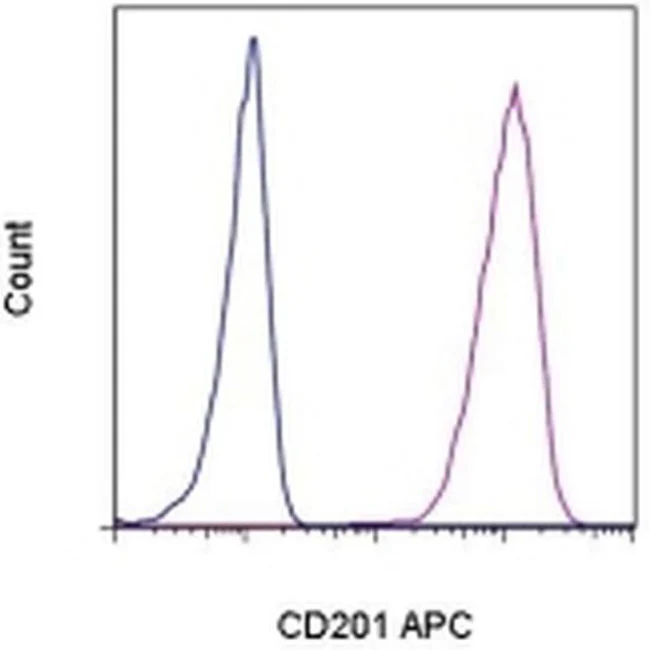
CD201 (EPCR) Monoclonal Antibody (RCR-227), APC, eBioscience
PRODUCT DETAILS
Host: Rat
Isotype: IgG1, kappa
Clonality: Monoclonal
Clone: RCR-227
Format: APC
Reactivity: Hu
Application: Flow Cytometry
Tested Dilution: 5 µL (0.125 µg)/test
Concentration: 5 μL/Test
Storage: 4°C, store in dark, DO NOT FREEZE!
Formulation: PBS with BSA and 0.09% sodium azide; pH 7.2
Purification: Affinity chromatography
Data Sheet: TDS
Specific Information
Description: The monoclonal antibody RCR-227 reacts with human CD201, which is also known as the endothelial protein C receptor (EPCR), a 46-kDa transmembrane protein related to class I MHC. CD201 was originally identified on vascular endothelium cells, predominantly larger blood vessels. It is also expressed on monocytes, lymphocytes, hematopoietic stem cells, neutrophils, and eosinophils. CD201 serves as a binding site for protein C, activated protein C (APC), and factor VII/VIIa. A soluble form has also been identified in the plasma. CD201 plays a role in controlling coagulation as disruption of its gene in mice caused placental thrombosis and early embryonic death. This cell surface molecule is also involved in the anti-inflammatory response. APC binding to CD201 enables PAR-1 activation that confers cytoprotective effects. In monocytes, APC binding decreases secretion of proinflammatory cytokines, chemokines, and growth factors. Finally, CD201 has been shown to inhibit lymphocyte migration.
Applications Reported: This RCR-227 antibody has been reported for use in flow cytometric analysis.
Applications Tested: This RCR-227 antibody has been pre-titrated and tested by flow cytometric analysis of HUVECs. This can be used at 5 µL (0.125 µg) per test. A test is defined as the amount (µg) of antibody that will stain a cell sample in a final volume of 100 µL. Cell number should be determined empirically but can range from 10^5 to 10^8 cells/test.
Excitation: 633-647 nm; Emission: 660 nm; Laser: Red Laser.
Filtration: 0.2 µm post-manufacturing filtered.
For Research Use Only. Not for use in diagnostic procedures. Not for resale without express authorization.
Original: $388.00
-70%$388.00
$116.40CD201 (EPCR) Monoclonal Antibody (RCR-227), APC, eBioscience
PRODUCT DETAILS
Host: Rat
Isotype: IgG1, kappa
Clonality: Monoclonal
Clone: RCR-227
Format: APC
Reactivity: Hu
Application: Flow Cytometry
Tested Dilution: 5 µL (0.125 µg)/test
Concentration: 5 μL/Test
Storage: 4°C, store in dark, DO NOT FREEZE!
Formulation: PBS with BSA and 0.09% sodium azide; pH 7.2
Purification: Affinity chromatography
Data Sheet: TDS
Specific Information
Description: The monoclonal antibody RCR-227 reacts with human CD201, which is also known as the endothelial protein C receptor (EPCR), a 46-kDa transmembrane protein related to class I MHC. CD201 was originally identified on vascular endothelium cells, predominantly larger blood vessels. It is also expressed on monocytes, lymphocytes, hematopoietic stem cells, neutrophils, and eosinophils. CD201 serves as a binding site for protein C, activated protein C (APC), and factor VII/VIIa. A soluble form has also been identified in the plasma. CD201 plays a role in controlling coagulation as disruption of its gene in mice caused placental thrombosis and early embryonic death. This cell surface molecule is also involved in the anti-inflammatory response. APC binding to CD201 enables PAR-1 activation that confers cytoprotective effects. In monocytes, APC binding decreases secretion of proinflammatory cytokines, chemokines, and growth factors. Finally, CD201 has been shown to inhibit lymphocyte migration.
Applications Reported: This RCR-227 antibody has been reported for use in flow cytometric analysis.
Applications Tested: This RCR-227 antibody has been pre-titrated and tested by flow cytometric analysis of HUVECs. This can be used at 5 µL (0.125 µg) per test. A test is defined as the amount (µg) of antibody that will stain a cell sample in a final volume of 100 µL. Cell number should be determined empirically but can range from 10^5 to 10^8 cells/test.
Excitation: 633-647 nm; Emission: 660 nm; Laser: Red Laser.
Filtration: 0.2 µm post-manufacturing filtered.
For Research Use Only. Not for use in diagnostic procedures. Not for resale without express authorization.
Product Information
Product Information
Shipping & Returns
Shipping & Returns
Description
PRODUCT DETAILS
Host: Rat
Isotype: IgG1, kappa
Clonality: Monoclonal
Clone: RCR-227
Format: APC
Reactivity: Hu
Application: Flow Cytometry
Tested Dilution: 5 µL (0.125 µg)/test
Concentration: 5 μL/Test
Storage: 4°C, store in dark, DO NOT FREEZE!
Formulation: PBS with BSA and 0.09% sodium azide; pH 7.2
Purification: Affinity chromatography
Data Sheet: TDS
Specific Information
Description: The monoclonal antibody RCR-227 reacts with human CD201, which is also known as the endothelial protein C receptor (EPCR), a 46-kDa transmembrane protein related to class I MHC. CD201 was originally identified on vascular endothelium cells, predominantly larger blood vessels. It is also expressed on monocytes, lymphocytes, hematopoietic stem cells, neutrophils, and eosinophils. CD201 serves as a binding site for protein C, activated protein C (APC), and factor VII/VIIa. A soluble form has also been identified in the plasma. CD201 plays a role in controlling coagulation as disruption of its gene in mice caused placental thrombosis and early embryonic death. This cell surface molecule is also involved in the anti-inflammatory response. APC binding to CD201 enables PAR-1 activation that confers cytoprotective effects. In monocytes, APC binding decreases secretion of proinflammatory cytokines, chemokines, and growth factors. Finally, CD201 has been shown to inhibit lymphocyte migration.
Applications Reported: This RCR-227 antibody has been reported for use in flow cytometric analysis.
Applications Tested: This RCR-227 antibody has been pre-titrated and tested by flow cytometric analysis of HUVECs. This can be used at 5 µL (0.125 µg) per test. A test is defined as the amount (µg) of antibody that will stain a cell sample in a final volume of 100 µL. Cell number should be determined empirically but can range from 10^5 to 10^8 cells/test.
Excitation: 633-647 nm; Emission: 660 nm; Laser: Red Laser.
Filtration: 0.2 µm post-manufacturing filtered.
For Research Use Only. Not for use in diagnostic procedures. Not for resale without express authorization.