CD194 (CCR4) Monoclonal Antibody (D8SEE), PE, eBioscience
PRODUCT DETAILS
Host: Mouse
Isotype: IgG1, kappa
Clonality: Monoclonal
Clone: D8SEE
Format: PE
Reactivity: Hu
Application: Flow Cytometry
Tested Dilution: 5 µL (0.25 µg)/test
Concentration: 5 μL/Test
Storage: 4°C, store in dark, DO NOT FREEZE!
Formulation: PBS with BSA and 0.09% sodium azide; pH 7.2
Purification: Affinity chromatography
Data Sheet: TDS
Specific Information
Description: This D8SEE monoclonal antibody reacts with human CD194 (CCR4). CD194, also known as C-C Chemokine Receptor 4 (CCR4) is a member of the G protein-coupled receptor family, a large family characterized by seven transmembrane alpha helical domains. The ligands for CCR4 are CCL17 (TARC) and CCL22 (MDC), which direct the migration of target cells. CCR4 and its ligands, along with the other receptors CCR10 and CLA, are particularly important for the recruitment of T cells into the skin, where they may also play a role in adhesion and extravasation. Although CCR4 expression was originally believed to be restricted to Th2 cells, it has since been observed in some subsets of Th17, Treg, and Th1 cells. It is not expressed by naive T cells, indicating a role in memory or effector function. Other cells that express CCR4 are activated NK cells, platelets, monocytes, and basophils.
Applications Reported: This D8SEE antibody has been reported for use in flow cytometric analysis.
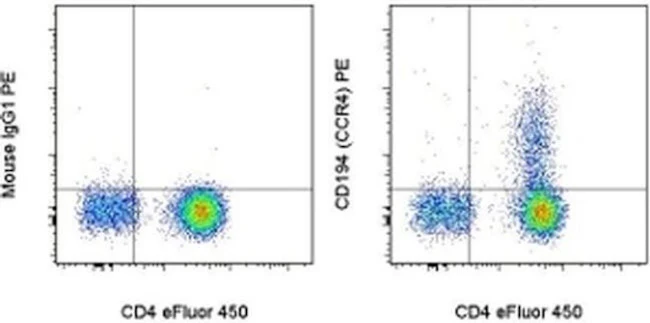
Applications Tested: This D8SEE antibody has been pre-titrated and tested by flow cytometric anaylis of normal human peripheral blood cells. This can be used at 5 µL (0.25 µg) per test. A test is defined as the amount (µg) of antibody that will stain a cell sample in a final volume of 100 µL. Cell number should be determined empirically but can range from 10^5 to 10^8 cells/test.
Excitation: 488-561 nm; Emission: 578 nm; Laser: Blue Laser, Green Laser, Yellow-Green Laser.
Filtration: 0.2 µm post-manufacturing filtered.
For Research Use Only. Not for use in diagnostic procedures. Not for resale without express authorization.
CD194 (CCR4) Monoclonal Antibody (D8SEE), PE, eBioscience
PRODUCT DETAILS
Host: Mouse
Isotype: IgG1, kappa
Clonality: Monoclonal
Clone: D8SEE
Format: PE
Reactivity: Hu
Application: Flow Cytometry
Tested Dilution: 5 µL (0.25 µg)/test
Concentration: 5 μL/Test
Storage: 4°C, store in dark, DO NOT FREEZE!
Formulation: PBS with BSA and 0.09% sodium azide; pH 7.2
Purification: Affinity chromatography
Data Sheet: TDS
Specific Information
Description: This D8SEE monoclonal antibody reacts with human CD194 (CCR4). CD194, also known as C-C Chemokine Receptor 4 (CCR4) is a member of the G protein-coupled receptor family, a large family characterized by seven transmembrane alpha helical domains. The ligands for CCR4 are CCL17 (TARC) and CCL22 (MDC), which direct the migration of target cells. CCR4 and its ligands, along with the other receptors CCR10 and CLA, are particularly important for the recruitment of T cells into the skin, where they may also play a role in adhesion and extravasation. Although CCR4 expression was originally believed to be restricted to Th2 cells, it has since been observed in some subsets of Th17, Treg, and Th1 cells. It is not expressed by naive T cells, indicating a role in memory or effector function. Other cells that express CCR4 are activated NK cells, platelets, monocytes, and basophils.
Applications Reported: This D8SEE antibody has been reported for use in flow cytometric analysis.
Applications Tested: This D8SEE antibody has been pre-titrated and tested by flow cytometric anaylis of normal human peripheral blood cells. This can be used at 5 µL (0.25 µg) per test. A test is defined as the amount (µg) of antibody that will stain a cell sample in a final volume of 100 µL. Cell number should be determined empirically but can range from 10^5 to 10^8 cells/test.
Excitation: 488-561 nm; Emission: 578 nm; Laser: Blue Laser, Green Laser, Yellow-Green Laser.
Filtration: 0.2 µm post-manufacturing filtered.
For Research Use Only. Not for use in diagnostic procedures. Not for resale without express authorization.
Product Information
Product Information
Shipping & Returns
Shipping & Returns
Description
PRODUCT DETAILS
Host: Mouse
Isotype: IgG1, kappa
Clonality: Monoclonal
Clone: D8SEE
Format: PE
Reactivity: Hu
Application: Flow Cytometry
Tested Dilution: 5 µL (0.25 µg)/test
Concentration: 5 μL/Test
Storage: 4°C, store in dark, DO NOT FREEZE!
Formulation: PBS with BSA and 0.09% sodium azide; pH 7.2
Purification: Affinity chromatography
Data Sheet: TDS
Specific Information
Description: This D8SEE monoclonal antibody reacts with human CD194 (CCR4). CD194, also known as C-C Chemokine Receptor 4 (CCR4) is a member of the G protein-coupled receptor family, a large family characterized by seven transmembrane alpha helical domains. The ligands for CCR4 are CCL17 (TARC) and CCL22 (MDC), which direct the migration of target cells. CCR4 and its ligands, along with the other receptors CCR10 and CLA, are particularly important for the recruitment of T cells into the skin, where they may also play a role in adhesion and extravasation. Although CCR4 expression was originally believed to be restricted to Th2 cells, it has since been observed in some subsets of Th17, Treg, and Th1 cells. It is not expressed by naive T cells, indicating a role in memory or effector function. Other cells that express CCR4 are activated NK cells, platelets, monocytes, and basophils.
Applications Reported: This D8SEE antibody has been reported for use in flow cytometric analysis.
Applications Tested: This D8SEE antibody has been pre-titrated and tested by flow cytometric anaylis of normal human peripheral blood cells. This can be used at 5 µL (0.25 µg) per test. A test is defined as the amount (µg) of antibody that will stain a cell sample in a final volume of 100 µL. Cell number should be determined empirically but can range from 10^5 to 10^8 cells/test.
Excitation: 488-561 nm; Emission: 578 nm; Laser: Blue Laser, Green Laser, Yellow-Green Laser.
Filtration: 0.2 µm post-manufacturing filtered.
For Research Use Only. Not for use in diagnostic procedures. Not for resale without express authorization.