CD185 (CXCR5) Monoclonal Antibody (87.1), PE, eBioscience
PRODUCT DETAILS
Host: Mouse
Isotype: IgG1, kappa
Clonality: Monoclonal
Clone: 87.1
Format: PE
Reactivity: Nhp, Rh
Application: Flow Cytometry
Tested Dilution: 5 µL (0.125 µg)/test
Concentration: 5 μL/Test
Storage: 4°C, store in dark, DO NOT FREEZE!
Formulation: PBS with BSA and 0.09% sodium azide; pH 7.2
Purification: Affinity chromatography
Data Sheet: TDS
Specific Information
Description: This 87.1 monoclonal antibody reacts with non-human primate (specifically rhesus) CD185. CD185, which is also known as C-X-C chemokine receptor 5 (CXCR5) and Burkitt lymphoma receptor 1 (BLR1), is a seven transmembrane G protein-coupled receptor originally identified in Burkitt's lymphoma. In peripheral blood, CD185 is expressed on B cells, CD4+ T cells (but not Th1 or Th2 cells), and a subpopulation of memory (CD45RO+) T cells. CD185+ circulating T cells are in a resting state and migrate to the lymph nodes due to CCR7 and CD62L expression. In tonsils, CD185 is expressed on nearly all CD4+ cells along with CD45RO and the activation markers CD69 and ICOS. Tonsillar CD185+ cells have been shown to induce antibody production when co-cultured with B cells, thus supporting their role in providing B cell help. Furthermore, this chemokine receptor plays a critical role in lymphocyte trafficking, in particular CXCL13-induced T cell migration into the B cell follicles of germinal centers. Thus, CD185 is an established marker of follicular helper T cells (Tfh). In rhesus macaques, infection with simian immunodeficiency virus (SIV) has been reported to increase the number of germinal centers and Tfh cells within the lymph nodes.
Refer to the rhesus reactive alternative clone MU5UBEE (Product # 12-9185) for identification of CXCR5 on T cells in addition to B cells.
Applications Reported: This 87.1 antibody has been reported for use in flow cytometric analysis.
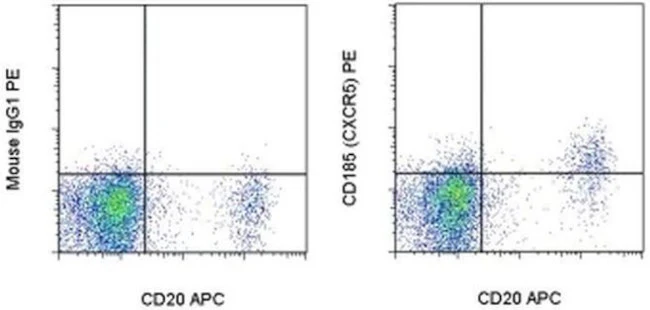
Applications Tested: This 87.1 antibody has been pre-titrated and tested by flow cytometric analysis of normal rhesus peripheral blood cells. This can be used at 5 µL (0.125 µg) per test. A test is defined as the amount (µg) of antibody that will stain a cell sample in a final volume of 100 µL. Cell number should be determined empirically but can range from 10^5 to 10^8 cells/test.
Excitation: 488-561 nm; Emission: 578 nm; Laser: Blue Laser, Green Laser, Yellow-Green Laser.
Filtration: 0.2 µm post-manufacturing filtered.
For Research Use Only. Not for use in diagnostic procedures. Not for resale without express authorization.
CD185 (CXCR5) Monoclonal Antibody (87.1), PE, eBioscience
PRODUCT DETAILS
Host: Mouse
Isotype: IgG1, kappa
Clonality: Monoclonal
Clone: 87.1
Format: PE
Reactivity: Nhp, Rh
Application: Flow Cytometry
Tested Dilution: 5 µL (0.125 µg)/test
Concentration: 5 μL/Test
Storage: 4°C, store in dark, DO NOT FREEZE!
Formulation: PBS with BSA and 0.09% sodium azide; pH 7.2
Purification: Affinity chromatography
Data Sheet: TDS
Specific Information
Description: This 87.1 monoclonal antibody reacts with non-human primate (specifically rhesus) CD185. CD185, which is also known as C-X-C chemokine receptor 5 (CXCR5) and Burkitt lymphoma receptor 1 (BLR1), is a seven transmembrane G protein-coupled receptor originally identified in Burkitt's lymphoma. In peripheral blood, CD185 is expressed on B cells, CD4+ T cells (but not Th1 or Th2 cells), and a subpopulation of memory (CD45RO+) T cells. CD185+ circulating T cells are in a resting state and migrate to the lymph nodes due to CCR7 and CD62L expression. In tonsils, CD185 is expressed on nearly all CD4+ cells along with CD45RO and the activation markers CD69 and ICOS. Tonsillar CD185+ cells have been shown to induce antibody production when co-cultured with B cells, thus supporting their role in providing B cell help. Furthermore, this chemokine receptor plays a critical role in lymphocyte trafficking, in particular CXCL13-induced T cell migration into the B cell follicles of germinal centers. Thus, CD185 is an established marker of follicular helper T cells (Tfh). In rhesus macaques, infection with simian immunodeficiency virus (SIV) has been reported to increase the number of germinal centers and Tfh cells within the lymph nodes.
Refer to the rhesus reactive alternative clone MU5UBEE (Product # 12-9185) for identification of CXCR5 on T cells in addition to B cells.
Applications Reported: This 87.1 antibody has been reported for use in flow cytometric analysis.
Applications Tested: This 87.1 antibody has been pre-titrated and tested by flow cytometric analysis of normal rhesus peripheral blood cells. This can be used at 5 µL (0.125 µg) per test. A test is defined as the amount (µg) of antibody that will stain a cell sample in a final volume of 100 µL. Cell number should be determined empirically but can range from 10^5 to 10^8 cells/test.
Excitation: 488-561 nm; Emission: 578 nm; Laser: Blue Laser, Green Laser, Yellow-Green Laser.
Filtration: 0.2 µm post-manufacturing filtered.
For Research Use Only. Not for use in diagnostic procedures. Not for resale without express authorization.
Product Information
Product Information
Shipping & Returns
Shipping & Returns
Description
PRODUCT DETAILS
Host: Mouse
Isotype: IgG1, kappa
Clonality: Monoclonal
Clone: 87.1
Format: PE
Reactivity: Nhp, Rh
Application: Flow Cytometry
Tested Dilution: 5 µL (0.125 µg)/test
Concentration: 5 μL/Test
Storage: 4°C, store in dark, DO NOT FREEZE!
Formulation: PBS with BSA and 0.09% sodium azide; pH 7.2
Purification: Affinity chromatography
Data Sheet: TDS
Specific Information
Description: This 87.1 monoclonal antibody reacts with non-human primate (specifically rhesus) CD185. CD185, which is also known as C-X-C chemokine receptor 5 (CXCR5) and Burkitt lymphoma receptor 1 (BLR1), is a seven transmembrane G protein-coupled receptor originally identified in Burkitt's lymphoma. In peripheral blood, CD185 is expressed on B cells, CD4+ T cells (but not Th1 or Th2 cells), and a subpopulation of memory (CD45RO+) T cells. CD185+ circulating T cells are in a resting state and migrate to the lymph nodes due to CCR7 and CD62L expression. In tonsils, CD185 is expressed on nearly all CD4+ cells along with CD45RO and the activation markers CD69 and ICOS. Tonsillar CD185+ cells have been shown to induce antibody production when co-cultured with B cells, thus supporting their role in providing B cell help. Furthermore, this chemokine receptor plays a critical role in lymphocyte trafficking, in particular CXCL13-induced T cell migration into the B cell follicles of germinal centers. Thus, CD185 is an established marker of follicular helper T cells (Tfh). In rhesus macaques, infection with simian immunodeficiency virus (SIV) has been reported to increase the number of germinal centers and Tfh cells within the lymph nodes.
Refer to the rhesus reactive alternative clone MU5UBEE (Product # 12-9185) for identification of CXCR5 on T cells in addition to B cells.
Applications Reported: This 87.1 antibody has been reported for use in flow cytometric analysis.
Applications Tested: This 87.1 antibody has been pre-titrated and tested by flow cytometric analysis of normal rhesus peripheral blood cells. This can be used at 5 µL (0.125 µg) per test. A test is defined as the amount (µg) of antibody that will stain a cell sample in a final volume of 100 µL. Cell number should be determined empirically but can range from 10^5 to 10^8 cells/test.
Excitation: 488-561 nm; Emission: 578 nm; Laser: Blue Laser, Green Laser, Yellow-Green Laser.
Filtration: 0.2 µm post-manufacturing filtered.
For Research Use Only. Not for use in diagnostic procedures. Not for resale without express authorization.