CD151 Monoclonal Antibody (50-6), APC, eBioscience
PRODUCT DETAILS
Host: Mouse
Isotype: IgG1, kappa
Clonality: Monoclonal
Clone: 50-6
Format: APC
Reactivity: Hu
Application: Flow Cytometry
Tested Dilution: 5 µL (0.125 µg)/test
Concentration: 5 μL/Test
Storage: 4°C, store in dark, DO NOT FREEZE!
Formulation: PBS with BSA and 0.09% sodium azide; pH 7.2
Purification: Affinity chromatography
Data Sheet: TDS
Specific Information
Description: The monoclonal antibody 50-6 recognizes human CD151 also known as PETA-3 (platelet-endothelial cell tetraspan antigen-3). CD151 has a molecular weight of 29 kDa and like other tetraspanin family members, CD151 contains four hydrophobic transmembrane domains, two short cytoplasmic tails, and one small and one large extracellular loop. CD151 is expressed on platelets, megakaryocytes, endothelial cells, at the cell-cell junctions, as well as epithelial cells where it localizes to basolateral surfaces exposed to extracellular matrix. The tetraspanins play a role in cell adhesion and migration; CD151 interacts with integrinalpha3 beta1 and integrinalpha6 beta4. In particular CD151 forms a functional complex with c-Met and integrin alpha3 and alpha6 in human salivary gland cancer cells. Additionally it can interact with CD46. Together these interactions are thought to play a role during early metastasis as a potential positive effector.
The 50-6 monoclonal antibody inhibits in vivo metastasis of a human epidermal carcinoma cell line, HEp-3.
Applications Reported: This 50-6 antibody has been reported for use in flow cytometric analysis.
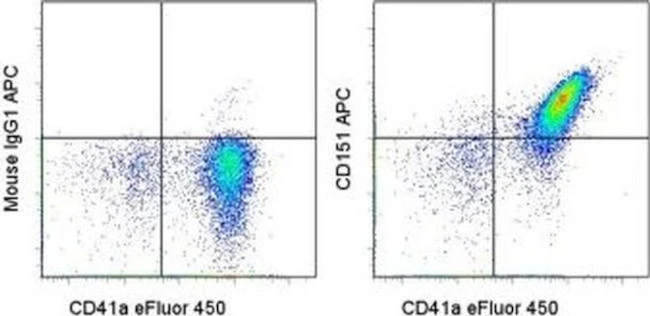
Applications Tested: This 50-6 antibody has been pre-titrated and tested by flow cytometric analysis of human platelets. This can be used at 5 µL (0.125 µg) per test. A test is defined as the amount (µg) of antibody that will stain a cell sample in a final volume of 100 µL. Cell number should be determined empirically but can range from 10^5 to 10^8 cells/test.
Excitation: 633-647 nm; Emission: 660 nm; Laser: Red Laser.
Filtration: 0.2 µm post-manufacturing filtered.
For Research Use Only. Not for use in diagnostic procedures. Not for resale without express authorization.
CD151 Monoclonal Antibody (50-6), APC, eBioscience
PRODUCT DETAILS
Host: Mouse
Isotype: IgG1, kappa
Clonality: Monoclonal
Clone: 50-6
Format: APC
Reactivity: Hu
Application: Flow Cytometry
Tested Dilution: 5 µL (0.125 µg)/test
Concentration: 5 μL/Test
Storage: 4°C, store in dark, DO NOT FREEZE!
Formulation: PBS with BSA and 0.09% sodium azide; pH 7.2
Purification: Affinity chromatography
Data Sheet: TDS
Specific Information
Description: The monoclonal antibody 50-6 recognizes human CD151 also known as PETA-3 (platelet-endothelial cell tetraspan antigen-3). CD151 has a molecular weight of 29 kDa and like other tetraspanin family members, CD151 contains four hydrophobic transmembrane domains, two short cytoplasmic tails, and one small and one large extracellular loop. CD151 is expressed on platelets, megakaryocytes, endothelial cells, at the cell-cell junctions, as well as epithelial cells where it localizes to basolateral surfaces exposed to extracellular matrix. The tetraspanins play a role in cell adhesion and migration; CD151 interacts with integrinalpha3 beta1 and integrinalpha6 beta4. In particular CD151 forms a functional complex with c-Met and integrin alpha3 and alpha6 in human salivary gland cancer cells. Additionally it can interact with CD46. Together these interactions are thought to play a role during early metastasis as a potential positive effector.
The 50-6 monoclonal antibody inhibits in vivo metastasis of a human epidermal carcinoma cell line, HEp-3.
Applications Reported: This 50-6 antibody has been reported for use in flow cytometric analysis.
Applications Tested: This 50-6 antibody has been pre-titrated and tested by flow cytometric analysis of human platelets. This can be used at 5 µL (0.125 µg) per test. A test is defined as the amount (µg) of antibody that will stain a cell sample in a final volume of 100 µL. Cell number should be determined empirically but can range from 10^5 to 10^8 cells/test.
Excitation: 633-647 nm; Emission: 660 nm; Laser: Red Laser.
Filtration: 0.2 µm post-manufacturing filtered.
For Research Use Only. Not for use in diagnostic procedures. Not for resale without express authorization.
Product Information
Product Information
Shipping & Returns
Shipping & Returns
Description
PRODUCT DETAILS
Host: Mouse
Isotype: IgG1, kappa
Clonality: Monoclonal
Clone: 50-6
Format: APC
Reactivity: Hu
Application: Flow Cytometry
Tested Dilution: 5 µL (0.125 µg)/test
Concentration: 5 μL/Test
Storage: 4°C, store in dark, DO NOT FREEZE!
Formulation: PBS with BSA and 0.09% sodium azide; pH 7.2
Purification: Affinity chromatography
Data Sheet: TDS
Specific Information
Description: The monoclonal antibody 50-6 recognizes human CD151 also known as PETA-3 (platelet-endothelial cell tetraspan antigen-3). CD151 has a molecular weight of 29 kDa and like other tetraspanin family members, CD151 contains four hydrophobic transmembrane domains, two short cytoplasmic tails, and one small and one large extracellular loop. CD151 is expressed on platelets, megakaryocytes, endothelial cells, at the cell-cell junctions, as well as epithelial cells where it localizes to basolateral surfaces exposed to extracellular matrix. The tetraspanins play a role in cell adhesion and migration; CD151 interacts with integrinalpha3 beta1 and integrinalpha6 beta4. In particular CD151 forms a functional complex with c-Met and integrin alpha3 and alpha6 in human salivary gland cancer cells. Additionally it can interact with CD46. Together these interactions are thought to play a role during early metastasis as a potential positive effector.
The 50-6 monoclonal antibody inhibits in vivo metastasis of a human epidermal carcinoma cell line, HEp-3.
Applications Reported: This 50-6 antibody has been reported for use in flow cytometric analysis.
Applications Tested: This 50-6 antibody has been pre-titrated and tested by flow cytometric analysis of human platelets. This can be used at 5 µL (0.125 µg) per test. A test is defined as the amount (µg) of antibody that will stain a cell sample in a final volume of 100 µL. Cell number should be determined empirically but can range from 10^5 to 10^8 cells/test.
Excitation: 633-647 nm; Emission: 660 nm; Laser: Red Laser.
Filtration: 0.2 µm post-manufacturing filtered.
For Research Use Only. Not for use in diagnostic procedures. Not for resale without express authorization.