CD144 (VE-cadherin) Monoclonal Antibody (eBioBV13 (BV13)), eFluor 660, eBioscience
PRODUCT DETAILS
Host: Rat
Isotype: IgG1, kappa
Clonality: Monoclonal
Clone: eBioBV13 (BV13)
Format: eFluor 660
Reactivity: Ms
Application: Flow Cytometry
Tested Dilution: 1 µg/test
Concentration: 0.2 mg/mL
Storage: 4°C, store in dark, DO NOT FREEZE!
Formulation: PBS with 0.09% sodium azide; pH 7.2
Purification: Affinity chromatography
Data Sheet: TDS
Specific Information
Description: The eBioBV13 (BV13) monoclonal antibody reacts with mouse VE-Cadherin (CD144). VE-Cadherin is a 120 kDa member of the type II Cadherin family, characterized by the presence of 5 extracellular cadherin domains (ECD), and anchored to the actin cytoskeleton through their cytoplasmic tail. VE-Cadherin mediates homophilic adhesion between neighbouring endothelial cells and is localized within specialized structures at cell-cell contacts, called adherens junctions. VE-Cadherin is expressed constitutively throughout the entire vasculature, and is required for numerous endothelial cell functions including migration, survival, contact-dependent growth inhibition and endothelial cell assembly into tubular structures. Furthermore, it is thought that VE-Cadherin+CD45- cells from the yolk sac or aorta-gonad-mesonephros (AGM) have the potential to give rise to hematopoietic cells.
Applications Reported: This eBioBV13 (BV13) antibody has been reported for use in flow cytometric analysis.
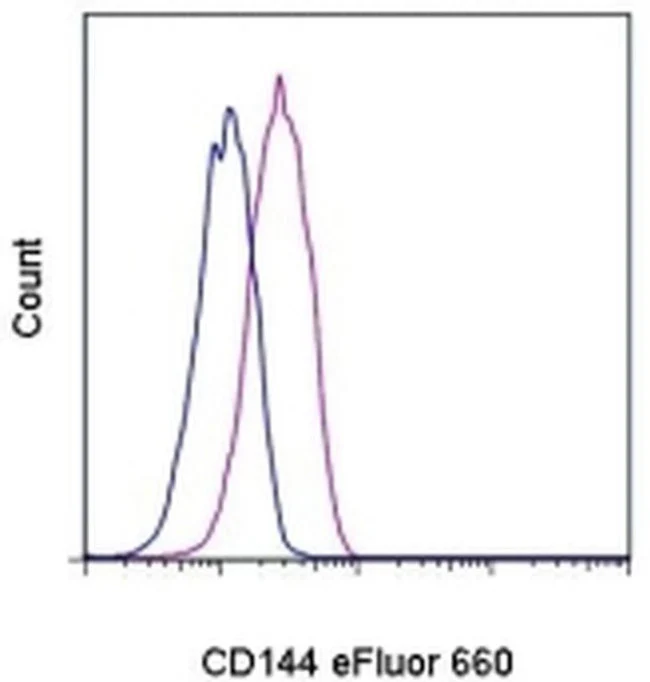
Applications Tested: This eBioBV13 (BV13) antibody has been tested by flow cytometric analysis of bEnd.3 cells. This can be used at less than or equal to 1 µg per test. A test is defined as the amount (µg) of antibody that will stain a cell sample in a final volume of 100 µL. Cell number should be determined empirically but can range from 10^5 to 10^8 cells/test. It is recommended that the antibody be carefully titrated for optimal performance in the assay of interest.
eFluor® 660 is a replacement for Alexa Fluor® 647. eFluor® 660 emits at 659 nm and is excited with the red laser (633 nm). Please make sure that your instrument is capable of detecting this fluorochome.
Excitation: 633-647 nm; Emission: 668 nm; Laser: Red Laser.
Filtration: 0.2 µm post-manufacturing filtered.
For Research Use Only. Not for use in diagnostic procedures. Not for resale without express authorization.
CD144 (VE-cadherin) Monoclonal Antibody (eBioBV13 (BV13)), eFluor 660, eBioscience
PRODUCT DETAILS
Host: Rat
Isotype: IgG1, kappa
Clonality: Monoclonal
Clone: eBioBV13 (BV13)
Format: eFluor 660
Reactivity: Ms
Application: Flow Cytometry
Tested Dilution: 1 µg/test
Concentration: 0.2 mg/mL
Storage: 4°C, store in dark, DO NOT FREEZE!
Formulation: PBS with 0.09% sodium azide; pH 7.2
Purification: Affinity chromatography
Data Sheet: TDS
Specific Information
Description: The eBioBV13 (BV13) monoclonal antibody reacts with mouse VE-Cadherin (CD144). VE-Cadherin is a 120 kDa member of the type II Cadherin family, characterized by the presence of 5 extracellular cadherin domains (ECD), and anchored to the actin cytoskeleton through their cytoplasmic tail. VE-Cadherin mediates homophilic adhesion between neighbouring endothelial cells and is localized within specialized structures at cell-cell contacts, called adherens junctions. VE-Cadherin is expressed constitutively throughout the entire vasculature, and is required for numerous endothelial cell functions including migration, survival, contact-dependent growth inhibition and endothelial cell assembly into tubular structures. Furthermore, it is thought that VE-Cadherin+CD45- cells from the yolk sac or aorta-gonad-mesonephros (AGM) have the potential to give rise to hematopoietic cells.
Applications Reported: This eBioBV13 (BV13) antibody has been reported for use in flow cytometric analysis.
Applications Tested: This eBioBV13 (BV13) antibody has been tested by flow cytometric analysis of bEnd.3 cells. This can be used at less than or equal to 1 µg per test. A test is defined as the amount (µg) of antibody that will stain a cell sample in a final volume of 100 µL. Cell number should be determined empirically but can range from 10^5 to 10^8 cells/test. It is recommended that the antibody be carefully titrated for optimal performance in the assay of interest.
eFluor® 660 is a replacement for Alexa Fluor® 647. eFluor® 660 emits at 659 nm and is excited with the red laser (633 nm). Please make sure that your instrument is capable of detecting this fluorochome.
Excitation: 633-647 nm; Emission: 668 nm; Laser: Red Laser.
Filtration: 0.2 µm post-manufacturing filtered.
For Research Use Only. Not for use in diagnostic procedures. Not for resale without express authorization.
Product Information
Product Information
Shipping & Returns
Shipping & Returns
Description
PRODUCT DETAILS
Host: Rat
Isotype: IgG1, kappa
Clonality: Monoclonal
Clone: eBioBV13 (BV13)
Format: eFluor 660
Reactivity: Ms
Application: Flow Cytometry
Tested Dilution: 1 µg/test
Concentration: 0.2 mg/mL
Storage: 4°C, store in dark, DO NOT FREEZE!
Formulation: PBS with 0.09% sodium azide; pH 7.2
Purification: Affinity chromatography
Data Sheet: TDS
Specific Information
Description: The eBioBV13 (BV13) monoclonal antibody reacts with mouse VE-Cadherin (CD144). VE-Cadherin is a 120 kDa member of the type II Cadherin family, characterized by the presence of 5 extracellular cadherin domains (ECD), and anchored to the actin cytoskeleton through their cytoplasmic tail. VE-Cadherin mediates homophilic adhesion between neighbouring endothelial cells and is localized within specialized structures at cell-cell contacts, called adherens junctions. VE-Cadherin is expressed constitutively throughout the entire vasculature, and is required for numerous endothelial cell functions including migration, survival, contact-dependent growth inhibition and endothelial cell assembly into tubular structures. Furthermore, it is thought that VE-Cadherin+CD45- cells from the yolk sac or aorta-gonad-mesonephros (AGM) have the potential to give rise to hematopoietic cells.
Applications Reported: This eBioBV13 (BV13) antibody has been reported for use in flow cytometric analysis.
Applications Tested: This eBioBV13 (BV13) antibody has been tested by flow cytometric analysis of bEnd.3 cells. This can be used at less than or equal to 1 µg per test. A test is defined as the amount (µg) of antibody that will stain a cell sample in a final volume of 100 µL. Cell number should be determined empirically but can range from 10^5 to 10^8 cells/test. It is recommended that the antibody be carefully titrated for optimal performance in the assay of interest.
eFluor® 660 is a replacement for Alexa Fluor® 647. eFluor® 660 emits at 659 nm and is excited with the red laser (633 nm). Please make sure that your instrument is capable of detecting this fluorochome.
Excitation: 633-647 nm; Emission: 668 nm; Laser: Red Laser.
Filtration: 0.2 µm post-manufacturing filtered.
For Research Use Only. Not for use in diagnostic procedures. Not for resale without express authorization.