CD141 Monoclonal Antibody (JAA17), FITC, eBioscience
PRODUCT DETAILS
Host: Mouse
Isotype: IgG2a, kappa
Clonality: Monoclonal
Clone: JAA17
Format: FITC
Reactivity: Hu
Application: Flow Cytometry
Tested Dilution: 5 µL (0.125 µg)/Test
Concentration: 5 μL/Test
Storage: 4°C, store in dark, DO NOT FREEZE!
Formulation: PBS with BSA and 0.09% sodium azide
Purification: Affinity chromatography
Data Sheet: TDS
Specific Information
This JAA17 monoclonal antibody recognizes human CD141 also known as thrombomodulin, fetomodulin, or BDCA-3. CD141 is a type I membrane receptor that binds and allosterically activates thrombin. The resulting complex cleaves protein C and the Thrombin Activatable Fibrinolysis Inhibitor (TAFI), initiating an important anticoagulant and anti-fibrinolytic pathway. Soluble thrombomodulin is constitutively present in the serum at a very low level and can be upregulated during inflammation. The anti-inflammatory activity of thrombomodulin results from its ability to block the highly pro-inflammatory activity of thrombin. Thrombomodulin prevents chemotaxis and binding of granulocytes to activated endothelium and inhibits activation of eosinophils and mast cells thereby reducing inflammation. Mutations in the CD141 gene result in thromboembolic disease, also known as inherited thrombophilia. Although expressed across many tissues and cell types, its highest expression has been reported on the luminal surface of vascular endothelial cell. In the immune system the highest expression can be observed on myeloid cells, including dendritic cells, macrophages and blood monocytes. In humans, CD141 is commonly used as a marker of cross-presenting dendritic cells in both lymphoid and non-lymphoid tissues. Retinoic acid has been shown to upregulate CD141 expression on human monocyte-derived dendritic cells and primary human dendritic cells.
The JAA17 antibody will recognize CD141 on cells that have been formaldehyde-fixed and permeabilized.
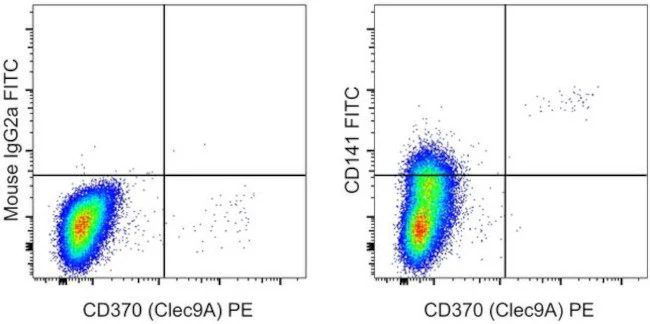
This JAA17 antibody has been pre-titrated and tested by flow cytometric analysis of normal human peripheral blood cells. This can be used at 5 µL (0.125 µg) per test. A test is defined as the amount (µg) of antibody that will stain a cell sample in a final volume of 100 µL. Cell number should be determined empirically but can range from 10^5 to 10^8 cells/test.
Filtration: 0.2 µm post-manufacturing filtered.
For Research Use Only. Not for use in diagnostic procedures. Not for resale without express authorization.
Original: $335.00
-70%$335.00
$100.50CD141 Monoclonal Antibody (JAA17), FITC, eBioscience
PRODUCT DETAILS
Host: Mouse
Isotype: IgG2a, kappa
Clonality: Monoclonal
Clone: JAA17
Format: FITC
Reactivity: Hu
Application: Flow Cytometry
Tested Dilution: 5 µL (0.125 µg)/Test
Concentration: 5 μL/Test
Storage: 4°C, store in dark, DO NOT FREEZE!
Formulation: PBS with BSA and 0.09% sodium azide
Purification: Affinity chromatography
Data Sheet: TDS
Specific Information
This JAA17 monoclonal antibody recognizes human CD141 also known as thrombomodulin, fetomodulin, or BDCA-3. CD141 is a type I membrane receptor that binds and allosterically activates thrombin. The resulting complex cleaves protein C and the Thrombin Activatable Fibrinolysis Inhibitor (TAFI), initiating an important anticoagulant and anti-fibrinolytic pathway. Soluble thrombomodulin is constitutively present in the serum at a very low level and can be upregulated during inflammation. The anti-inflammatory activity of thrombomodulin results from its ability to block the highly pro-inflammatory activity of thrombin. Thrombomodulin prevents chemotaxis and binding of granulocytes to activated endothelium and inhibits activation of eosinophils and mast cells thereby reducing inflammation. Mutations in the CD141 gene result in thromboembolic disease, also known as inherited thrombophilia. Although expressed across many tissues and cell types, its highest expression has been reported on the luminal surface of vascular endothelial cell. In the immune system the highest expression can be observed on myeloid cells, including dendritic cells, macrophages and blood monocytes. In humans, CD141 is commonly used as a marker of cross-presenting dendritic cells in both lymphoid and non-lymphoid tissues. Retinoic acid has been shown to upregulate CD141 expression on human monocyte-derived dendritic cells and primary human dendritic cells.
The JAA17 antibody will recognize CD141 on cells that have been formaldehyde-fixed and permeabilized.
This JAA17 antibody has been pre-titrated and tested by flow cytometric analysis of normal human peripheral blood cells. This can be used at 5 µL (0.125 µg) per test. A test is defined as the amount (µg) of antibody that will stain a cell sample in a final volume of 100 µL. Cell number should be determined empirically but can range from 10^5 to 10^8 cells/test.
Filtration: 0.2 µm post-manufacturing filtered.
For Research Use Only. Not for use in diagnostic procedures. Not for resale without express authorization.
Product Information
Product Information
Shipping & Returns
Shipping & Returns
Description
PRODUCT DETAILS
Host: Mouse
Isotype: IgG2a, kappa
Clonality: Monoclonal
Clone: JAA17
Format: FITC
Reactivity: Hu
Application: Flow Cytometry
Tested Dilution: 5 µL (0.125 µg)/Test
Concentration: 5 μL/Test
Storage: 4°C, store in dark, DO NOT FREEZE!
Formulation: PBS with BSA and 0.09% sodium azide
Purification: Affinity chromatography
Data Sheet: TDS
Specific Information
This JAA17 monoclonal antibody recognizes human CD141 also known as thrombomodulin, fetomodulin, or BDCA-3. CD141 is a type I membrane receptor that binds and allosterically activates thrombin. The resulting complex cleaves protein C and the Thrombin Activatable Fibrinolysis Inhibitor (TAFI), initiating an important anticoagulant and anti-fibrinolytic pathway. Soluble thrombomodulin is constitutively present in the serum at a very low level and can be upregulated during inflammation. The anti-inflammatory activity of thrombomodulin results from its ability to block the highly pro-inflammatory activity of thrombin. Thrombomodulin prevents chemotaxis and binding of granulocytes to activated endothelium and inhibits activation of eosinophils and mast cells thereby reducing inflammation. Mutations in the CD141 gene result in thromboembolic disease, also known as inherited thrombophilia. Although expressed across many tissues and cell types, its highest expression has been reported on the luminal surface of vascular endothelial cell. In the immune system the highest expression can be observed on myeloid cells, including dendritic cells, macrophages and blood monocytes. In humans, CD141 is commonly used as a marker of cross-presenting dendritic cells in both lymphoid and non-lymphoid tissues. Retinoic acid has been shown to upregulate CD141 expression on human monocyte-derived dendritic cells and primary human dendritic cells.
The JAA17 antibody will recognize CD141 on cells that have been formaldehyde-fixed and permeabilized.
This JAA17 antibody has been pre-titrated and tested by flow cytometric analysis of normal human peripheral blood cells. This can be used at 5 µL (0.125 µg) per test. A test is defined as the amount (µg) of antibody that will stain a cell sample in a final volume of 100 µL. Cell number should be determined empirically but can range from 10^5 to 10^8 cells/test.
Filtration: 0.2 µm post-manufacturing filtered.
For Research Use Only. Not for use in diagnostic procedures. Not for resale without express authorization.