CCL8 (MCP-2) Monoclonal Antibody (DWZEE), eFluor 660, eBioscience
PRODUCT DETAILS
Host: Mouse
Isotype: IgG1, kappa
Clonality: Monoclonal
Clone: DWZEE
Format: eFluor 660
Reactivity: Hu
Application: Flow Cytometry
Tested Dilution: 5 µL (0.125 µg)/test
Concentration: 5 μL/Test
Storage: 4°C, store in dark, DO NOT FREEZE!
Formulation: PBS with BSA and 0.09% sodium azide; pH 7.2
Purification: Affinity chromatography
Data Sheet: TDS
Specific Information
Description: This DWZEE monoclonal antibody reacts with human CCL8. CCL8, also known as MCP-2 (Monocyte Chemotactic Protein 2), is a member of the CC- subfamily of chemokines and is most closely related to CCL2 (MCP-1) and CCL7 (MCP-3). They are secreted by a variety of cell types in response to inflammatory stimuli and play critical roles in the recruitment of leukocytes to areas of inflammation. While all three MCP proteins are potent chemoattractants of monocytes and T cells, CCL7 appears to have the broadest range of activity, as it has also been demonstrated to attract activated NK cells, eosinophils, basophils, and neutrophils. CCL8 has also been demonstrated to attract NK cells, eosinophils, and basophils, but requires higher concentrations to do so. CCL8 signals via the g protein-coupled receptor CCR5, which is shared with other CC-chemokines. CCR5 is the primary co-receptor for HIV entry, which the virus binds through the gp120 envelope protein. All CCR5 ligands demonstrate potent inhibition of virus entry into the cell, both through steric hindrance of gp120-CCR5 interaction, and ligand-mediated receptor internalization.
Applications Reported: This DWZEE antibody has been reported for use in intracellular staining followed by flow cytometric analysis.
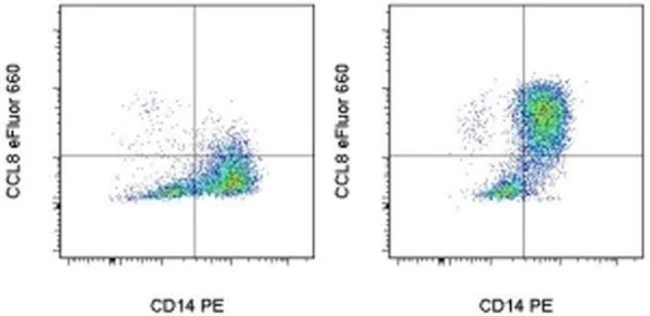
Applications Tested: This DWZEE antibody has been pre-titrated and tested by intracellular staining followed by flow cytometric analysis of normal human peripheral blood monocytes. This can be used at 5 µL (0.125 µg) per test. A test is defined as the amount (µg) of antibody that will stain a cell sample in a final volume of 100 µL. Cell number should be determined empirically but can range from 10^5 to 10^8 cells/test.
eFluor® 660 is a replacement for Alexa Fluor® 647. eFluor® 660 emits at 659 nm and is excited with the red laser (633 nm). Please make sure that your instrument is capable of detecting this fluorochome.
Excitation: 633-647 nm; Emission: 668 nm; Laser: Red Laser.
Filtration: 0.2 µm post-manufacturing filtered.
For Research Use Only. Not for use in diagnostic procedures. Not for resale without express authorization.
CCL8 (MCP-2) Monoclonal Antibody (DWZEE), eFluor 660, eBioscience
PRODUCT DETAILS
Host: Mouse
Isotype: IgG1, kappa
Clonality: Monoclonal
Clone: DWZEE
Format: eFluor 660
Reactivity: Hu
Application: Flow Cytometry
Tested Dilution: 5 µL (0.125 µg)/test
Concentration: 5 μL/Test
Storage: 4°C, store in dark, DO NOT FREEZE!
Formulation: PBS with BSA and 0.09% sodium azide; pH 7.2
Purification: Affinity chromatography
Data Sheet: TDS
Specific Information
Description: This DWZEE monoclonal antibody reacts with human CCL8. CCL8, also known as MCP-2 (Monocyte Chemotactic Protein 2), is a member of the CC- subfamily of chemokines and is most closely related to CCL2 (MCP-1) and CCL7 (MCP-3). They are secreted by a variety of cell types in response to inflammatory stimuli and play critical roles in the recruitment of leukocytes to areas of inflammation. While all three MCP proteins are potent chemoattractants of monocytes and T cells, CCL7 appears to have the broadest range of activity, as it has also been demonstrated to attract activated NK cells, eosinophils, basophils, and neutrophils. CCL8 has also been demonstrated to attract NK cells, eosinophils, and basophils, but requires higher concentrations to do so. CCL8 signals via the g protein-coupled receptor CCR5, which is shared with other CC-chemokines. CCR5 is the primary co-receptor for HIV entry, which the virus binds through the gp120 envelope protein. All CCR5 ligands demonstrate potent inhibition of virus entry into the cell, both through steric hindrance of gp120-CCR5 interaction, and ligand-mediated receptor internalization.
Applications Reported: This DWZEE antibody has been reported for use in intracellular staining followed by flow cytometric analysis.
Applications Tested: This DWZEE antibody has been pre-titrated and tested by intracellular staining followed by flow cytometric analysis of normal human peripheral blood monocytes. This can be used at 5 µL (0.125 µg) per test. A test is defined as the amount (µg) of antibody that will stain a cell sample in a final volume of 100 µL. Cell number should be determined empirically but can range from 10^5 to 10^8 cells/test.
eFluor® 660 is a replacement for Alexa Fluor® 647. eFluor® 660 emits at 659 nm and is excited with the red laser (633 nm). Please make sure that your instrument is capable of detecting this fluorochome.
Excitation: 633-647 nm; Emission: 668 nm; Laser: Red Laser.
Filtration: 0.2 µm post-manufacturing filtered.
For Research Use Only. Not for use in diagnostic procedures. Not for resale without express authorization.
Product Information
Product Information
Shipping & Returns
Shipping & Returns
Description
PRODUCT DETAILS
Host: Mouse
Isotype: IgG1, kappa
Clonality: Monoclonal
Clone: DWZEE
Format: eFluor 660
Reactivity: Hu
Application: Flow Cytometry
Tested Dilution: 5 µL (0.125 µg)/test
Concentration: 5 μL/Test
Storage: 4°C, store in dark, DO NOT FREEZE!
Formulation: PBS with BSA and 0.09% sodium azide; pH 7.2
Purification: Affinity chromatography
Data Sheet: TDS
Specific Information
Description: This DWZEE monoclonal antibody reacts with human CCL8. CCL8, also known as MCP-2 (Monocyte Chemotactic Protein 2), is a member of the CC- subfamily of chemokines and is most closely related to CCL2 (MCP-1) and CCL7 (MCP-3). They are secreted by a variety of cell types in response to inflammatory stimuli and play critical roles in the recruitment of leukocytes to areas of inflammation. While all three MCP proteins are potent chemoattractants of monocytes and T cells, CCL7 appears to have the broadest range of activity, as it has also been demonstrated to attract activated NK cells, eosinophils, basophils, and neutrophils. CCL8 has also been demonstrated to attract NK cells, eosinophils, and basophils, but requires higher concentrations to do so. CCL8 signals via the g protein-coupled receptor CCR5, which is shared with other CC-chemokines. CCR5 is the primary co-receptor for HIV entry, which the virus binds through the gp120 envelope protein. All CCR5 ligands demonstrate potent inhibition of virus entry into the cell, both through steric hindrance of gp120-CCR5 interaction, and ligand-mediated receptor internalization.
Applications Reported: This DWZEE antibody has been reported for use in intracellular staining followed by flow cytometric analysis.
Applications Tested: This DWZEE antibody has been pre-titrated and tested by intracellular staining followed by flow cytometric analysis of normal human peripheral blood monocytes. This can be used at 5 µL (0.125 µg) per test. A test is defined as the amount (µg) of antibody that will stain a cell sample in a final volume of 100 µL. Cell number should be determined empirically but can range from 10^5 to 10^8 cells/test.
eFluor® 660 is a replacement for Alexa Fluor® 647. eFluor® 660 emits at 659 nm and is excited with the red laser (633 nm). Please make sure that your instrument is capable of detecting this fluorochome.
Excitation: 633-647 nm; Emission: 668 nm; Laser: Red Laser.
Filtration: 0.2 µm post-manufacturing filtered.
For Research Use Only. Not for use in diagnostic procedures. Not for resale without express authorization.