Alexa Fluor® 647 anti-mouse CXCL9 (MIG)
MIG, also known as mig-1, CXCL9, is a member of the alpha subfamily of inflammatory chemokine. It is inducible in macrophages, hepatocytes, and endothelial cells by IFN-γ, but not by TNF-α or bacterial lipopolysacchrides (LPS). Mig functions as a chemotactic factor for resting memory and activated T cells, both CD4+ and CD8+, and natural killer cells. Furthermore, it was reported that Mig induced both calcium signals and chemotaxis in activated B cells and that B cell activation induced expression of mouse CXCR3. MIG and CXCR3 may be important not only to recruit T cells to peripheral inflammatory sites, but also in some cases to maximize interactions among activated T cells, B cells, and dendritic cells within lymphoid organs to provide optimal humoral responses to pathogens.
PRODUCT DETAILS
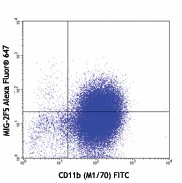
Clone: MIG-2F5.5
Antibody Type: Monoclonal
Reactivity: Mouse
Format: Alexa Fluor 647
Host: Armenian Hamster
Isotype: IgG
Applications: ICFC - Quality tested
Regulatory Status: RUO
Note to Purchaser: This product is manufactured and supplied by BioLegend, Inc. under an agreement between BioLegend, Inc. and Cytek Biosciences, Inc. Information related to this product is provided by BioLegend, Inc.
Original: $449.00
-70%$449.00
$134.70More Images

Alexa Fluor® 647 anti-mouse CXCL9 (MIG)
MIG, also known as mig-1, CXCL9, is a member of the alpha subfamily of inflammatory chemokine. It is inducible in macrophages, hepatocytes, and endothelial cells by IFN-γ, but not by TNF-α or bacterial lipopolysacchrides (LPS). Mig functions as a chemotactic factor for resting memory and activated T cells, both CD4+ and CD8+, and natural killer cells. Furthermore, it was reported that Mig induced both calcium signals and chemotaxis in activated B cells and that B cell activation induced expression of mouse CXCR3. MIG and CXCR3 may be important not only to recruit T cells to peripheral inflammatory sites, but also in some cases to maximize interactions among activated T cells, B cells, and dendritic cells within lymphoid organs to provide optimal humoral responses to pathogens.
PRODUCT DETAILS
Clone: MIG-2F5.5
Antibody Type: Monoclonal
Reactivity: Mouse
Format: Alexa Fluor 647
Host: Armenian Hamster
Isotype: IgG
Applications: ICFC - Quality tested
Regulatory Status: RUO
Note to Purchaser: This product is manufactured and supplied by BioLegend, Inc. under an agreement between BioLegend, Inc. and Cytek Biosciences, Inc. Information related to this product is provided by BioLegend, Inc.
Product Information
Product Information
Shipping & Returns
Shipping & Returns
Description
MIG, also known as mig-1, CXCL9, is a member of the alpha subfamily of inflammatory chemokine. It is inducible in macrophages, hepatocytes, and endothelial cells by IFN-γ, but not by TNF-α or bacterial lipopolysacchrides (LPS). Mig functions as a chemotactic factor for resting memory and activated T cells, both CD4+ and CD8+, and natural killer cells. Furthermore, it was reported that Mig induced both calcium signals and chemotaxis in activated B cells and that B cell activation induced expression of mouse CXCR3. MIG and CXCR3 may be important not only to recruit T cells to peripheral inflammatory sites, but also in some cases to maximize interactions among activated T cells, B cells, and dendritic cells within lymphoid organs to provide optimal humoral responses to pathogens.
PRODUCT DETAILS
Clone: MIG-2F5.5
Antibody Type: Monoclonal
Reactivity: Mouse
Format: Alexa Fluor 647
Host: Armenian Hamster
Isotype: IgG
Applications: ICFC - Quality tested
Regulatory Status: RUO
Note to Purchaser: This product is manufactured and supplied by BioLegend, Inc. under an agreement between BioLegend, Inc. and Cytek Biosciences, Inc. Information related to this product is provided by BioLegend, Inc.